A rescue puppy with limited history needs a room that is deliberately boring, secure, easy to clean, and flexible enough to change as you learn. Start with cautious assumptions: the puppy may chew, eliminate indoors, startle at ordinary sounds, avoid touch, seek hiding space, or dislike confinement—but do not decide that any of these are true until you observe them. Your goal is not to test the puppy. It is to reduce avoidable risk while giving the puppy room to rest, watch, and make small choices.
This guide covers the room itself: location, hazard control, decompression-friendly arrangement, observation, and evidence-based adjustments. It does not provide a full first-day schedule, overnight routine, medical assessment, or general whole-house puppy plan.
Choose a room that is quiet, secure, and still connected
A useful safe room is low traffic without being socially abandoned. A bedroom corner, home office, or calm living-space section may work better than a remote basement or busy laundry area. The puppy should be able to hear and see some normal life without being surrounded by visitors, children, other pets, appliances, or frequent door movement.
Before choosing, stand inside the room and check the routes around it. Ask:
- Does an exterior door open directly into this space?
- Can the puppy reach a window screen, blind cord, radiator, vent, or unstable furniture?
- Will people have to step over the puppy to enter?
- Can a baby gate be mounted securely for this puppy’s current size and likely jumping ability?
- Is there a quiet path for necessary exits without crossing a crowded room?
VCA recommends a decompression space that is not easily accessed by children or other pets and emphasizes properly latching doors and windows, removing reachable chewables, securing cords, and storing trash, cleaning products, and medications out of reach in its puppy-proofing guidance. Vca
Limited history changes the standard: do not assume a barrier is familiar, a crate is comforting, or a room is large enough simply because it looks comfortable to you. Select the simplest space you can secure and supervise.
Build from an empty-room hazard audit
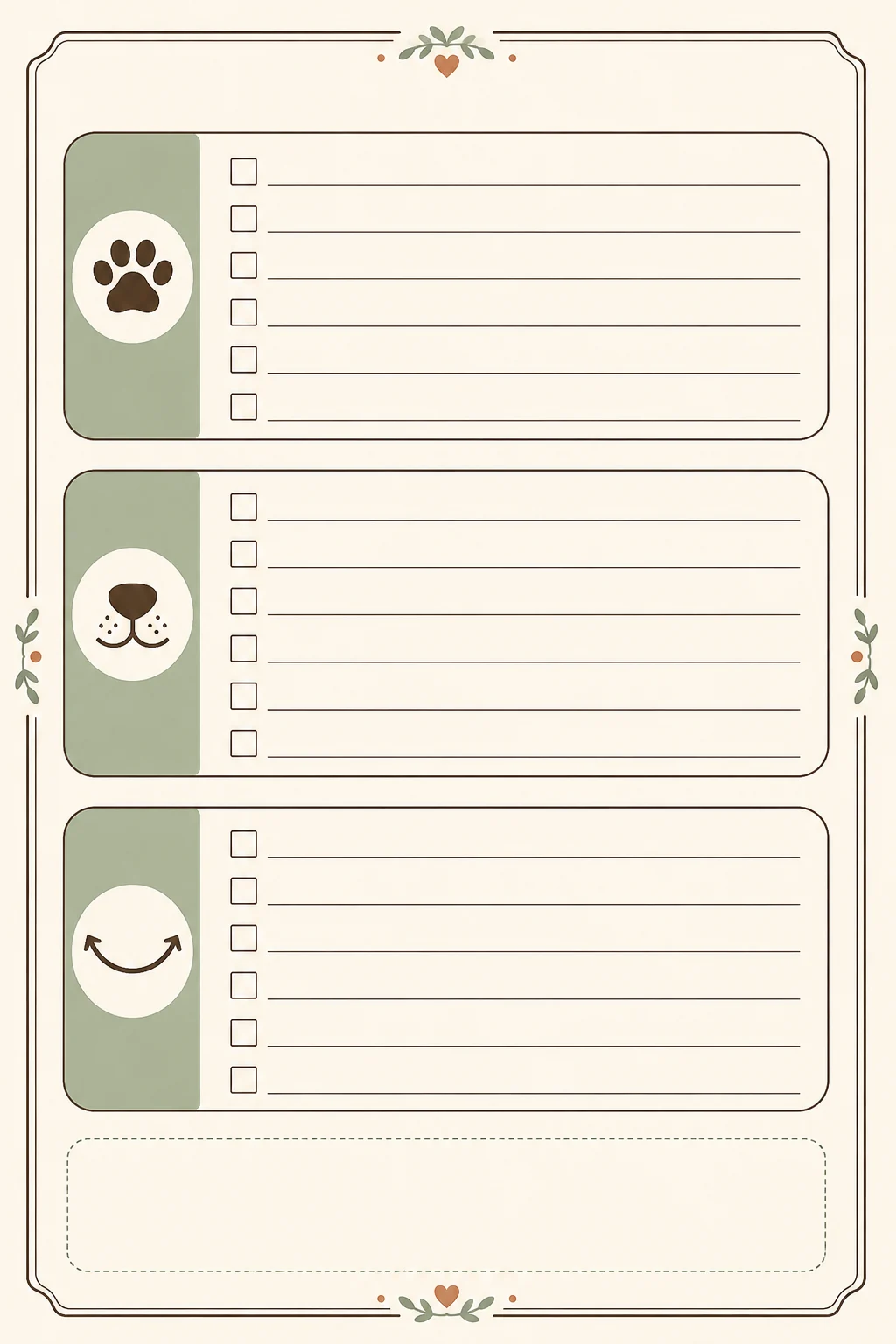
Remove first; furnish second. Get down to puppy height and inspect the room three times: at floor level, at nose height, and at the highest point the puppy might reach by standing or jumping.
Floor level: Pick up cords, rubber bands, hair ties, coins, batteries, children’s pieces, fabric scraps, shoes, bags, cleaning cloths, and anything that can be swallowed or shredded. Check gaps behind furniture and under cabinets. Cover or block access to floor vents if the puppy could catch a paw or remove the cover.
Nose height: Move medications, cosmetics, food, trash, remotes, candles, diffusers, houseplants, and cleaning supplies into closed storage. Do not rely on a child-resistant cap to resist chewing. The ASPCA notes that household products can present exposure risks and advises contacting a veterinarian or poison control immediately after a suspected toxic exposure; its household products guide is general information, not a substitute for case-specific help. aspca.org
Jumping height: Stabilize shelves and lamps, remove tablecloths that can be pulled, secure blind cords, and check whether the puppy could launch from a bed or chair toward a window, gate, or shelf.
Then test the room as though you were the puppy. Tug the gate. Push the window. Nudge the water bowl. Pull gently on every visible cable cover. Look for sharp edges, peeling paint, exposed staples, loose flooring, and narrow gaps. A room is not puppy-safe because hazards are unlikely; it is safer because reachable hazards have been removed or physically secured.
Follow the SAFE Room Action Map
Use this five-step map to prepare the room and decide what to change. Complete the steps in order; later steps depend on what you observe in earlier ones.
| Step | Action | What to set up | Completion check |
|---|---|---|---|
| S — Secure the shell | Control exits and access before adding supplies. | Latched windows, protected cords, stable gate, closed storage, uncluttered path. | You can account for every exit, gap, chewable object, and reachable container. |
| A — Add only essentials | Keep the first version visually simple. | Fresh water, washable non-slip resting surface, one or two simple puppy-appropriate items, cleanup supplies stored outside reach. | Nothing requires you to know the puppy’s exact play style, food preference, or chewing intensity. |
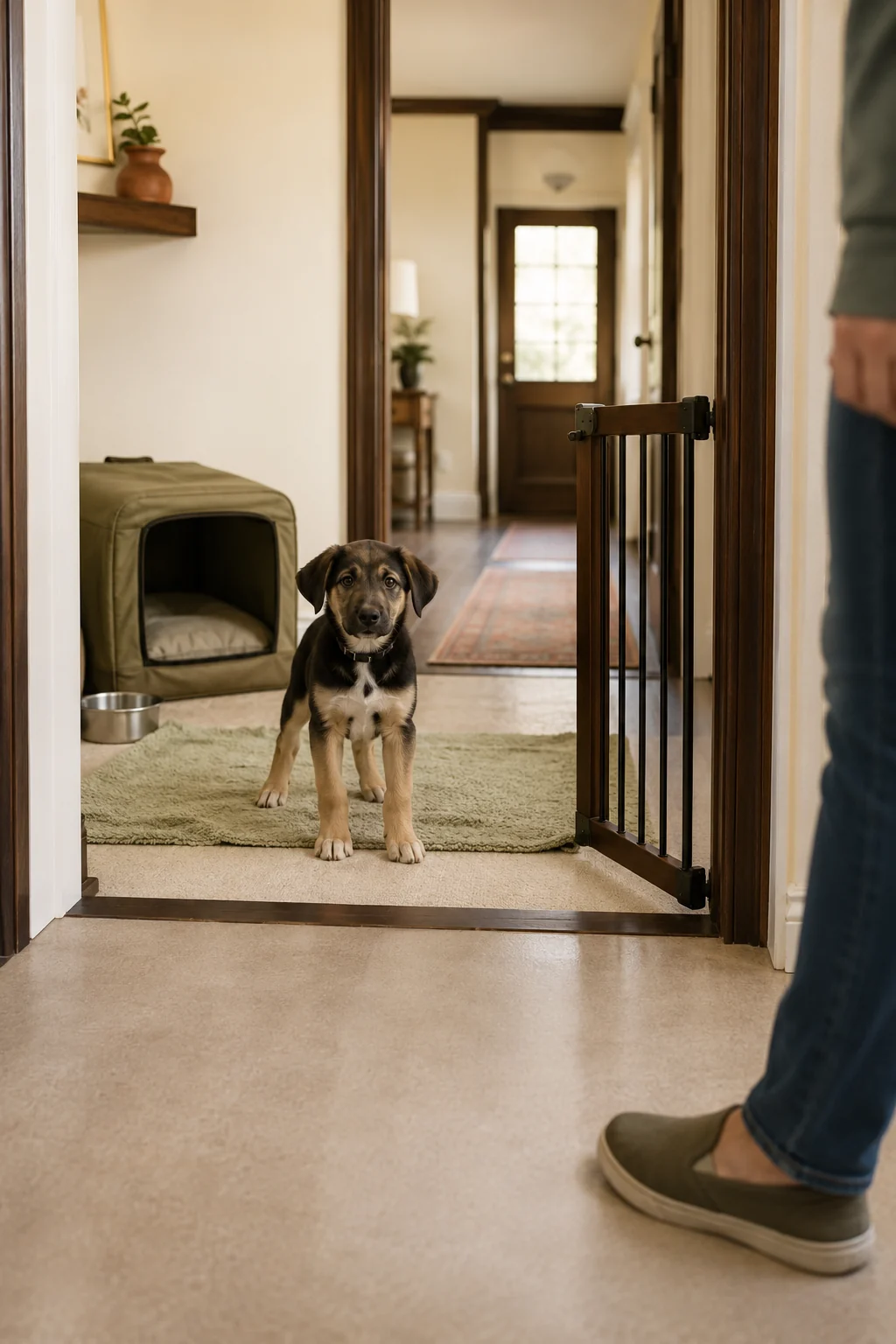
| F — Form low-pressure choices | Give options without creating a maze. | Open covered retreat or open-door crate, exposed mat, distance from the doorway, and a place where the puppy can observe. | The puppy can approach or leave each resting option without being pulled, cornered, or lifted. |
| E — Examine behavior quietly | Observe rather than provoke a response. | Short notes on triggers, movement, recovery, resting places, drinking, chewing, and barrier interest. | You can describe what happened without labels such as “stubborn,” “dominant,” or “bad.” |
| + — Expand one variable | Change only one feature after repeated observations. | One new object, a slightly different placement, a little more supervised space, or reduced stimulation. | You know what changed and can reverse it if the puppy becomes less settled or less safe. |
The plus sign matters: room setup is not finished at arrival. It should become more personalized as evidence replaces assumptions.
Arrange decompression-friendly choices
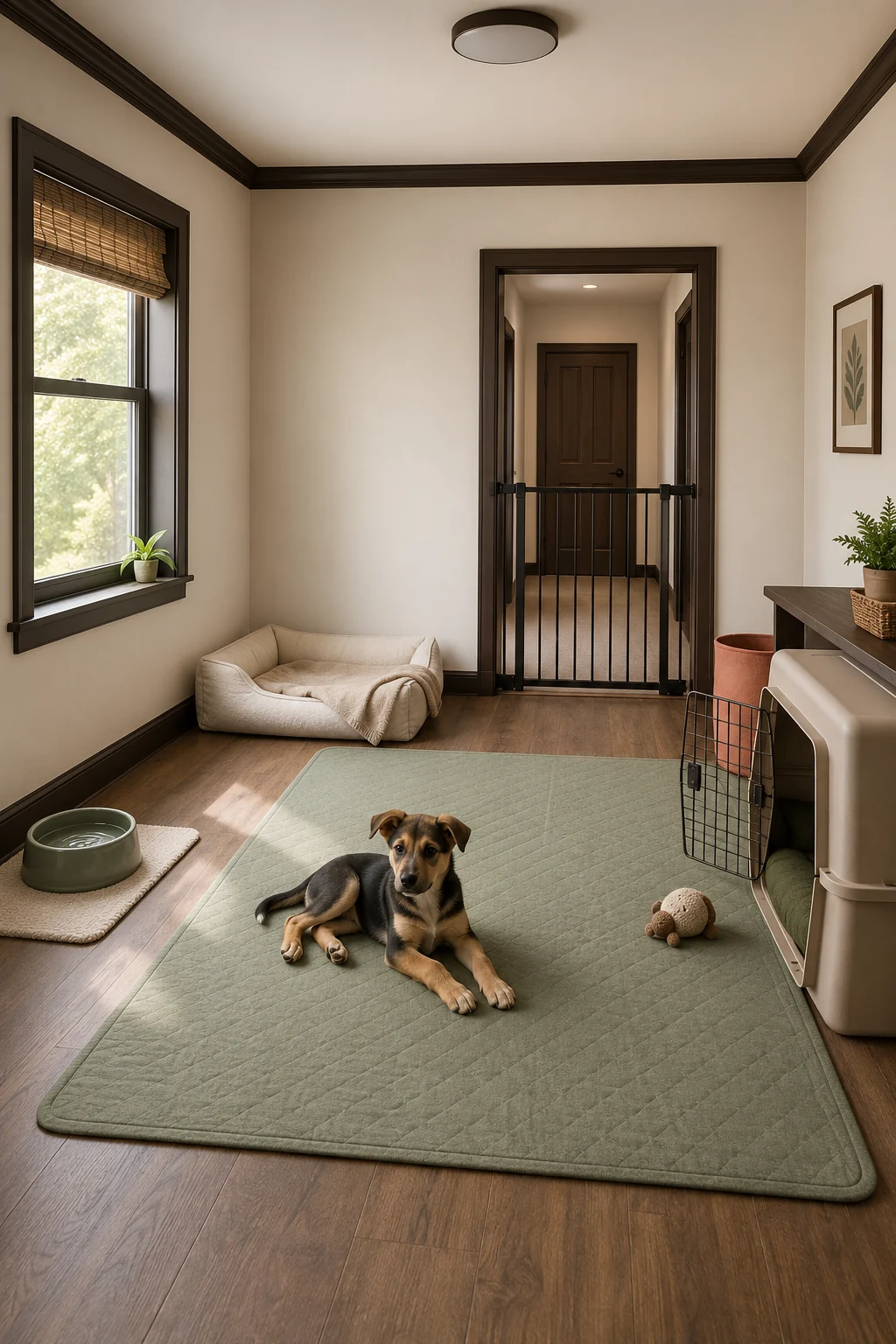
Start with two resting options when space allows: an exposed washable mat and a more sheltered retreat. The retreat might be an open-door crate with a cover over part of it, a sturdy covered bed, or a protected corner. Keep the exit unobstructed. A puppy who enters should not be reached for, dragged out, or surrounded.
Fear Free guidance for newly adopted or fearful dogs emphasizes environmental management, including gates, pens, or crates when supervision is limited, while also advising against forced petting and crowding. It notes that some dogs feel safer in a small space and may need time to watch unfamiliar surroundings from security in What To Do When You Adopt a Fearful Dog. Fear Free Happy Homes
However, “small space” does not mean “shut the puppy in a crate.” With unknown history, offer the retreat first and watch. If the puppy avoids it, do not lure repeatedly, block the exit, or interpret avoidance as disobedience. The location may be too exposed, the floor may slide, the cover may move, or the enclosure may have an unpleasant prior association.
Keep the room predictable. Avoid frequent furniture moves, strong scents, loud media, visitors leaning over the gate, and a pile of exciting toys. Consistency can help a newly adopted dog understand what to expect, and Fear Free’s successful adoption habits recommends structure, soft introductions, choices, and attention to stress-related body language. Fear Free Happy Homes
Use observation instead of personality guesses
“Limited history” is a data problem, not a character description. Record visible behavior and context. Avoid conclusions such as “hates men,” “was abused,” “is crate trained,” or “guards toys” after one event.
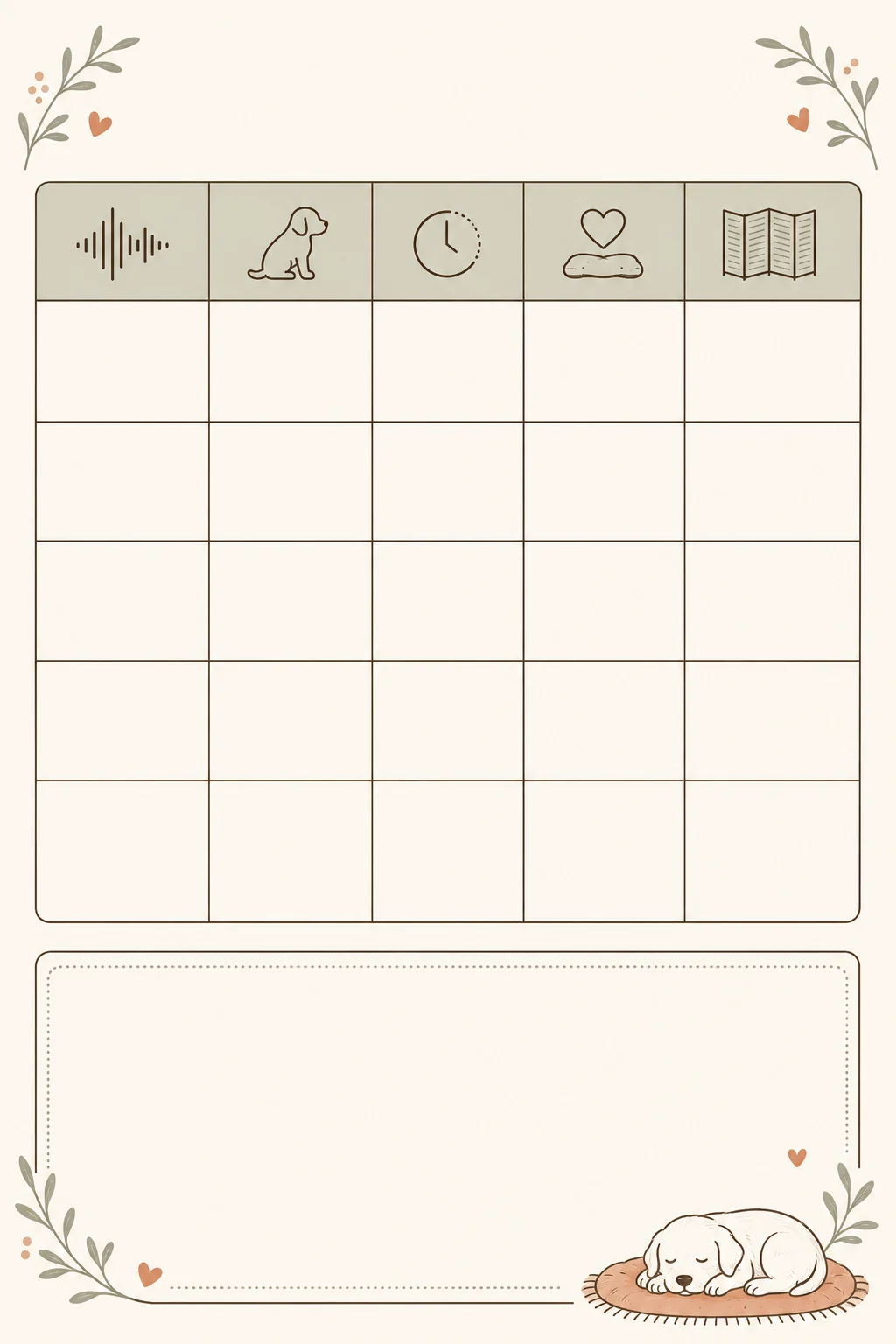
Use this observation table whenever something changes:
| Date and context | Trigger or event | Observable response | Recovery | Preference shown | One room change |
|---|---|---|---|---|---|
| Example: vacuum used in hall | Low mechanical sound outside room | Puppy paused, moved behind mat, watched doorway | Lay down after sound stopped | Chose greater distance from door | Close interior door during vacuuming |
Write what a camera could capture: “paced for two minutes,” “did not take the chew,” “settled behind chair,” or “scratched at gate after footsteps.” Recovery matters as much as the initial reaction. A brief startle followed by settling is different from escalating pacing, escape attempts, or inability to rest.
Useful questions include:
- Which resting surface does the puppy choose when no one is nearby?
- Does the puppy move toward or away from voices, footsteps, and household sounds?
- Can the puppy leave the retreat freely?
- Does the puppy investigate objects gently, chew intensely, shred fabric, or ignore them?
- Does the puppy watch the doorway, push the gate, climb, freeze, vocalize, or settle?
- After a change, does recovery become faster, slower, or unchanged?
Do not manufacture “tests” by dropping objects, cornering the puppy, taking items away, touching paws, or closing a crate to see what happens. The room should reveal behavior during ordinary, low-pressure life.
Adjust one variable at a time
When the puppy appears unsettled, make the smallest reversible change.
If the puppy watches the doorway constantly: Reduce foot traffic, add a partial visual screen that does not block airflow, or move the mat farther from the threshold.
If the puppy avoids the covered retreat: Remove the cover, stabilize it, widen the opening, or offer a different resting surface nearby. Do not place the puppy inside.
If the puppy chews bedding or pulls at barriers: Remove loose fabric, simplify the room, and increase direct supervision. Recheck fasteners, gate spacing, and all edges at mouth height.
If the puppy startles at ordinary sounds: Increase distance from the sound source, close an interior door, or use steady low-level household sound only if the puppy appears more settled with it. Do not flood the puppy with repeated exposure.
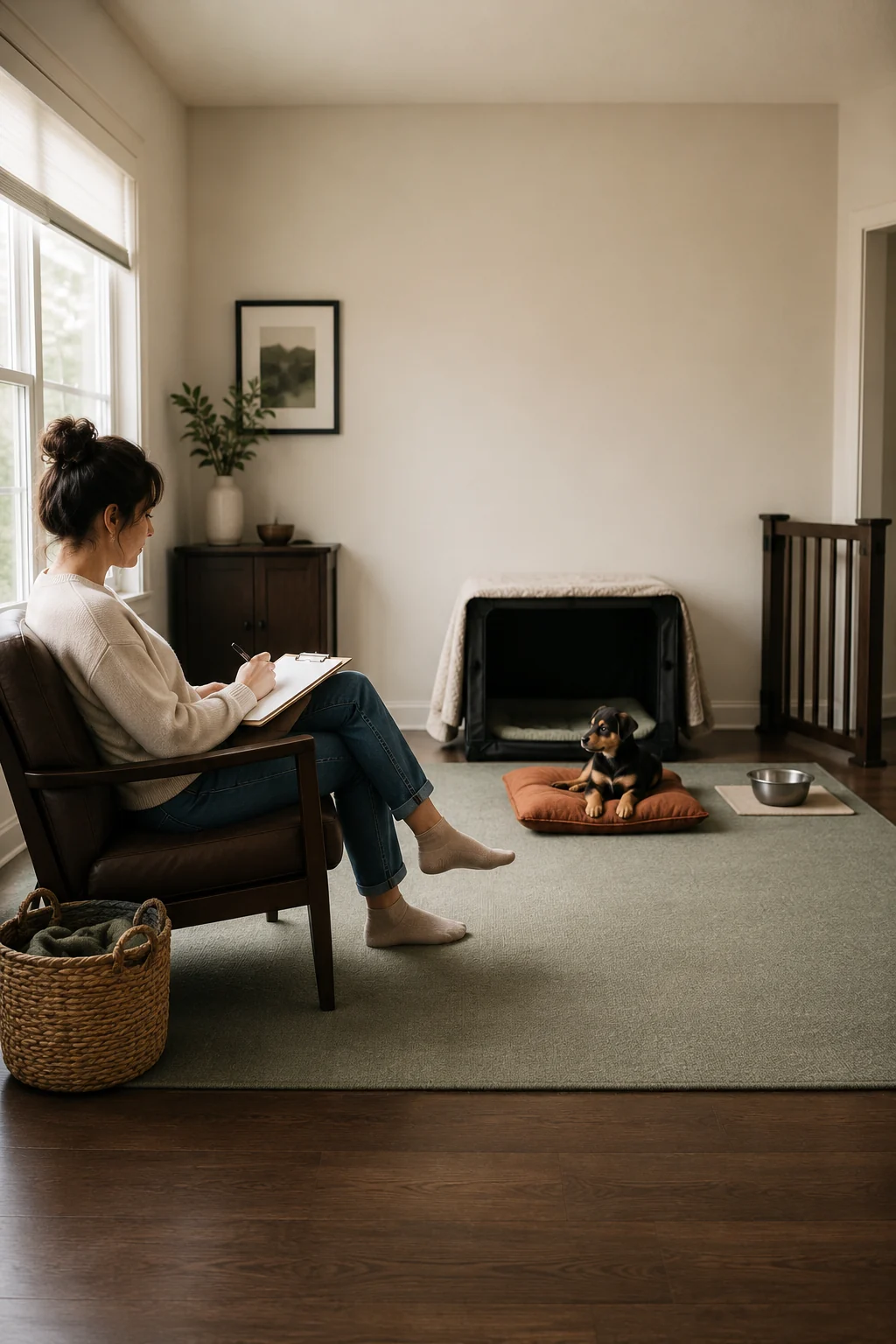
If the puppy cannot settle when people are close: Sit farther away, turn sideways, reduce eye contact, and allow the puppy to initiate approach. A safe retreat is meant to provide security and voluntary rest; Fear Free’s safe-fortress guidance describes quiet locations, hiding options, and resources such as water and bedding. Fear Free Happy Homes
A single observation is a clue, not a rule. Look for repeated patterns across similar contexts before deciding the room needs a permanent change.
Avoid common limited-history setup mistakes
Making the room too full. Extra beds, blankets, toys, bowls, decor, and storage create more variables and more items to chew, guard, soil, or avoid.
Assuming a crate is automatically calming. It may be familiar, unfamiliar, or frightening. Offer it as an open option unless reliable history and appropriate training support another plan.
Using isolation as decompression. Quiet is helpful; social deprivation is not the goal. Choose a place where the puppy can rest without being cut off from all safe human presence.
Inviting everyone to “help socialize.” The safe room should not become a greeting station. Limit visitors and protect the retreat from reaching hands, staring, and crowding.
Changing several things after one reaction. If you move the bed, add music, cover the gate, and remove the toy together, you will not know which change helped.
Expanding space because a set number of days passed. Readiness is individual. Add access based on repeated safe movement and manageable supervision, while preserving the original room as a return option.
Treating behavior notes as diagnosis. Observation helps you manage the environment. It does not establish a medical or behavioral diagnosis. Seek qualified help if fear, aggression, escape behavior, inability to rest, or other concerning signs are intense, persistent, or worsening.
A concise completion check
Your first version is ready when the room has secure exits, no reachable hazards, a washable resting surface, fresh water, a voluntary retreat, a stable barrier, and a clear observation point. You should also have a plan to record what the puppy actually does and to alter only one variable at a time.
The safest assumption is not that the puppy has a difficult past. It is that you do not yet know. A simple room, protected choices, and careful notes let the puppy supply the missing information without being pressured to prove anything.
Helpful visuals from this guide
Use these five visuals as quick reminders, then return to the full guide for context, limitations, and source details.
Pinterest does not let websites prefill its Title field. Each button below copies the correct title and opens that Pin. Click the Title field in Pinterest, press Ctrl + V, then save it to the board above.
Start with Pin 1 and repeat through Pin 5.
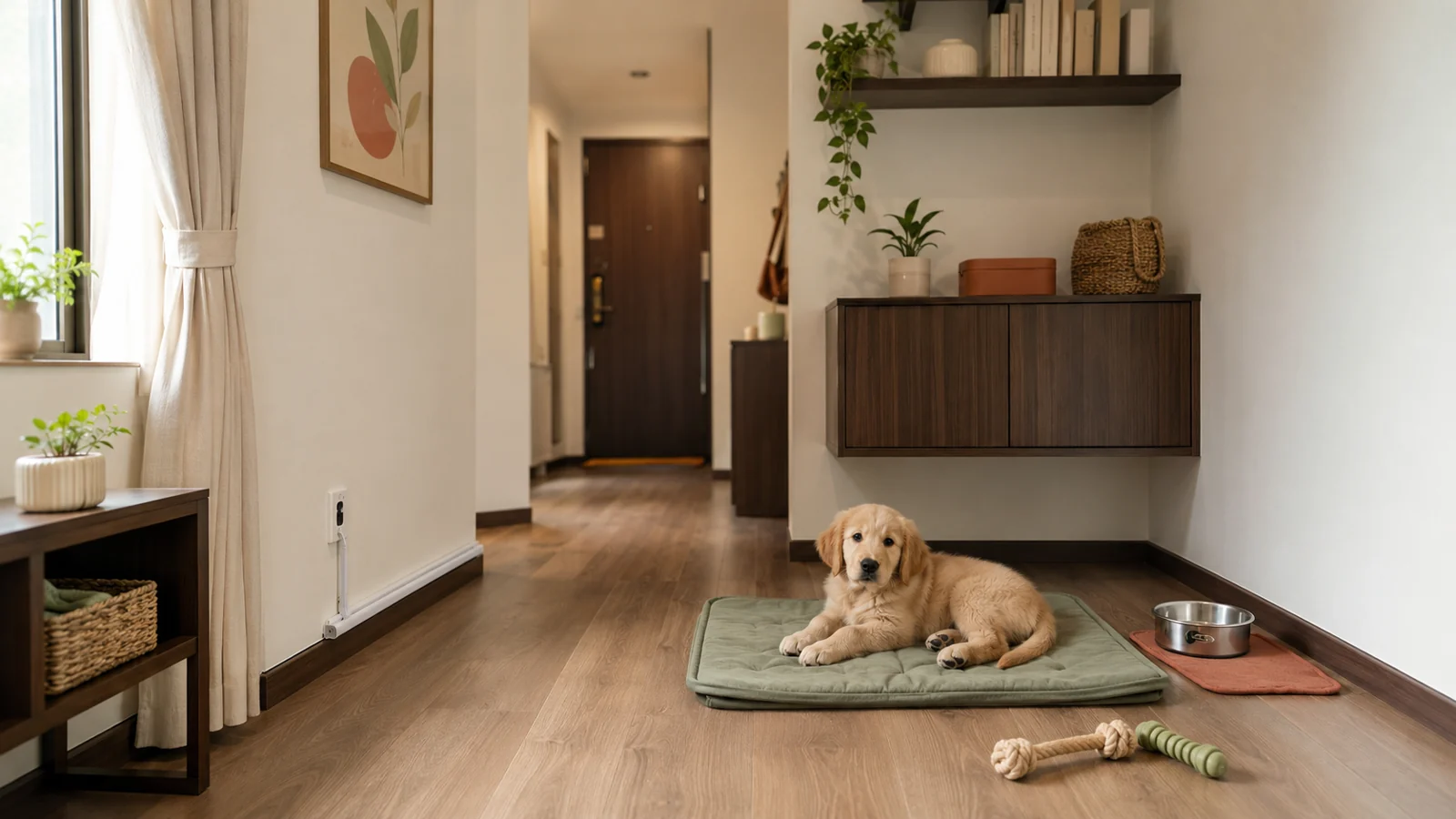
- Rescue Puppy Safe Room Layout
See a calm, low-clutter room layout designed for a rescue puppy whose previous routines and preferences are still unknown.
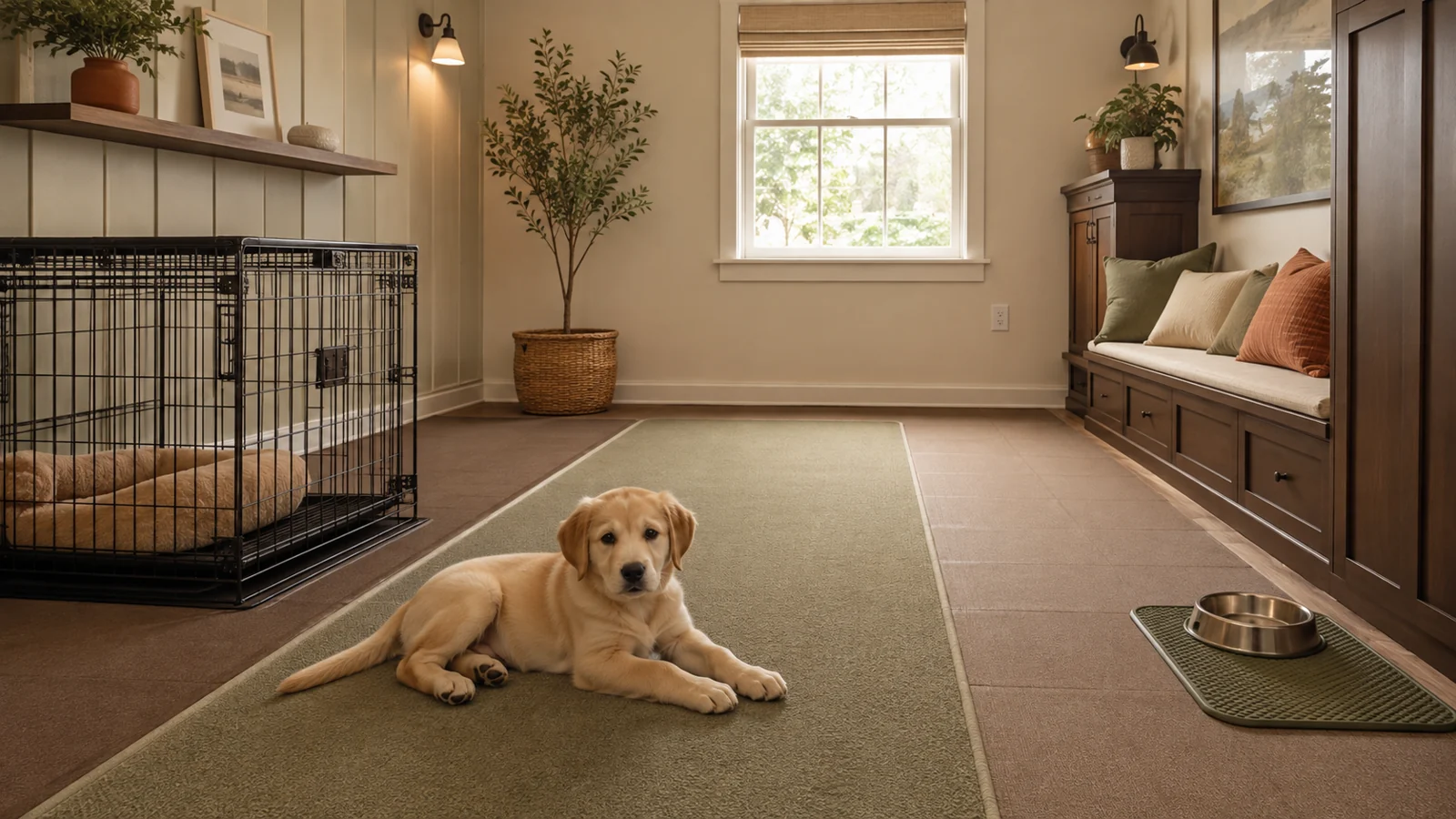
- Three-Height Puppy Room Safety Scan
Use this visual concept to check hazards at floor level, nose height, and possible jumping height before a rescue puppy enters the room.
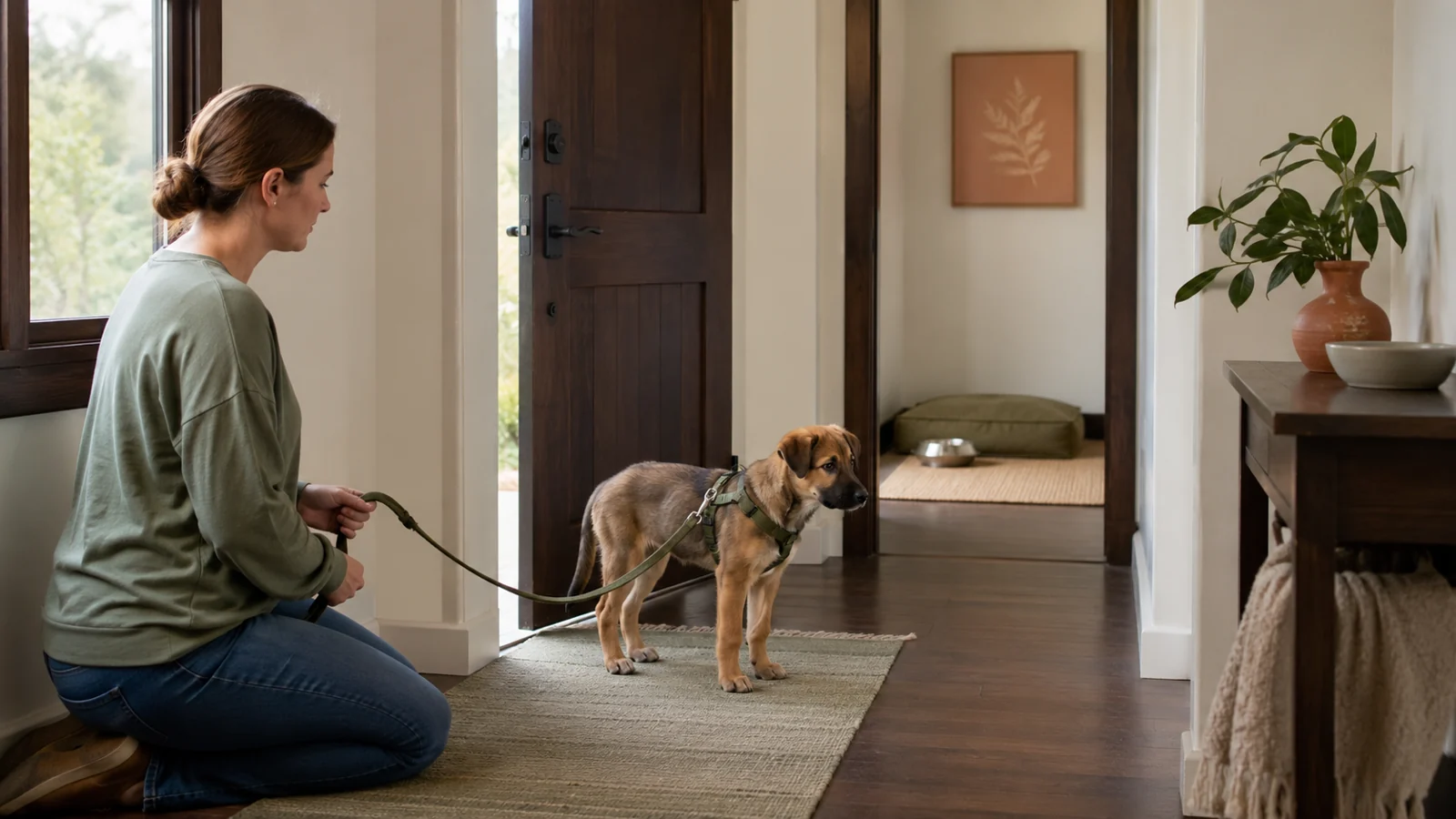
- Observe a Rescue Puppy Without Pressure
A calm example of giving a rescue puppy distance and choice while noting what helps the puppy settle in a new safe room.
- Rescue Puppy Room Observation Log
Turn vague impressions into useful notes by tracking triggers, responses, recovery, preferences, and one room adjustment at a time.
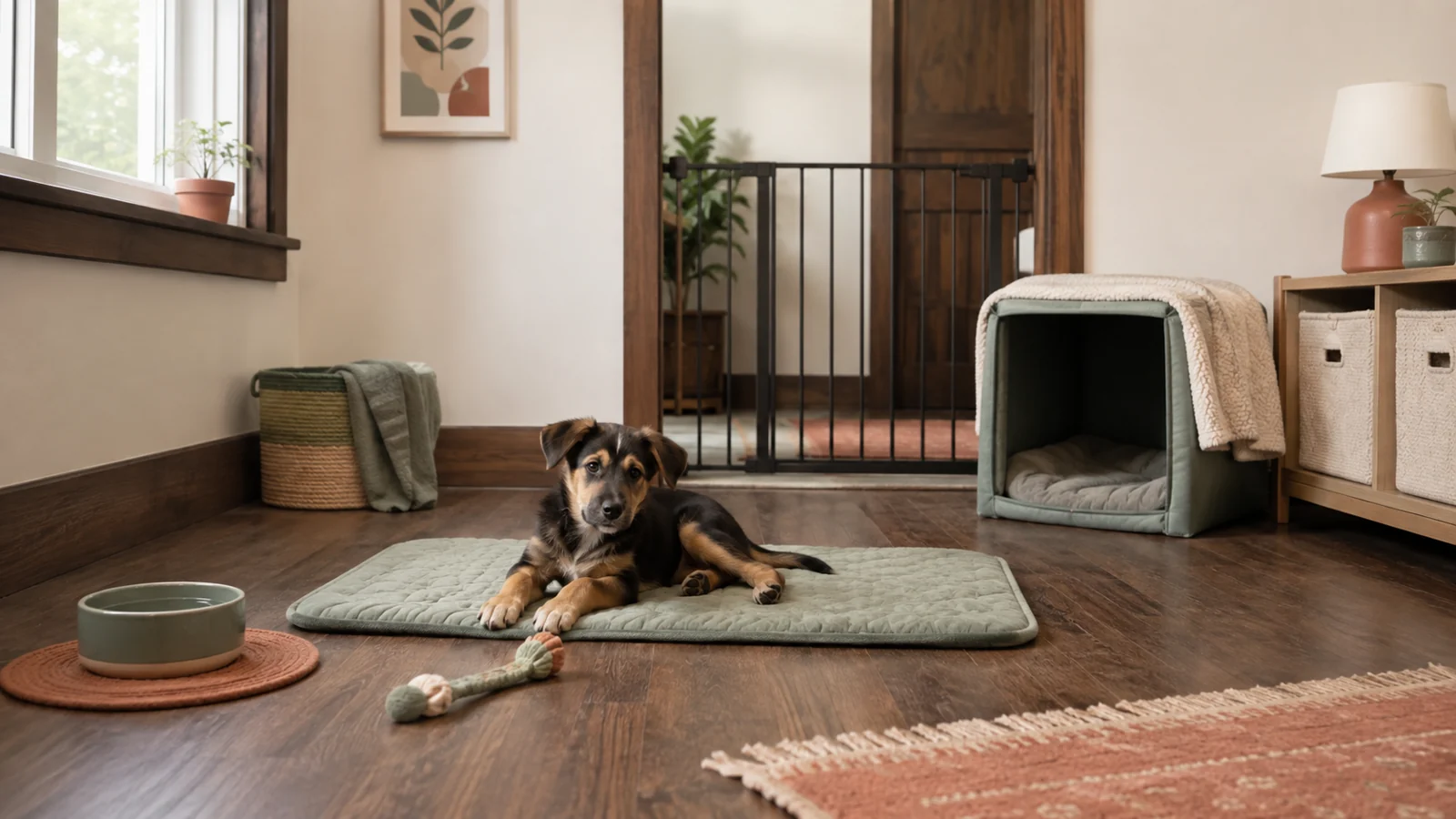
- Expand a Rescue Puppy’s Space Gradually
See how a secure gate and an available retreat can support gradual, observation-led access beyond the puppy-safe room.
Optional: choose all 5 images at once
Frequently asked questions
Should the rescue puppy’s room be completely silent?
Not necessarily. Aim for a low-traffic room where ordinary household sounds are softened, then observe which sounds the puppy notices and how quickly the puppy recovers.
Do I need to close the puppy inside a crate?
No. With limited history, an open-door crate or covered retreat can be offered as a choice unless you already know the puppy is comfortable with confinement and the setup is appropriate.
What if the puppy will not use the bed or retreat?
Do not force the issue. Check whether the location, surface, temperature, movement nearby, or shape of the retreat may be uncomfortable, and change only one factor before observing again.
How do I know when to add more toys?
Start with very few simple, puppy-appropriate items. Add one item only after you have observed how the puppy mouths, shreds, guards, ignores, or settles with the current options.
When can the puppy have access to more of the home?
Use repeated evidence rather than a fixed deadline. Expand one controlled area when the puppy is moving safely, barriers remain secure, and current-room behavior is predictable enough to supervise.
What should I do if the puppy appears panicked or unsafe?
Reduce stimulation and avoid forcing contact. Contact a veterinarian or qualified reward-based behavior professional promptly when fear is intense, persistent, escalating, or creates a bite or escape risk.
Sources & further reading
- Puppy-proofing 101VCA Animal Hospitals · Accessed 2026-07-31
- Bringing a New Dog Home: Successful Adoption HabitsFear Free Happy Homes · Accessed 2026-07-31
- What To Do When You Adopt a Fearful DogFear Free Happy Homes · Accessed 2026-07-31
- Poisonous Household ProductsASPCA · Accessed 2026-07-31