A puppy-safe room in a multi-dog home should function as a protected home base, not a shared playroom. Set it up so the puppy can eat, drink, sleep, chew, and decompress without another dog entering, while every resident dog keeps an equally reliable retreat and its own valued resources. Use barriers and short, supervised access periods to build familiarity gradually, then record how each dog behaves before increasing contact.
This guide focuses only on room setup for a household that already has one or more dogs. It does not replace an individualized plan from a veterinarian or qualified behavior professional when a dog has a history of bites, serious fights, or intense resource guarding.
1. Build the room around separation, not forced togetherness
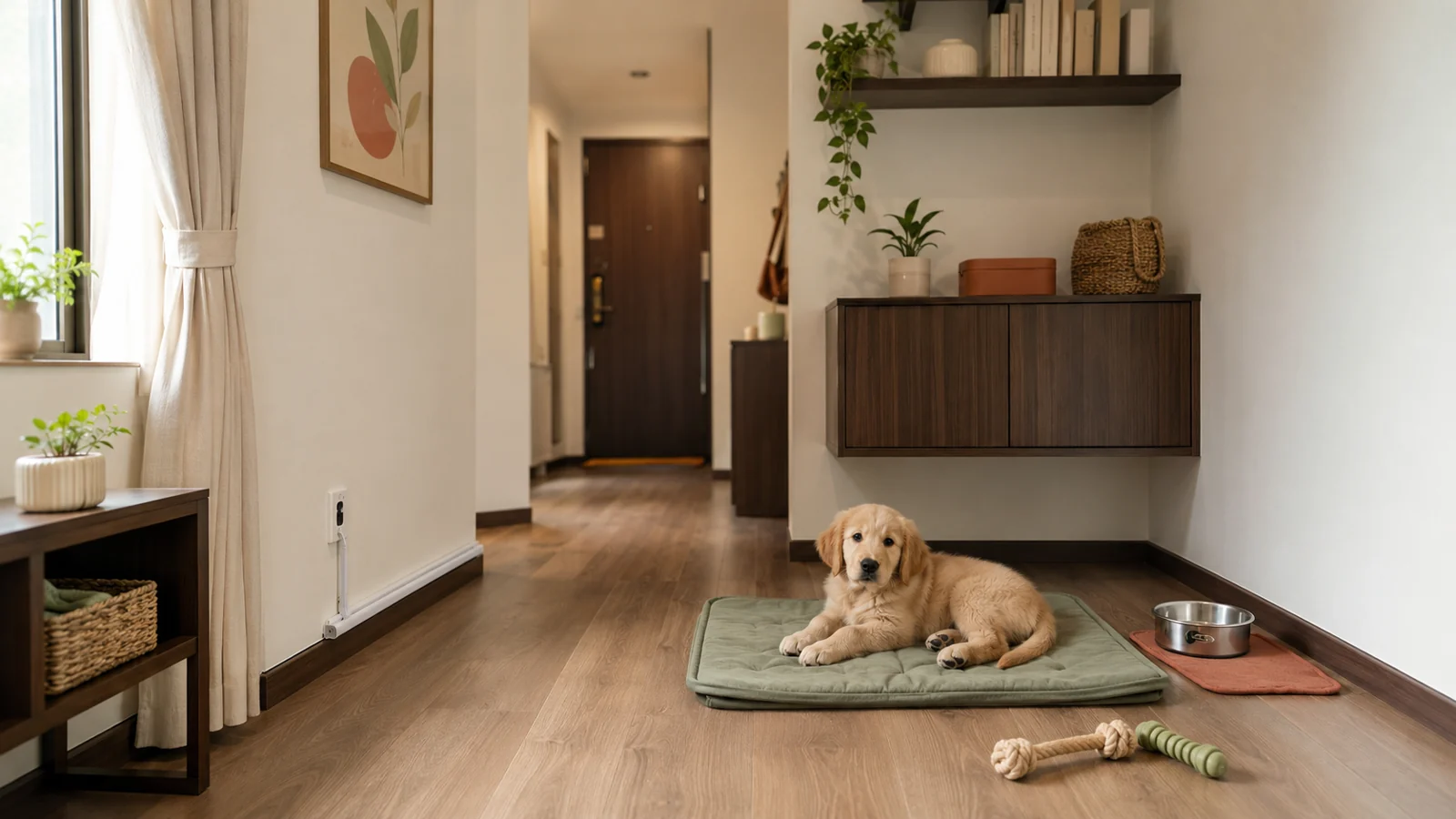
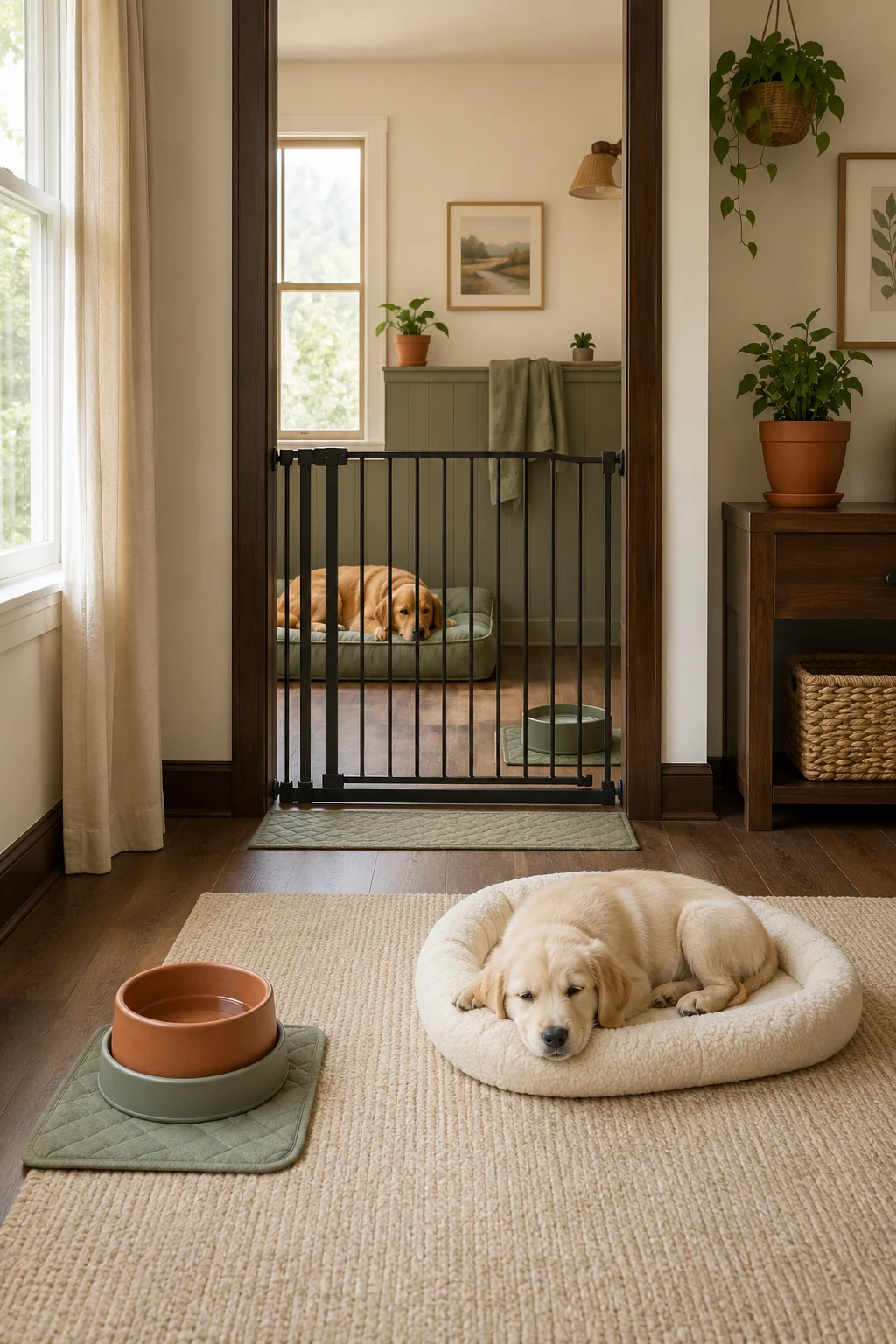
Choose a room or gated area that can be closed securely and reached without making the puppy pass through a crowded dog gathering point. A spare bedroom, laundry room, office corner with a secure exercise pen, or another low-traffic area can work if it is quiet, easy to clean, and free of hazards.
The core layout should include:
- A secure boundary: Use a closed door, pet-safe gate, or pen that resident dogs cannot push over, jump, or squeeze through. Check for gaps that could trap a paw, collar, or head.
- A calm resting zone: Place the puppy’s bed or crate away from the doorway so the puppy is not forced to rest nose-to-nose with a watching resident dog.
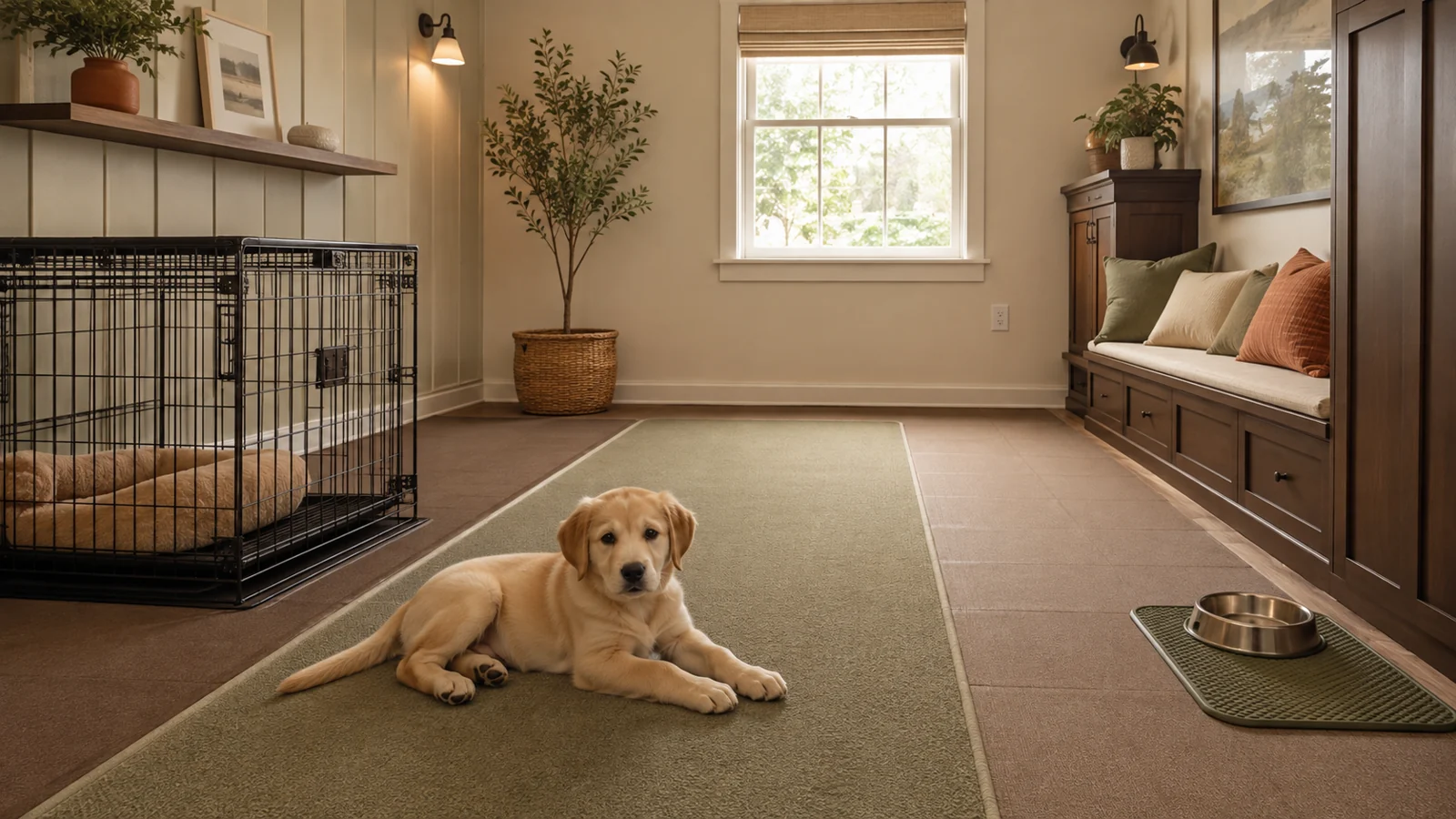
- A separate food and water station: Keep bowls fully inside the puppy zone, not beside the gate where another dog can stare, crowd, or reach through.
- A controlled chew and toy area: Keep puppy toys in the room and remove especially valuable shared items from common areas while relationships are still developing.
- A clear human path: You should be able to enter, refill water, and take the puppy out without opening a wide route for other dogs to rush in.
VCA recommends preparing safe zones for both the new puppy and existing pets, then allowing each animal to settle in its own area after controlled introductions. It also advises separate feeding areas and individual toys when sharing may create competition (How to prepare for a new puppy).
Puppy-proof the room as if the puppy will investigate everything. Put cords, shoes, laundry, waste bins, cleaning products, medications, small objects, and fragile items out of reach. The ASPCA notes that chewing is normal for puppies and recommends removing inappropriate items, providing suitable chew options, and supervising until the dog reliably chooses appropriate objects (Destructive Chewing).
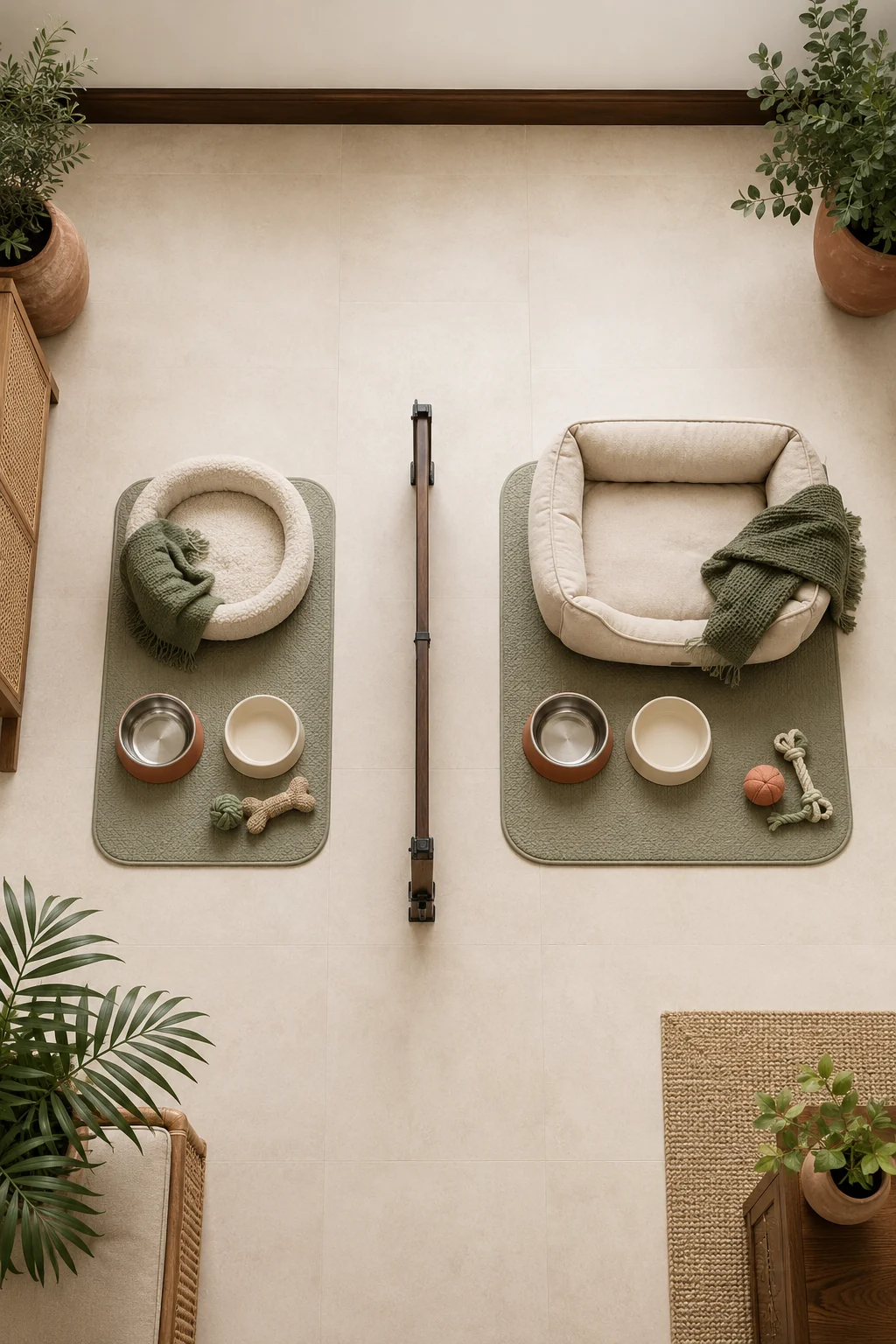
2. Give every dog protected resources
A puppy-safe room works only if it does not make the resident dogs feel that their own beds, bowls, toys, or access to you have suddenly disappeared. Before the puppy uses the room, map the resources for every dog in the household.
Use this simple rule: one dog should not need to pass another dog, crowd a doorway, or defend an item to meet a basic need.
Create separate locations for:
| Resource | Puppy setup | Resident-dog setup | Management rule |
|---|---|---|---|
| Meals | Inside the puppy room with the boundary closed | Separate rooms or well-spaced closed areas | Pick up bowls after meals |
| Water | Stable bowl inside the puppy zone | At least one reliably accessible station outside | Prevent gate-side crowding |
| Rest | Bed or crate away from the doorway | Existing beds and quiet retreats preserved | Do not let the puppy invade resting dogs |
| Chews | Offered only during supervised, separated time | Offered in another closed area | Remove before shared access |
| Toys | A small puppy-only rotation | Familiar toys available separately | Put high-value favorites away during early shared sessions |
| Human attention | Short one-on-one visits in the room | Scheduled one-on-one time elsewhere | Avoid making access to you a competition |
VCA’s guidance for adding another dog recommends extra beds, water bowls, and toys, supervision around resources, and separation when nobody is home (Getting a Second Dog). The ASPCA also describes separate-room or behind-barrier feeding as a reasonable safety precaution for dogs that guard food (Food Guarding).
Do not test whether the dogs “will share.” Good management prevents rehearsal of stealing, hovering, blocking, or guarding. Sharing can be evaluated later, one low-value item at a time, under close supervision.
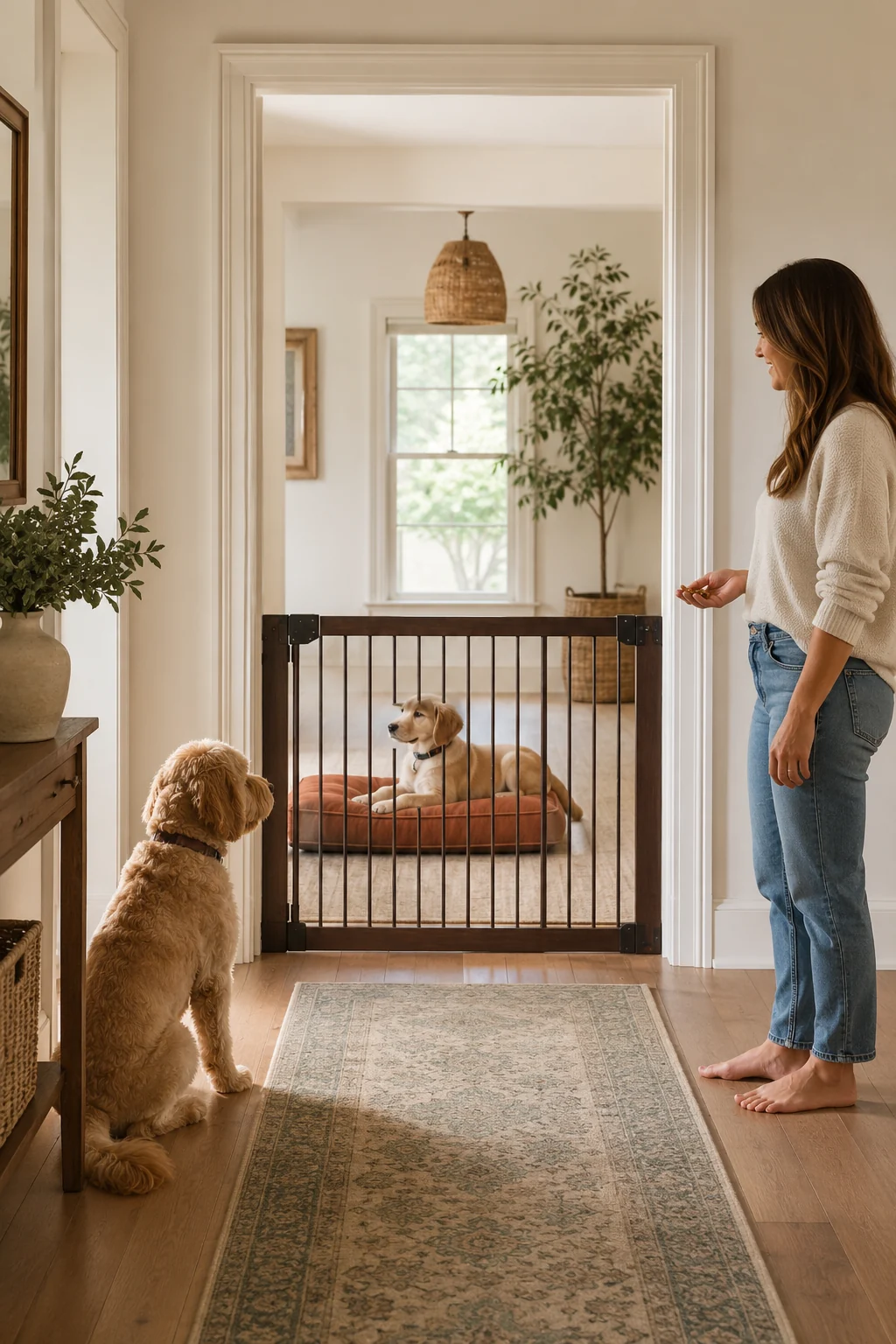
3. Use the doorway as a controlled transition point
The doorway or gate is often the most emotionally charged part of the setup because it controls access. Prevent it from becoming a place where dogs stare, bark, paw, or rush one another.
Use a gradual access sequence:
- Closed-door settling: Let the puppy rest behind a closed door while resident dogs continue normal activities elsewhere. The goal is calm separation, not constant investigation.
- Brief scent and sound exposure: Allow resident dogs to pass the closed door without stopping there. Move them away with calm cues and rewards for disengaging.
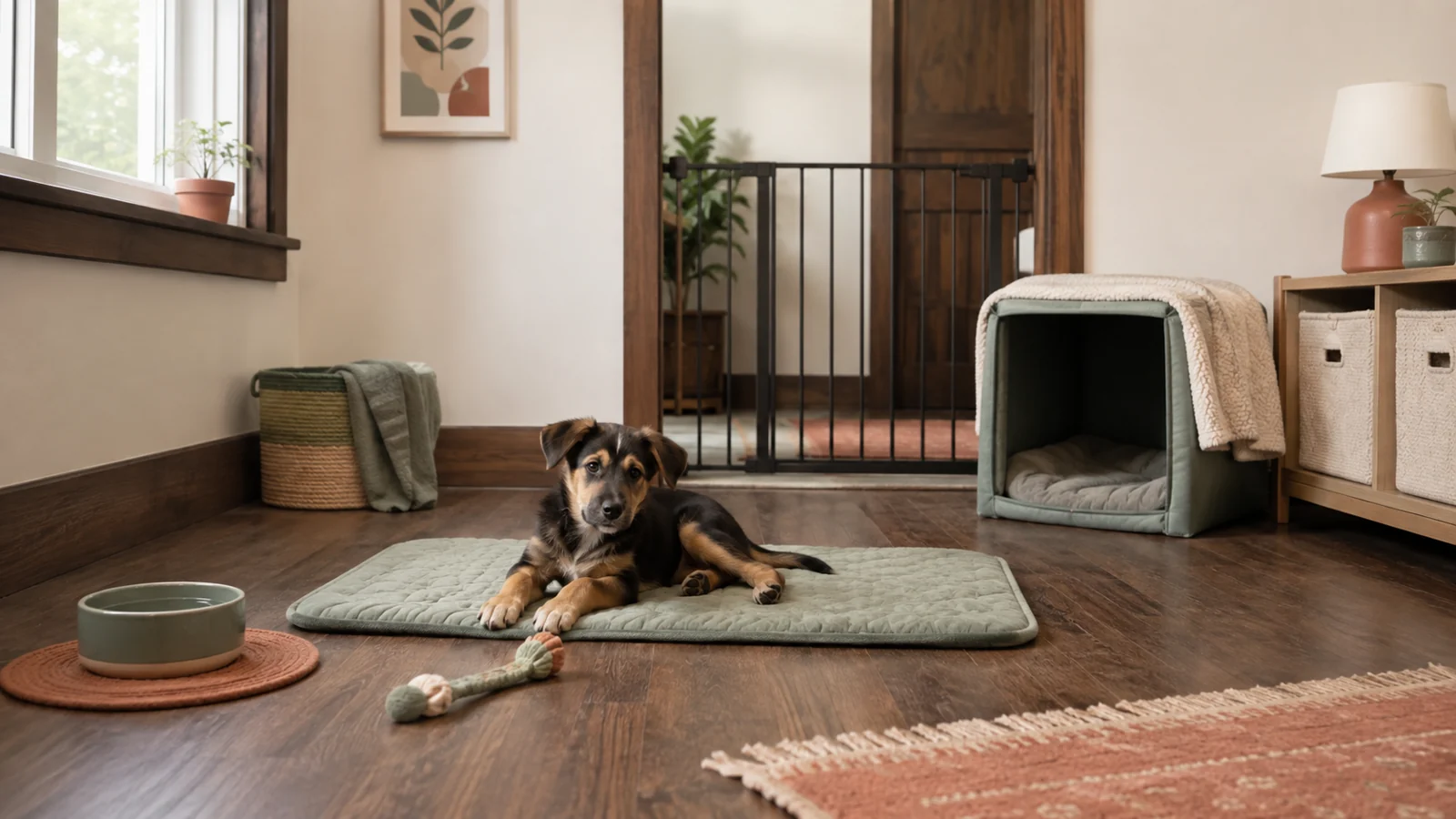
- Visual access at distance: Use a secure gate only when both sides can remain several feet back. Keep sessions short and end before either dog becomes highly excited.
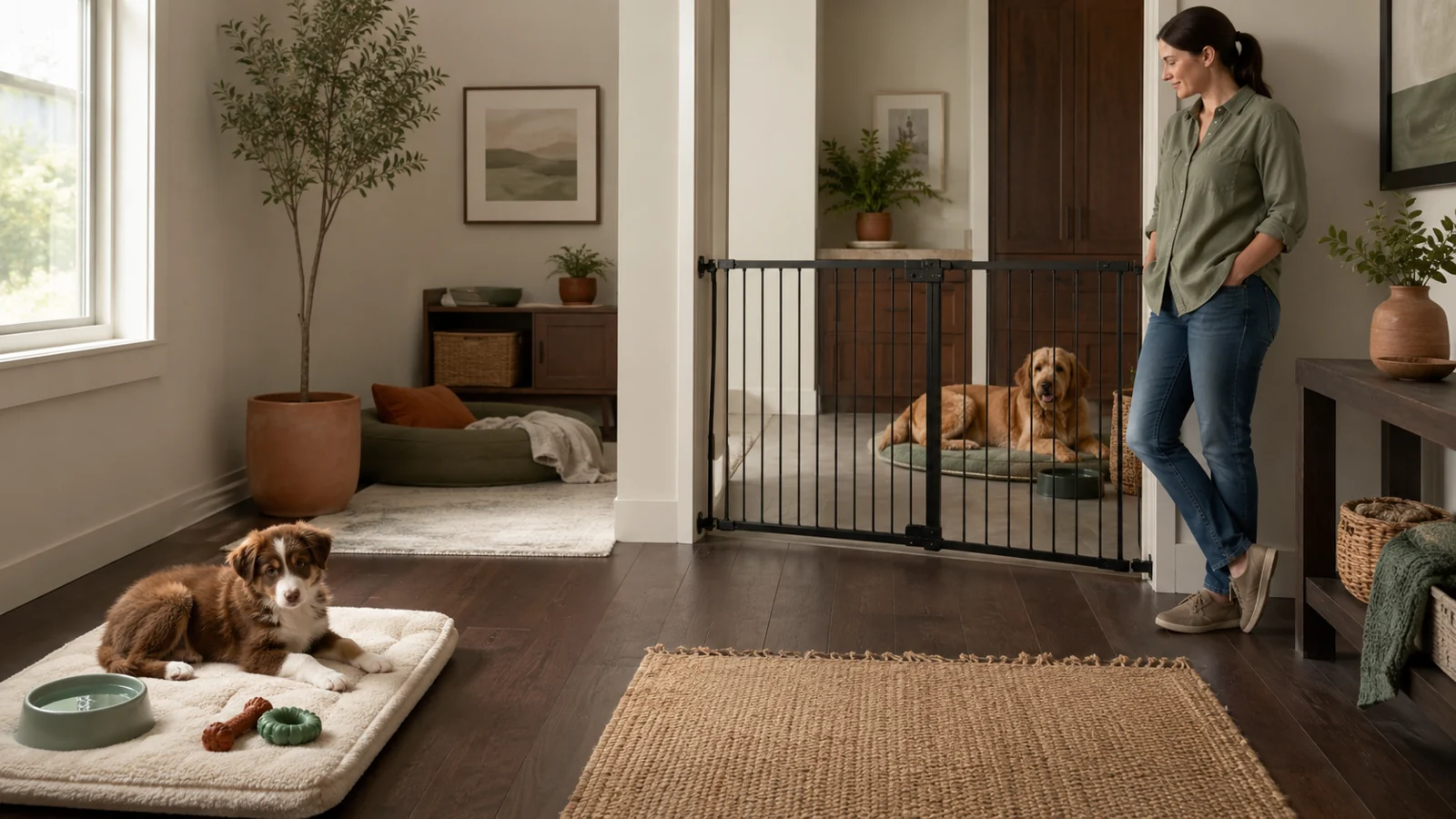
- One resident dog at a time: In a multi-dog household, introduce access separately because each puppy–dog relationship is different. VCA specifically recommends one-at-a-time introductions when several dogs already live in the home.
- Short supervised room entry: Invite one calm resident dog into a cleared room only after both dogs have shown relaxed behavior through earlier stages. Remove food, chews, and favorite toys first.
- Return to separate zones: End while the dogs are still coping well. A successful two-minute session is more useful than a ten-minute session that ends in crowding or conflict.
Do not use the gate as a substitute for supervision. A barrier can prevent direct contact but may also create frustration if dogs spend long periods staring or barking through it. Cover part of the gate or increase distance when either dog cannot disengage.
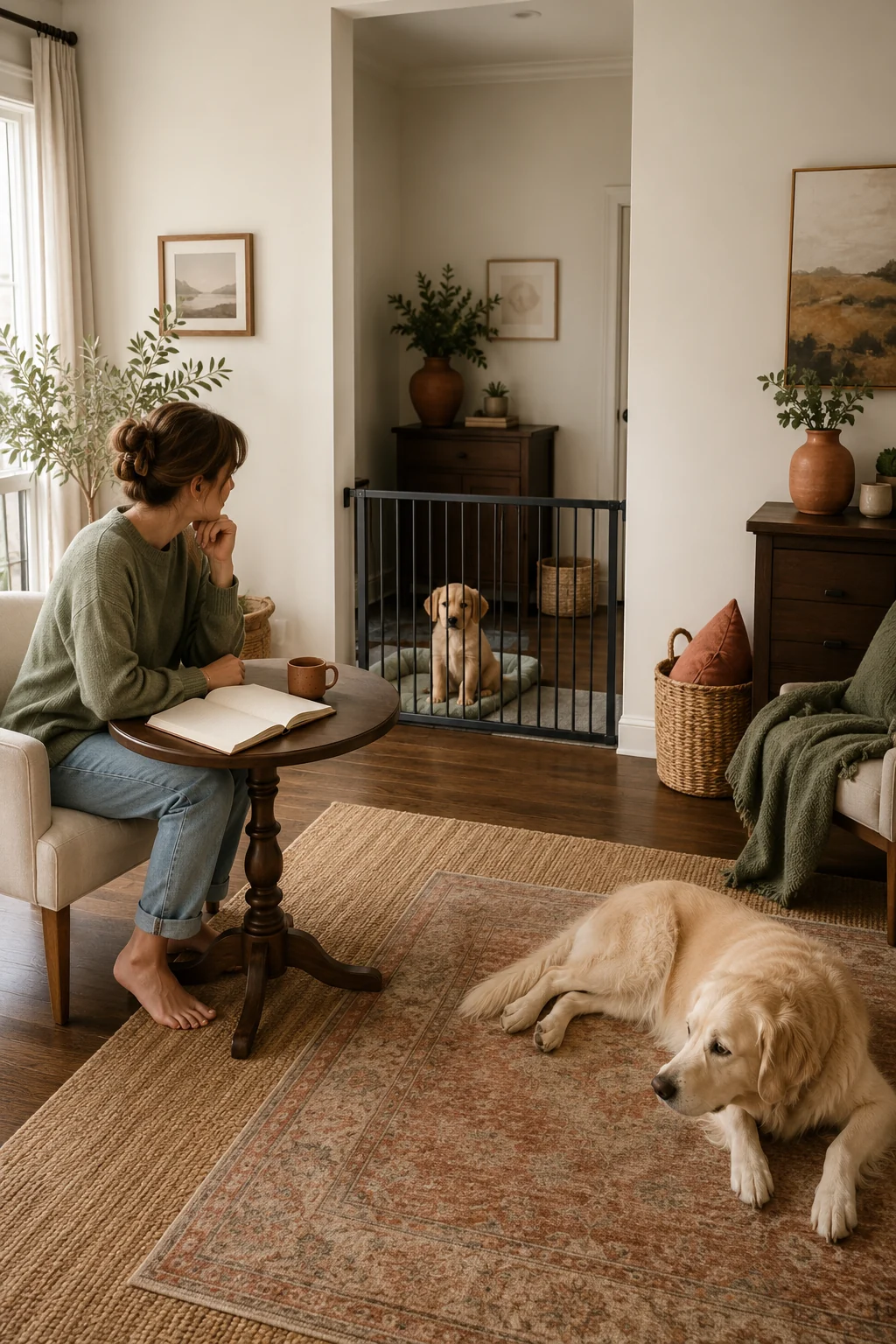
4. Observe each dog as an individual
“Everyone seems fine” is too vague for a multi-dog household. Watch the puppy and each resident dog separately, because one dog may relax while another is becoming tense.
During and after a session, record observable behavior rather than assigning motives. Useful observations include:
- Can the dog look away from the other dog?
- Can the dog take a treat gently and respond to a familiar cue?
- Does the dog choose to approach, stay neutral, or move away?
- Is the body loose, or does it become still and stiff?
- Does either dog block the doorway, water, bed, or human?
- Does the puppy continue resting after a resident dog passes?
- Does arousal settle within a few minutes after separation?
Pause and increase distance if you see repeated freezing, hard staring, persistent gate charging, cornering, resource hovering, frantic escape attempts, or play that repeatedly overwhelms one dog. Growling is information; do not punish it. End the interaction calmly and review what happened immediately before the warning.
The VCA introduction guidance recommends watching body posture and facial expression, allowing dogs to ignore one another, keeping early sessions short, and giving each dog individual attention (Introducing a New Dog to Your Family Dog). If a dog has bitten, attempted to bite, or shows intense guarding, stop informal experiments and seek qualified professional help.
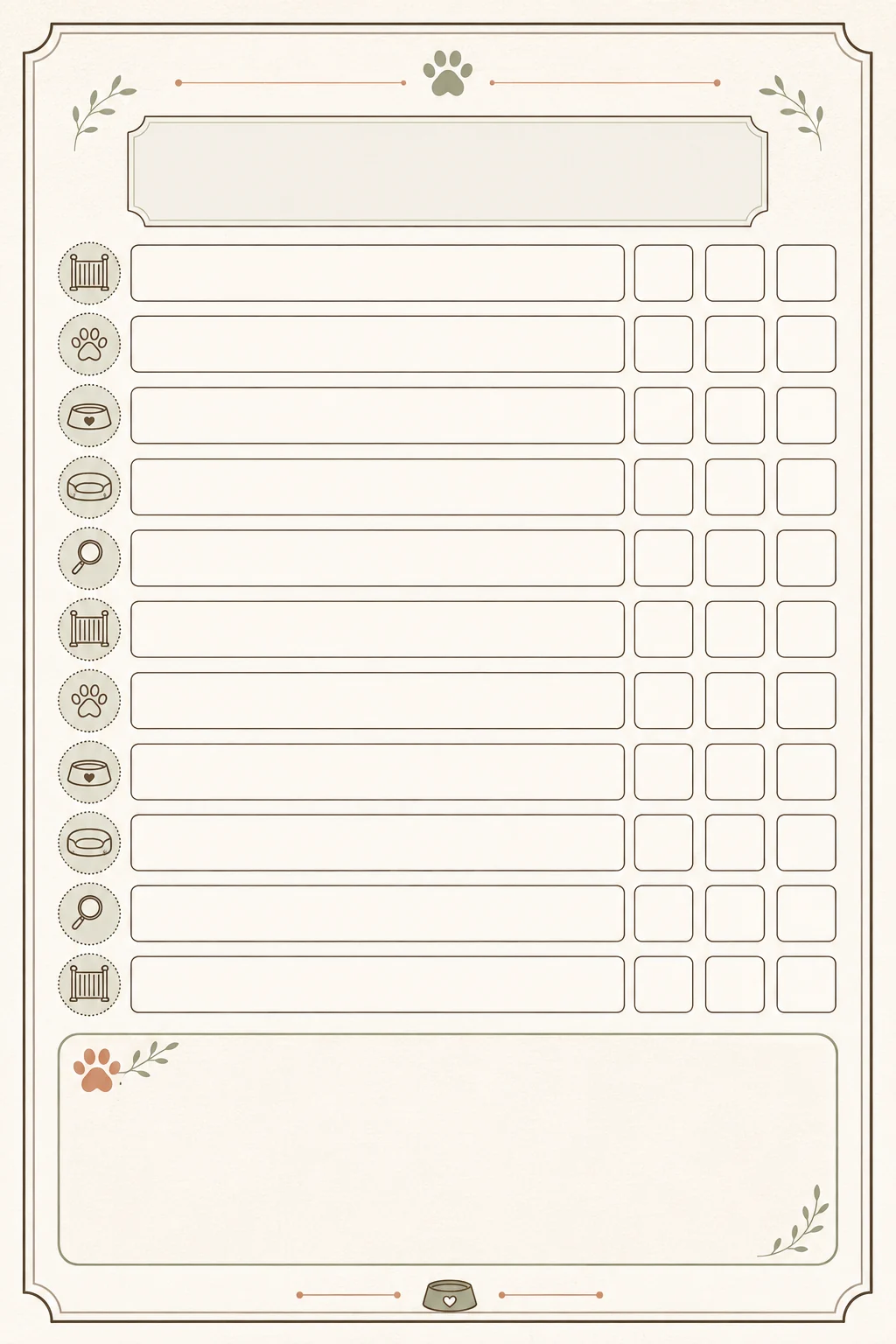
5. Use the puppy-safe room weekly audit scorecard
Complete this audit once a week and after any significant setup change. Score each item 0, 1, or 2:
- 0 = not in place or repeated concern
- 1 = partly reliable or needs adjustment
- 2 = consistently working this week
| Audit item | 0 | 1 | 2 | Weekly notes |
|---|---|---|---|---|
| Boundary stays secure when dogs are nearby | ☐ | ☐ | ☐ | |
| Puppy can rest away from the doorway | ☐ | ☐ | ☐ | |
| Puppy food, water, chews, and toys remain separate | ☐ | ☐ | ☐ | |
| Every resident dog retains a quiet retreat | ☐ | ☐ | ☐ | |
| Dogs do not crowd or camp at the gate | ☐ | ☐ | ☐ | |
| Introductions occur one resident dog at a time | ☐ | ☐ | ☐ | |
| Shared sessions stay short and supervised | ☐ | ☐ | ☐ | |
| Each dog can disengage and move away | ☐ | ☐ | ☐ | |
| No dog blocks beds, bowls, doors, or people | ☐ | ☐ | ☐ | |
| Human one-on-one time is protected for each dog | ☐ | ☐ | ☐ | |
| The room remains free of chewable hazards | ☐ | ☐ | ☐ | |
| Notes identify which dog showed which behavior | ☐ | ☐ | ☐ |
Score interpretation
- 20–24: The setup is functioning reliably. Keep the same structure and change only one variable at a time.
- 14–19: The room is usable, but strengthen the lowest-scoring items before increasing shared access.
- 0–13: Return to more complete separation and correct the environment before attempting longer interactions.
A high score is not permission to leave dogs together unsupervised. It shows that the room plan is working under the conditions you actually observed. Readiness for less management depends on repeated calm behavior, not a deadline.
6. Common setup mistakes and practical fixes
The gate is beside the bowls
Problem: Dogs eat or drink while another dog watches from inches away.
Fix: Move bowls deeper into each dog’s zone and close the visual line during meals.
The puppy room replaces the older dog’s favorite retreat
Problem: The resident dog loses a valued sleeping or quiet area when the puppy arrives.
Fix: Preserve the original retreat or create an equally comfortable alternative before the room changes.
All resident dogs meet the puppy together
Problem: Group excitement makes it difficult to see which relationship is comfortable and which is not.
Fix: Rotate one resident dog at a time and keep separate notes for each pairing.
Toys remain scattered during early access
Problem: A dog suddenly guards, grabs, or hovers over an item.
Fix: Begin with an empty floor. Add low-value items later only when both dogs can disengage easily.
Calm is judged only during contact
Problem: A dog appears quiet during the session but paces, barks, or cannot settle afterward.
Fix: Include post-session recovery in your notes. Shorten the next session if recovery is slow.
The puppy is confined while resident dogs crowd the barrier
Problem: The room is physically separate but not emotionally restful.
Fix: Create a no-camping buffer around the door, redirect resident dogs to mats or other rooms, and use a partial visual cover when needed.
7. Know the limits of a room plan
A well-designed room reduces preventable competition and gives you better information, but it cannot guarantee compatibility. Age, size, play style, previous experiences, pain, fear, and guarding history can all affect how dogs respond.
Contact your veterinarian or a qualified behavior professional before expanding access when there is a bite history, injury, repeated fighting, escalating guarding, or a dog that cannot settle even with distance and barriers. The room should remain a safe management tool while professional guidance is arranged, not a place to stage repeated tests.
The most useful goal is not immediate friendship. It is a household in which the puppy and every resident dog can access rest, water, food, space, and human attention without pressure. Build that reliability first, observe each relationship separately, and let calm behavior—not the calendar—guide the next step.
Helpful visuals from this guide
Use these five visuals as quick reminders, then return to the full guide for context, limitations, and source details.
Pinterest does not let websites prefill its Title field. Each button below copies the correct title and opens that Pin. Click the Title field in Pinterest, press Ctrl + V, then save it to the board above.
Start with Pin 1 and repeat through Pin 5.
- Plan Separate Safe Zones for Every Dog
See how to position a puppy home base and preserve a resident dog's retreat without creating doorway crowding.
- Separate Dog Resources Without Guessing
Use this visual concept to plan independent meal, water, rest, toy, and chew locations in a multi-dog home.
- Use the Gate as a Calm Transition
Learn what a short, one-dog-at-a-time doorway session can look like before shared room access.
- Track Each Puppy–Dog Pair Separately
A simple observation habit helps you notice doorway blocking, slow recovery, or calm disengagement before changing the setup.
- Weekly Puppy-Safe Room Audit
Turn the article's 12-point audit into a printable visual for checking barriers, resources, supervised access, and dog-specific notes.
Optional: choose all 5 images at once
Frequently asked questions
Can a baby gate be the puppy room's only barrier?
Only when it is secure for the size and behavior of every dog, cannot be climbed or pushed over, and the dogs are not left to crowd or agitate one another through it. A closed door may be more restful at first.
Should the older dog be allowed inside the puppy-safe room?
Not automatically. Keep the room puppy-only during settling and resource use, then consider brief supervised entry by one calm resident dog after earlier stages remain relaxed.
How many water bowls does a multi-dog home need?
There is no universal number that fits every floor plan. Provide enough separately placed stations that no dog must pass, crowd, or displace another dog to drink, including one reliable bowl inside the puppy zone.
What should I do when a resident dog watches the gate constantly?
Increase distance, redirect the dog to another resting place, shorten visual sessions, and consider covering part of the gate. The puppy room should support rest rather than prolonged staring.
When can the puppy and older dog stay together unsupervised?
Do not use a fixed timeline. Continue separation when nobody is supervising until repeated interactions are calm, resources are not guarded, both dogs disengage easily, and an appropriate professional has been consulted if there is any concerning history.
Does growling mean the room plan has failed?
Growling is a warning signal, not a reason to punish the dog. End the interaction calmly, restore distance, identify the trigger, and seek qualified help if warnings repeat, escalate, or accompany bite risk.
Sources & further reading
- How to prepare for a new puppyVCA Animal Hospitals · Accessed 2026-07-31
- Getting a Second DogVCA Animal Hospitals · Accessed 2026-07-31
- Dog Behavior and Training - Introducing a New Dog to Your Family DogVCA Animal Hospitals · Accessed 2026-07-31
- Destructive ChewingASPCA · Accessed 2026-07-31
- Food GuardingASPCA · Accessed 2026-07-31