A puppy’s first night must be planned together with the next office day. The safest workable approach is to keep the first evening quiet, place the puppy’s sleeping area close enough for you to notice waking or distress, and arrange human care so the puppy is never expected to cover a full work shift plus commute alone. For a young puppy, one midday visit is often not enough; calculate every gap from the moment one person leaves until the next person arrives.
Start with the next workday, not bedtime
Your first decision is not which blanket to use. It is whether the puppy has realistic care coverage after you leave for work.
Write down four times:
- The time you walk out the door.
- The time you actually reach home.
- The earliest time a caregiver can arrive.
- The latest time that caregiver can reliably stay.
Include commuting, parking, overtime risk, and errands. A nominal 8:00 a.m.–5:00 p.m. job can easily create a ten-hour door-to-door absence.
VCA notes that puppies left alone for more than three hours need a bathroom break and suggests a friend, pet sitter, or a larger confined area with separate resting and toileting zones when longer absences cannot be avoided. Its pediatric puppy guidance also offers an age-based rule of thumb: roughly one hour alone per month of age, up to six months. Treat these as planning ceilings, not promises. A newly arrived puppy may need shorter intervals because the home, people, sleeping place, and departure routine are all unfamiliar. See VCA’s housetraining guidance and VCA’s puppy crate-training guidance.
Use this decision rule: choose the shortest interval supported by the puppy’s age, known routine from the breeder or rescue, observed comfort, and your veterinarian’s advice. Then make every coverage gap shorter than that interval.
Choose an arrival date that protects the first office day
When possible, bring the puppy home before a day or two when you are not scheduled to work. This gives you time to observe how often the puppy wakes, whether the sleeping setup is tolerable, and how the puppy responds when you briefly step away. It does not “finish” alone-time training, but it gives you information before a long absence.
When time off is impossible, arrange care before pickup. Good first-week coverage can include a trusted adult staying in the home, splitting the day between two reliable caregivers, or scheduled drop-ins close enough together to keep every gap within your chosen limit. The plan should already have a backup person; do not wait until the sitter cancels on the morning of work.
A practical example: suppose you leave at 7:15 a.m. and return at 6:00 p.m., creating a 10-hour-45-minute absence. If the puppy’s conservative planned gap is two hours, a single noon visit still leaves gaps of nearly five hours before and six hours after. That plan fails on timing alone. A person staying for a substantial block, several coordinated visits, or temporary care in a trusted home is more realistic.
The AAHA new-dog checklist recommends a calm environment, consistent routines, and short periods of crate use rather than long confinement. Those principles support a quiet first night and a coverage plan that does not ask a new puppy to tolerate a full office day immediately.
Build a simple first-evening timeline
Keep the evening deliberately uneventful. Your aim is not to tire the puppy into sleeping all night. Your aim is to reduce novelty, learn the puppy’s signals, and create a repeatable sequence.
A sample timeline for an after-work pickup might look like this:
- Arrival: Take the puppy directly to the designated elimination area, then allow a short, supervised look around only the rooms needed that evening.
- First hour: Offer water, follow the food instructions already provided by the breeder, rescue, or veterinarian, and keep visitors away.
- Calm period: Use gentle interaction and a few minutes of quiet settling near the sleeping area. Avoid a party, a long neighborhood tour, or repeated introductions.
- Before bed: Give one calm elimination opportunity, check that tomorrow’s caregiver instructions are ready, and place the puppy in the prepared sleep space.
- Overnight: Respond to waking with a brief, calm elimination trip when needed, then return to the sleep setup without turning it into playtime.
- Morning: Allow enough time for a calm wake-up, care, and caregiver handoff before your departure. Do not design a schedule that requires rushing through every step.
VCA advises that young puppies may need overnight outings and that nighttime breaks should be calm and businesslike. This article does not replace a separate potty schedule; use the puppy’s known routine and your veterinarian’s guidance rather than assuming one fixed overnight interval fits every puppy.
Make the sleep setup useful for both night and workday
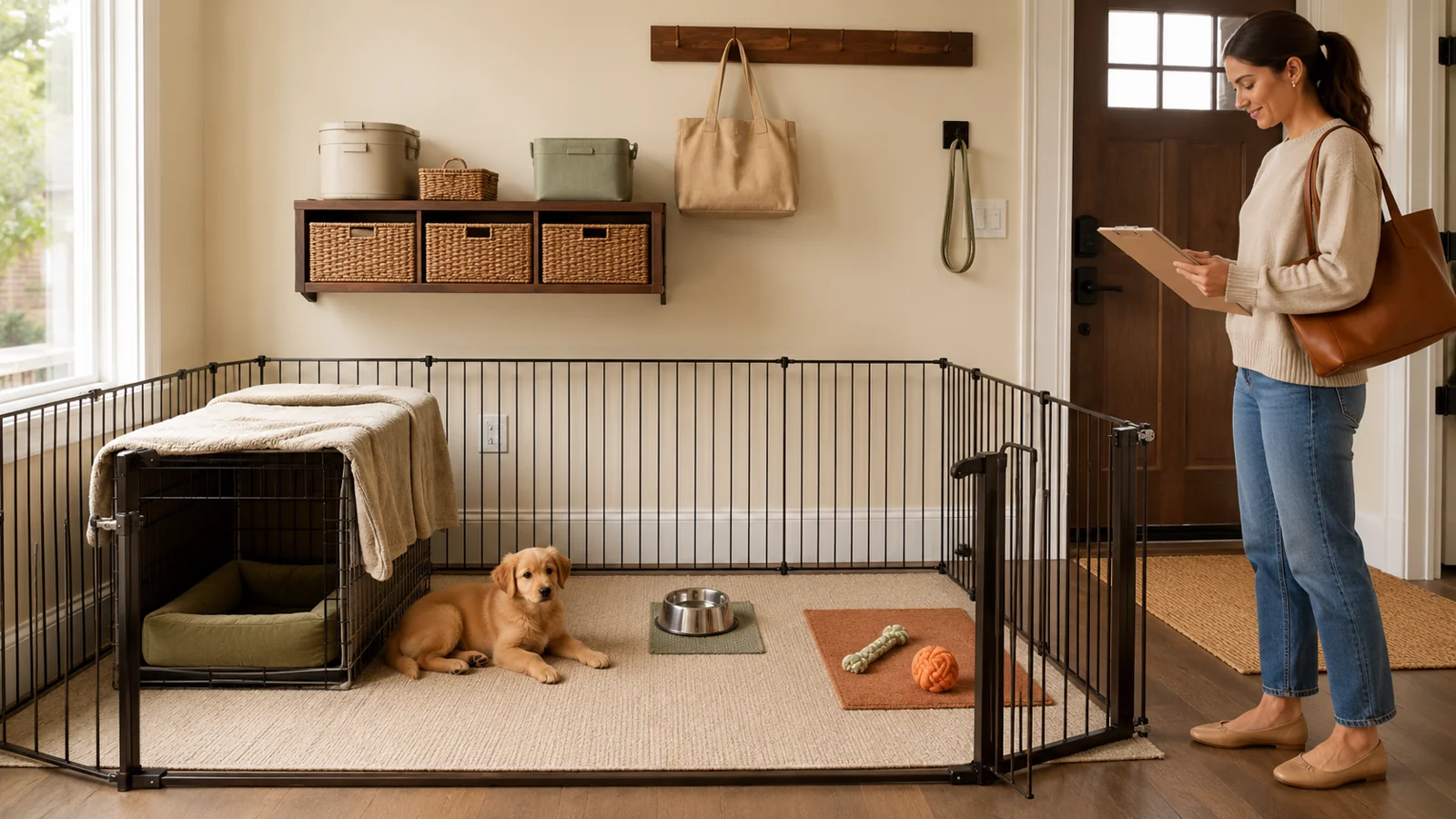
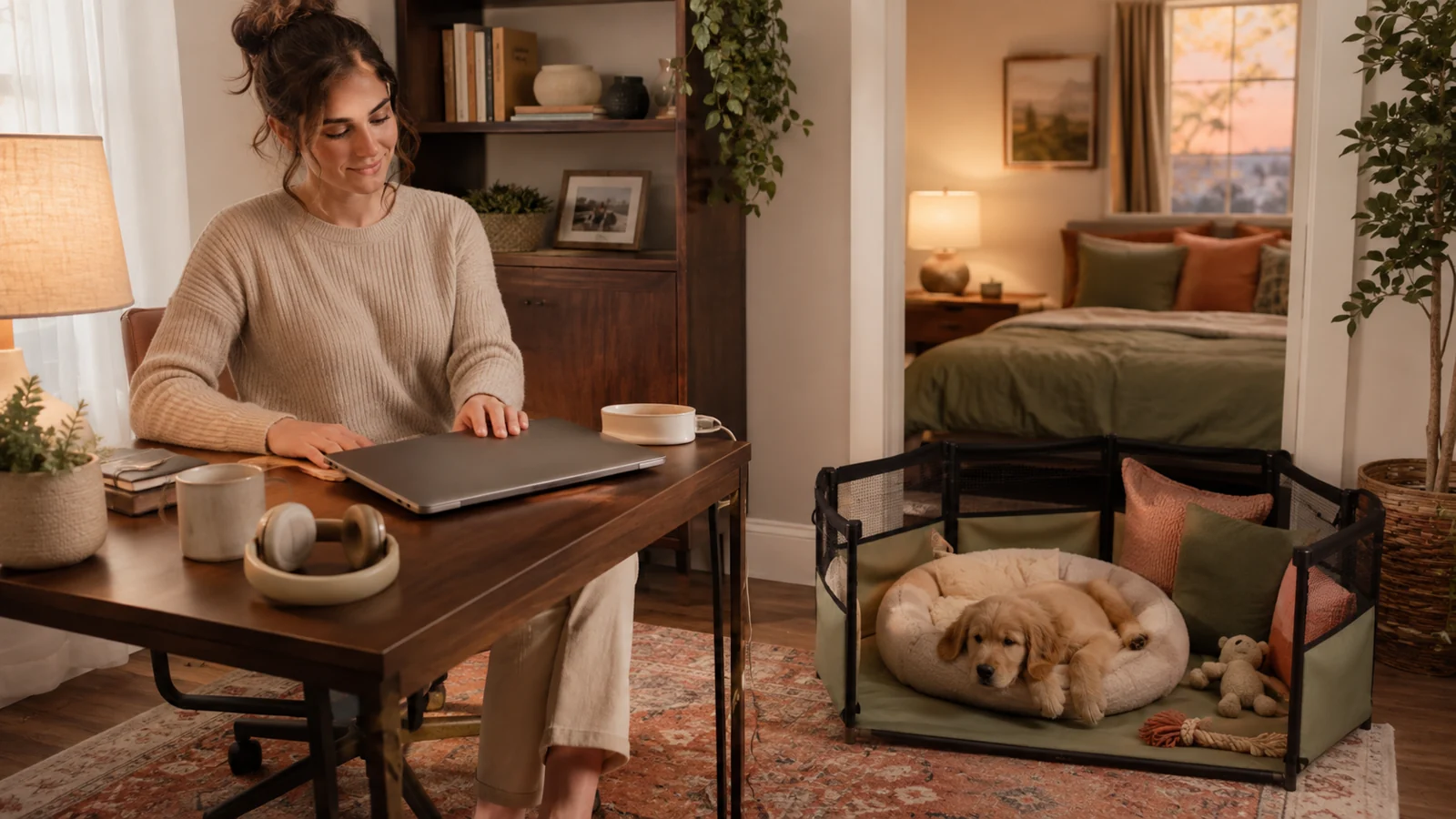
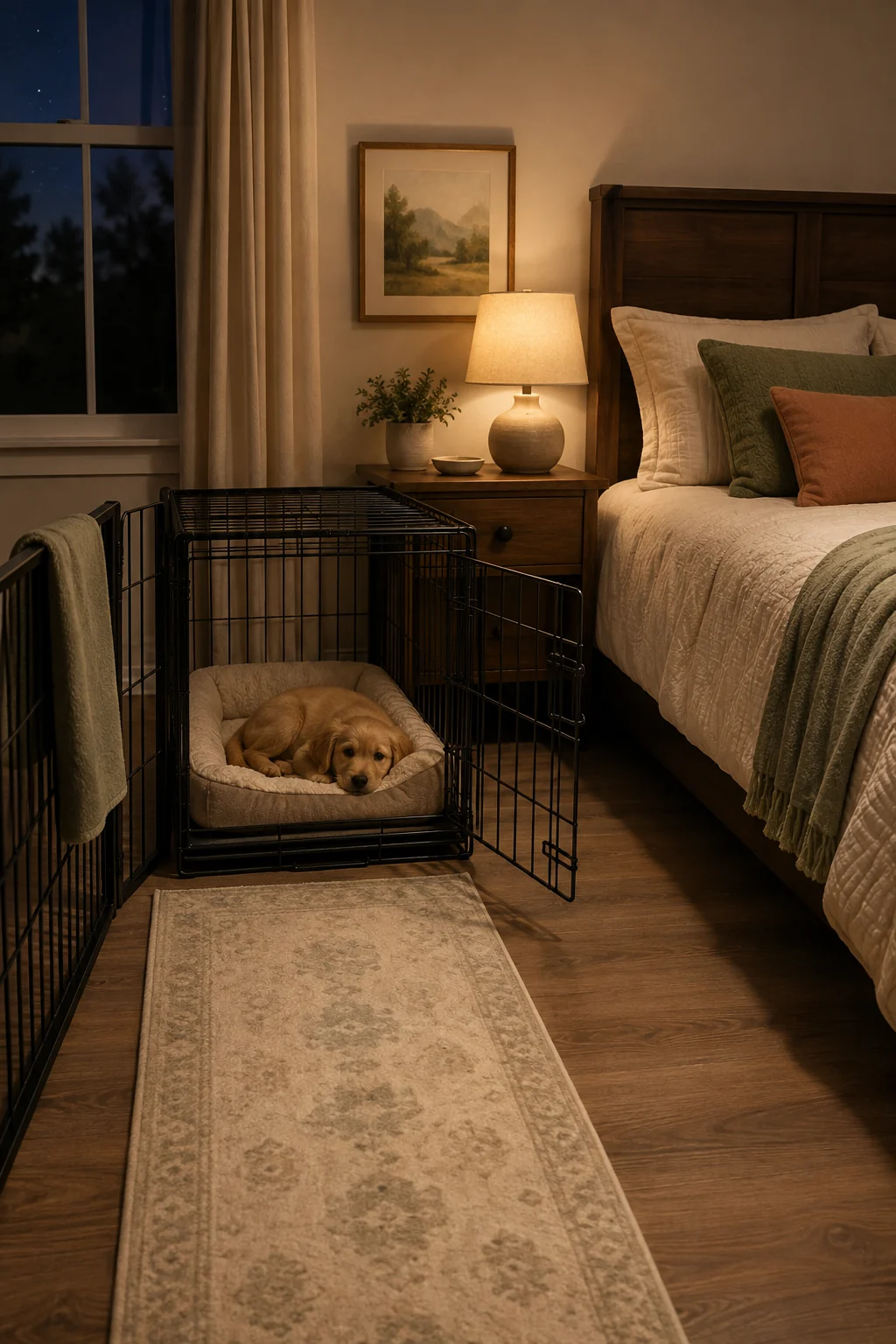
Place the crate, pen, or other safe sleep space where you can hear the puppy during the first night. A bedroom or immediately adjacent area is often easier than isolating the puppy at the far end of the home. The setup should be large enough for comfortable rest and free of items the puppy could shred, swallow, climb, or become tangled in.
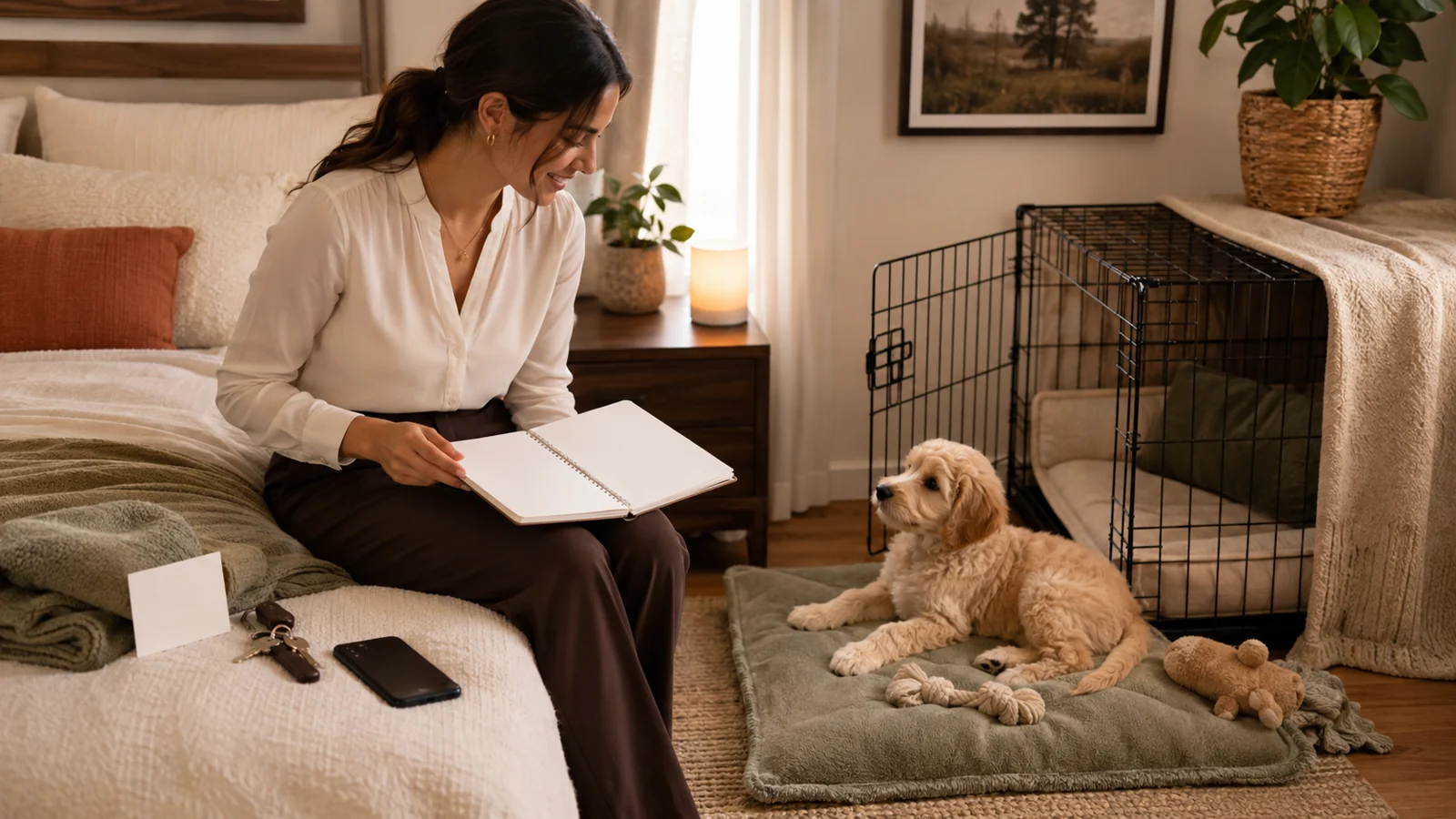
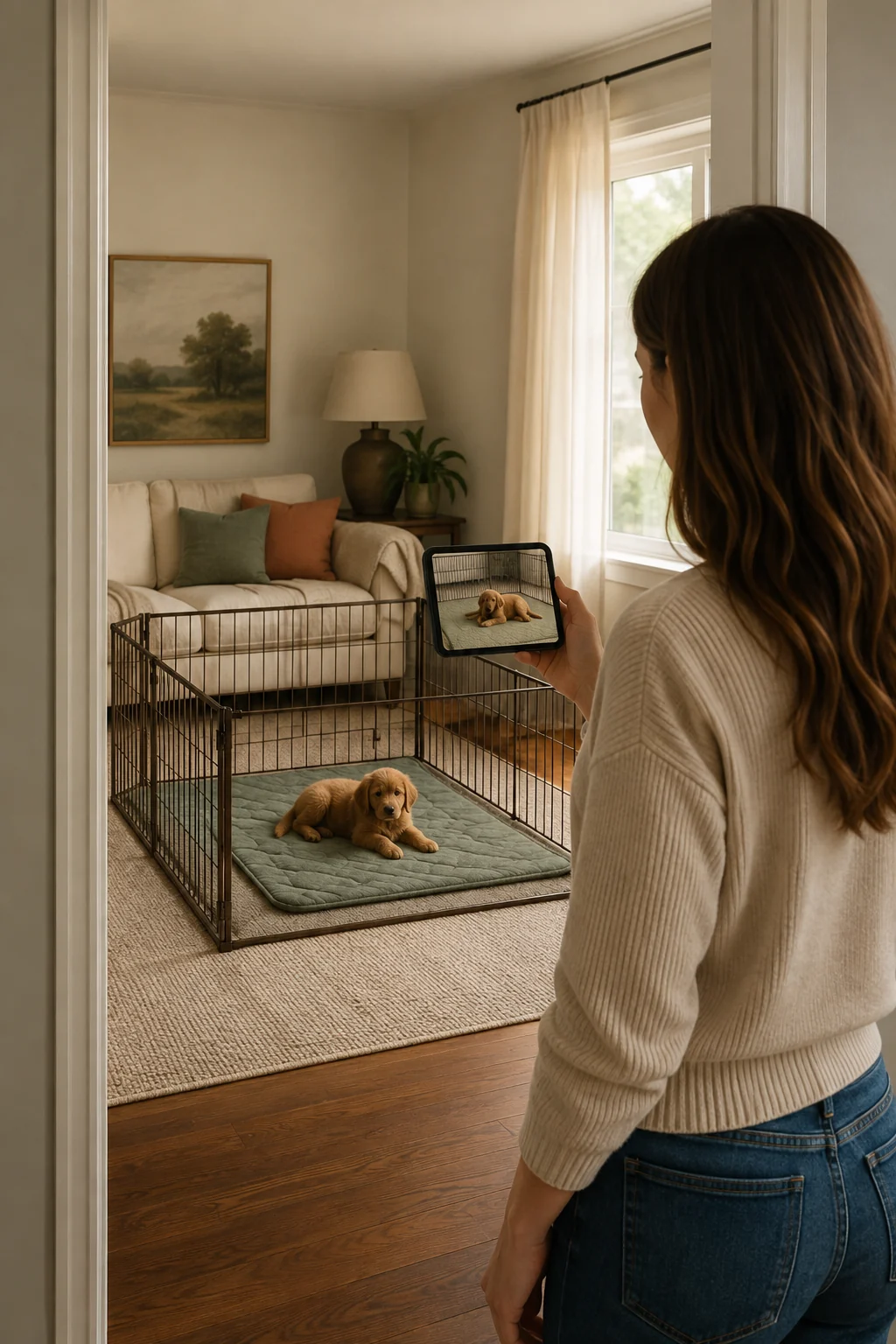
Do not force a frightened puppy into a crate and expect the first night to create instant acceptance. VCA’s confinement guide recommends positive, gradual exposure: begin with the door open, pair the space with calm rewards, close the door while staying nearby, and increase distance in small steps. It also notes that extended confinement is not healthy and that a camera can help you check early separations for distress.
The nighttime setup and the workday setup do not have to be identical. A puppy who can rest briefly in a bedroom crate may still need a larger pen or puppy-proofed zone with a separate rest area during caregiver gaps. Choose the arrangement based on what the puppy has actually tolerated, not on what is most convenient to leave closed for ten hours.
Practice tiny separations before the office departure
The first night is not the time to “cry it out” or test the puppy with a long absence. Practice separations that are short enough for the puppy to remain reasonably calm.
Start with ordinary actions: step behind a gate, walk to another room, pick up your keys without leaving, or close the door for a few seconds while the puppy is settled. Return before the puppy escalates into persistent panic. Increase duration gradually only when the previous step was calm.
The ASPCA recommends practicing short periods alone and gradually increasing them rather than making the schedule change abrupt. AAHA likewise advises beginning with absences short enough that the pet stays calm and notes that a crate can worsen distress for some animals who are not already comfortable there. Review ASPCA’s schedule-transition tips and AAHA’s separation-anxiety overview.
Brief whining that settles is different from escalating distress. Persistent vocalizing, frantic escape attempts, repeated pacing, heavy panting unrelated to heat or exercise, refusal to settle, or self-injury means the plan is too difficult. End the test, reduce the next separation, and seek veterinary or qualified behavior help when distress is severe or continues.
Printable first-night and office-day planning worksheet
Copy this section into a document and print it. Complete it before pickup, then revise it after observing the first night.
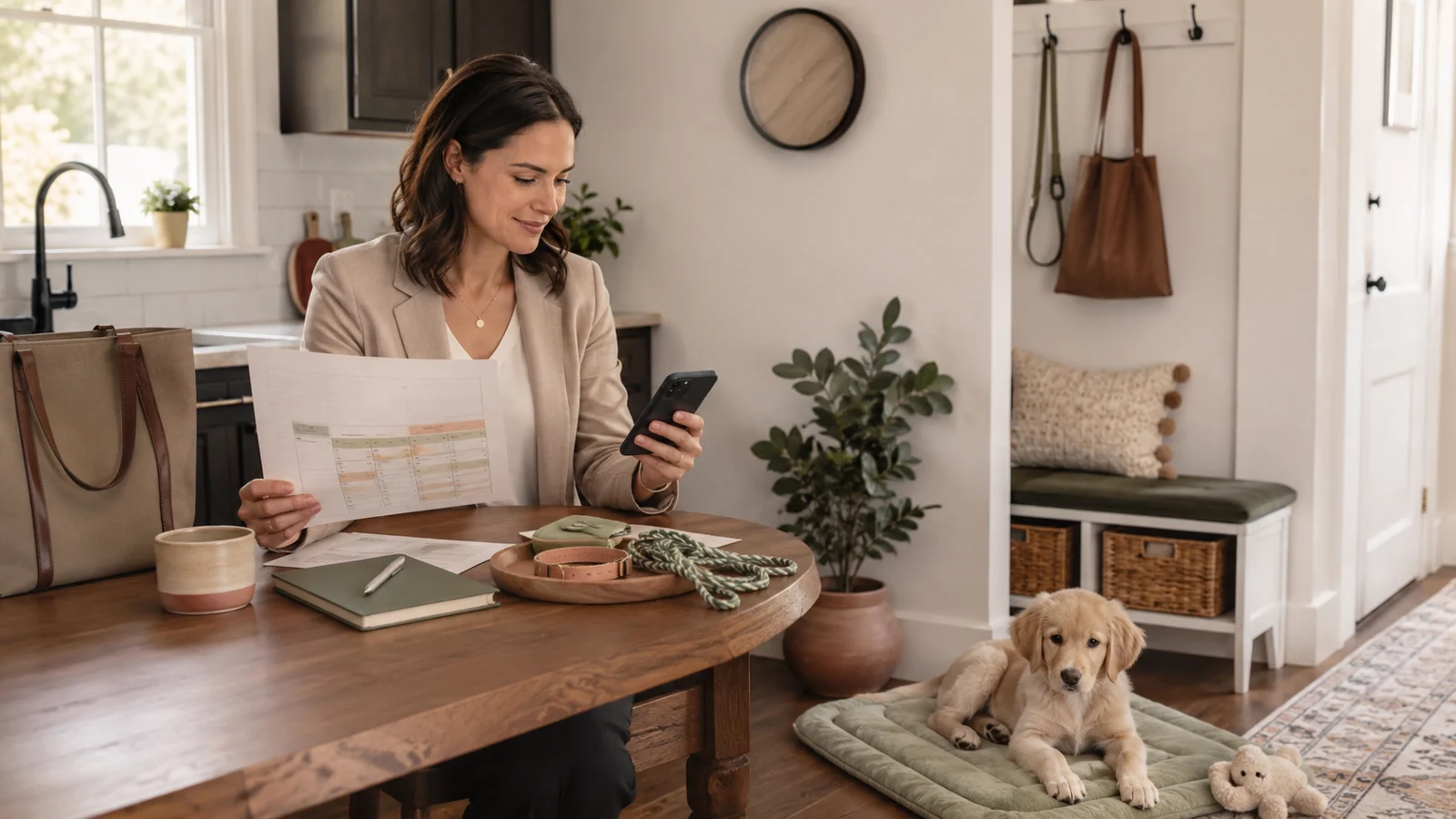
A. Door-to-door schedule
| Planning item | Your answer |
|---|---|
| Puppy’s age on arrival | |
| Arrival date and time | |
| First office day | |
| I leave home at | |
| I return home at | |
| Total door-to-door absence | |
| Conservative maximum planned gap | |
| Source for that limit: prior routine, age guideline, observation, or veterinarian |
Coverage estimate: minimum visits = ceiling(total absence ÷ maximum planned gap) − 1
This formula is only a timing screen. Round up, add buffer for late arrivals, and remember that a newly arrived puppy may need shorter gaps. When the result requires several visits, a caregiver staying for a longer block may be more reliable than a chain of brief drop-ins.
B. First-night sequence
| Time | Planned action | Who is responsible | What happened |
|---|---|---|---|
| Arrival | Calm elimination opportunity and limited exploration | ||
| Early evening | Food/water instructions and quiet settling | ||
| Before bed | Final calm check and sleep-space setup | ||
| Overnight check 1 | Brief response only if puppy wakes or signals | ||
| Overnight check 2 | Add only if needed from observed routine | ||
| Morning | Wake, care, and caregiver handoff |
C. Coverage map
| Coverage block | Start | End | Caregiver | Confirmed? | Backup |
|---|---|---|---|---|---|
| Owner before work | |||||
| Care block 1 | |||||
| Care block 2 | |||||
| Care block 3 | |||||
| Owner after work |
Circle every uncovered gap. If any gap exceeds the conservative maximum, the plan is incomplete.
D. Caregiver handoff card
- Puppy’s name and age:
- Your phone number:
- Veterinarian and emergency contact:
- Building or home access instructions:
- Exact arrival and departure window:
- Approved food, rewards, and safe activities:
- Sleep or confinement area:
- Signs the puppy usually needs a break:
- What calm behavior looked like last night:
- What distress looked like last night:
- Items the caregiver must not offer or leave accessible:
- Backup caregiver and contact:
- Where to record arrival, departure, elimination, food/water, play, rest, and concerns:
E. Morning go/no-go check
Answer yes or no:
- Every gap has a named, confirmed adult.
- The backup person has access instructions.
- No gap exceeds the conservative planned limit.
- The puppy has already spent at least one calm, brief period in the selected area.
- The caregiver knows what to do if the puppy cannot settle.
- You can return home or authorize backup care if the plan fails.
Any “no” means the office-day plan needs revision before you leave.
Common mistakes for full-time office workers
Counting only paid work hours. Commute, security lines, parking, lunch meetings, and overtime all belong in the absence calculation.
Assuming one midday visit solves the problem. It may not. Measure the gap before and after the visit rather than counting the visit itself.
Using the first night as a confinement test. A puppy who is exhausted or quiet at midnight has not demonstrated readiness for hours alone the next morning.
Changing food, sleep location, and caregiver at once. Keep as much continuity as possible from the puppy’s previous routine and give the caregiver the same instructions you are following.
Leaving the backup vague. “A neighbor might help” is not coverage. A backup is a named person who has agreed, has access, and knows the handoff plan.
Ignoring the puppy’s evidence. A mathematically valid schedule still fails if video or caregiver notes show escalating distress, repeated accidents, or inability to rest.
When to revise the plan
Revise immediately when a caregiver is late, the puppy cannot settle in the chosen area, the actual workday runs longer than planned, or the overnight observations show the puppy needs more frequent support than expected.
For a missed visit, activate the backup rather than stretching the gap. For repeated distress, shorten separations and discuss the pattern with your veterinarian or an appropriately credentialed behavior professional. For a schedule that repeatedly requires more visits than anyone can reliably provide, use a longer in-home care block or delay the normal office routine until dependable coverage exists.
The first night is successful when it produces a calm beginning and better information for the next day—not when the puppy stays silent for eight hours. Plan from the full door-to-door absence, keep every gap conservative, document what the puppy actually does, and make human care coverage the non-negotiable part of returning to the office.
Helpful visuals from this guide
Use these five visuals as quick reminders, then return to the full guide for context, limitations, and source details.
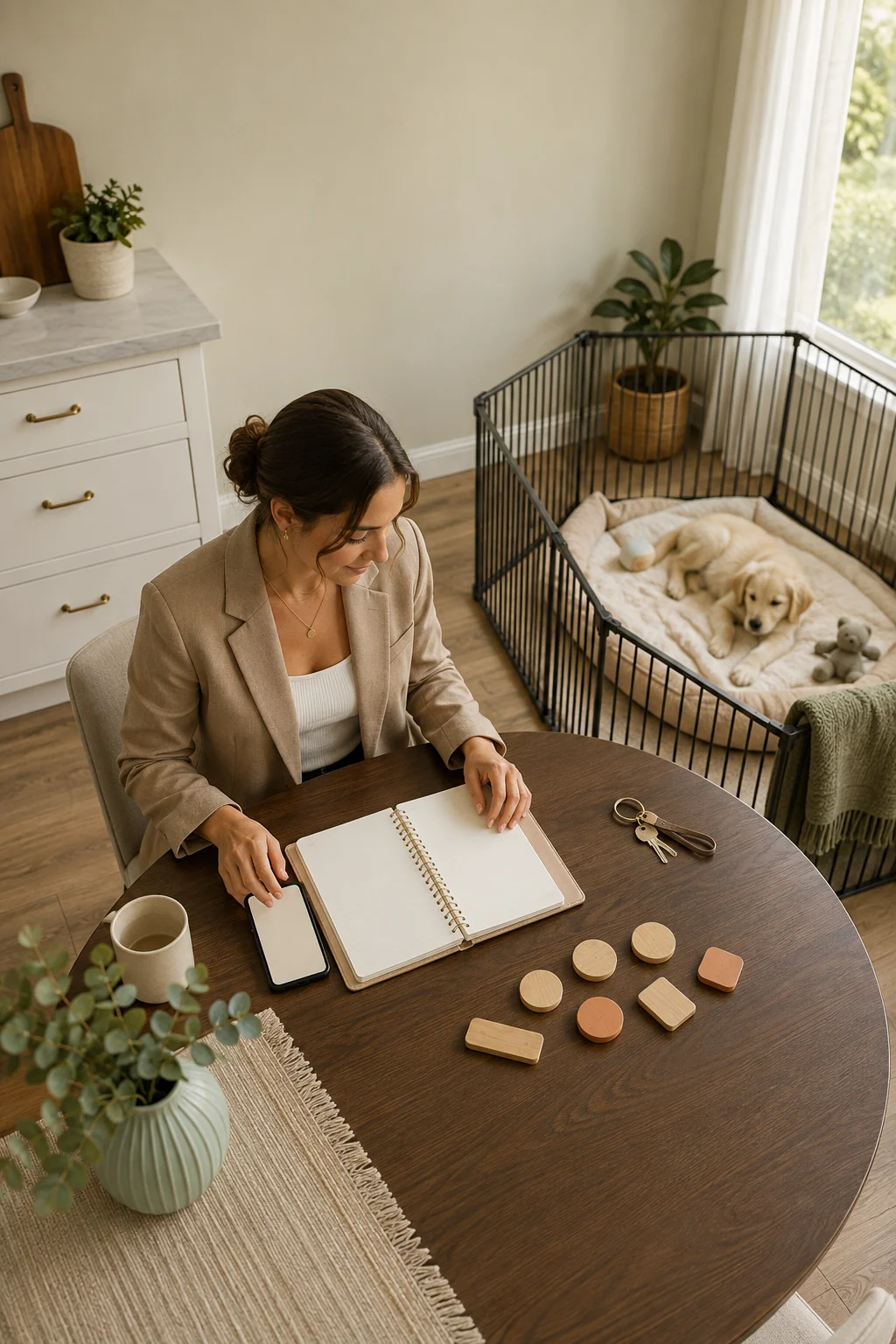
Pinterest does not let websites prefill its Title field. Each button below copies the correct title and opens that Pin. Click the Title field in Pinterest, press Ctrl + V, then save it to the board above.
Start with Pin 1 and repeat through Pin 5.
- Calm Puppy First-Night Sleep Setup
See a practical first-night sleep arrangement for a puppy when the next day includes an office schedule and caregiver handoffs.
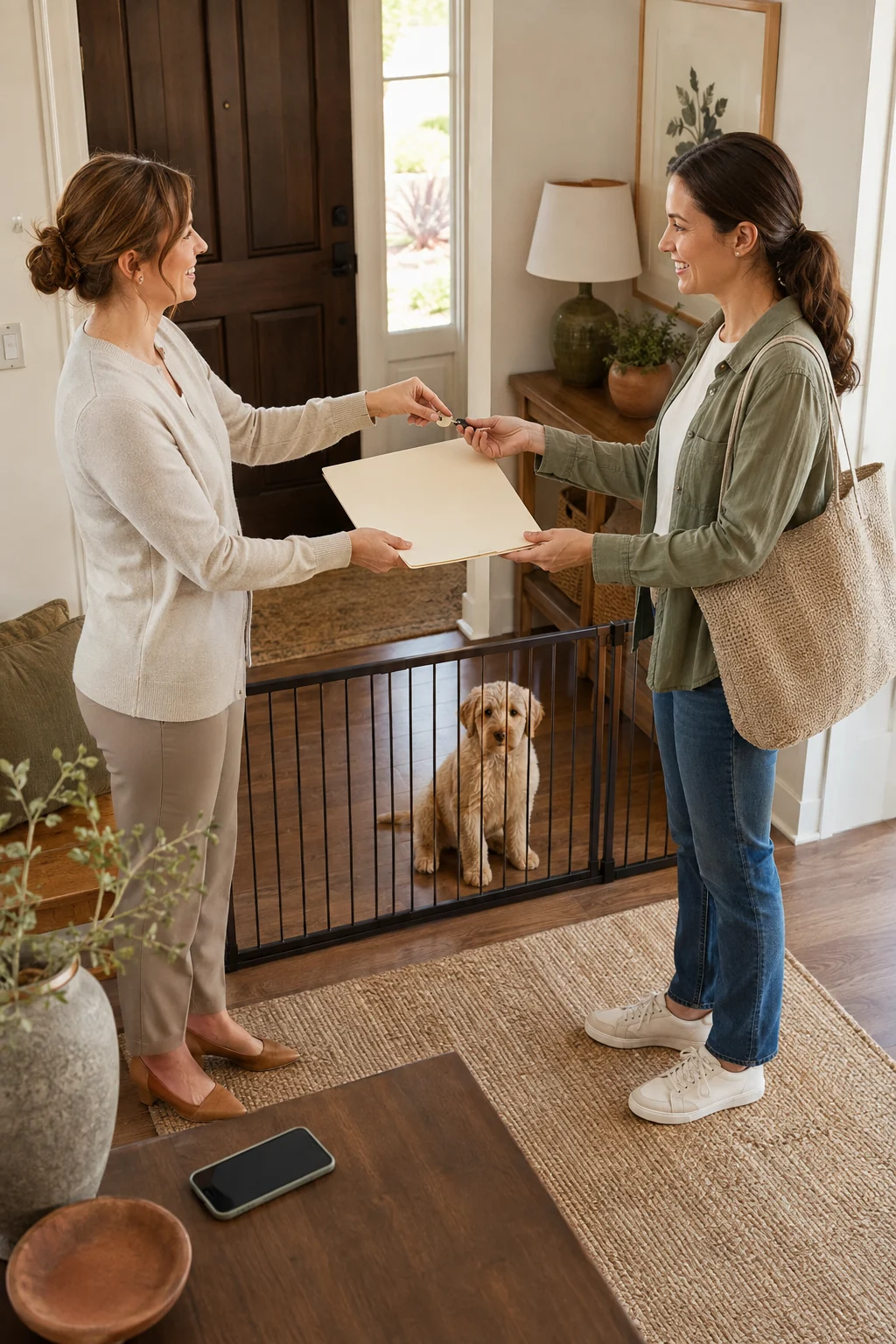
- Puppy Caregiver Handoff Plan
Use a clear caregiver handoff to prevent uncovered gaps when returning to a full-time office schedule after a puppy’s first night.
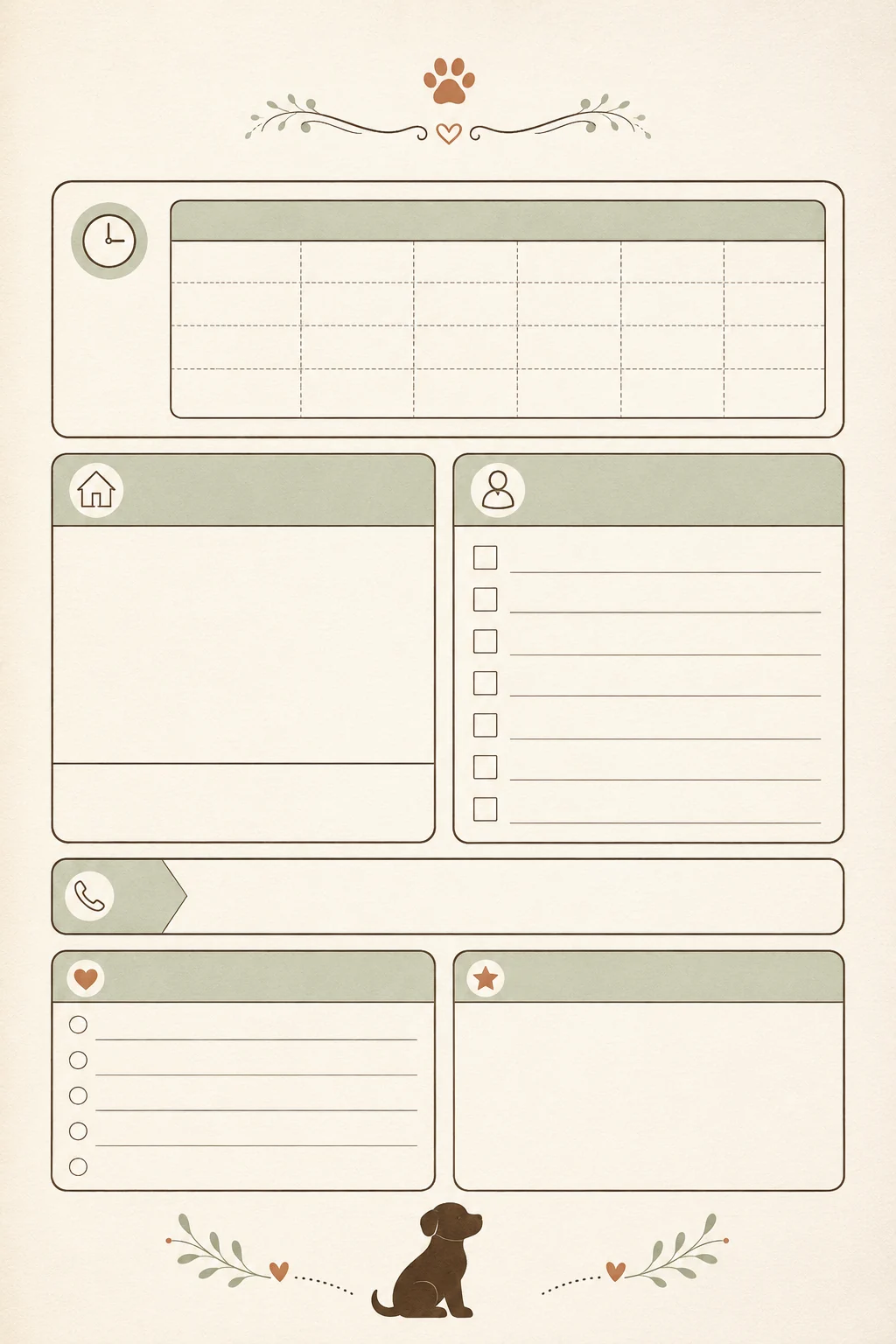
- Printable Puppy First-Night Planner
Organize arrival timing, office-day coverage, caregiver details, and backup plans with a printable puppy planning worksheet.
- Practice Puppy Alone Time Gradually
Learn why brief, monitored separations are more useful than testing a new puppy with a long absence after the first night.
- Calculate Your Puppy’s Workday Gaps
Plan realistic puppy care coverage by including commute time, caregiver windows, and a confirmed backup before the first office day.
Optional: choose all 5 images at once
Frequently asked questions
Can I bring a puppy home Sunday night and work Monday?
Only with confirmed care coverage that keeps every door-to-door gap within a conservative limit for that puppy. Bringing the puppy home before one or two non-work days is usually more practical because it lets you observe sleeping, waking, and brief-separation behavior first.
Is one lunchtime puppy-sitter visit enough?
Not necessarily. Calculate the gap from your departure to the sitter’s arrival and the second gap from the sitter’s departure to your return. For a young puppy, either gap may still be too long even when a noon visit is scheduled.
Should the puppy sleep in a crate on the first night?
A crate can be useful when the puppy is introduced positively and can settle there, but it should not be forced. Keep the sleep area nearby, use gradual exposure, and consider a secure pen or other suitable confined area when the puppy is not comfortable in a closed crate.
How do I calculate puppy care visits for my workday?
Divide the total door-to-door absence by the conservative maximum planned gap, round up, and subtract one to estimate the minimum number of handoffs or visits. Then add buffer and replace several fragile drop-ins with a longer caregiver block when that is more reliable.
What should I tell the puppy sitter after the first night?
Share the exact access window, approved food and activities, safe confinement area, observed waking and settling pattern, signs that the puppy needed a break, what distress looked like, your veterinarian’s contact, and the backup plan.
What if the puppy cries whenever I leave the room?
Reduce the difficulty and practice much shorter separations that end before distress escalates. Persistent panic, frantic escape attempts, self-injury, or inability to settle warrants guidance from a veterinarian or appropriately credentialed behavior professional.
Sources & further reading
- New dog checklist: Your step-by-step guide to a successful startAmerican Animal Hospital Association · Accessed 2026-07-31
- Housetraining for Puppies and Dogs | VCA Animal HospitalsVCA Animal Hospitals · Accessed 2026-07-31
- Life Skills for Pets: Crate Training and Confinement for Puppies and Dogs | VCA Animal HospitalsVCA Animal Hospitals · Accessed 2026-07-31
- Separation Anxiety in Pets: 7 Tips and TricksAmerican Society for the Prevention of Cruelty to Animals · Accessed 2026-07-31
- Separation Anxiety in Pets: Signs, Causes, and SolutionsAmerican Animal Hospital Association · Accessed 2026-07-31
- How To Crate Train Your PuppyVCA Animal Hospitals · Accessed 2026-07-31