Bringing a puppy home on a workday is only workable when the puppy’s care is covered from arrival through bedtime and every absence is shorter than the puppy can comfortably manage. A normal office shift plus commuting should never be treated as one uninterrupted “alone-time block” for a newly arrived puppy. Arrange leave, a trusted adult, or multiple caregiver visits before pickup; if coverage is uncertain, change the pickup time or date.
The first day is not the time to test whether a puppy can tolerate a full workday alone. It is a transition day: the puppy is learning where to rest, where to eliminate, who is safe, and what happens when people briefly leave and return. The plan below stays focused on that first day for a dog mom who works outside the home full time.
Start with the hard constraint: coverage before pickup
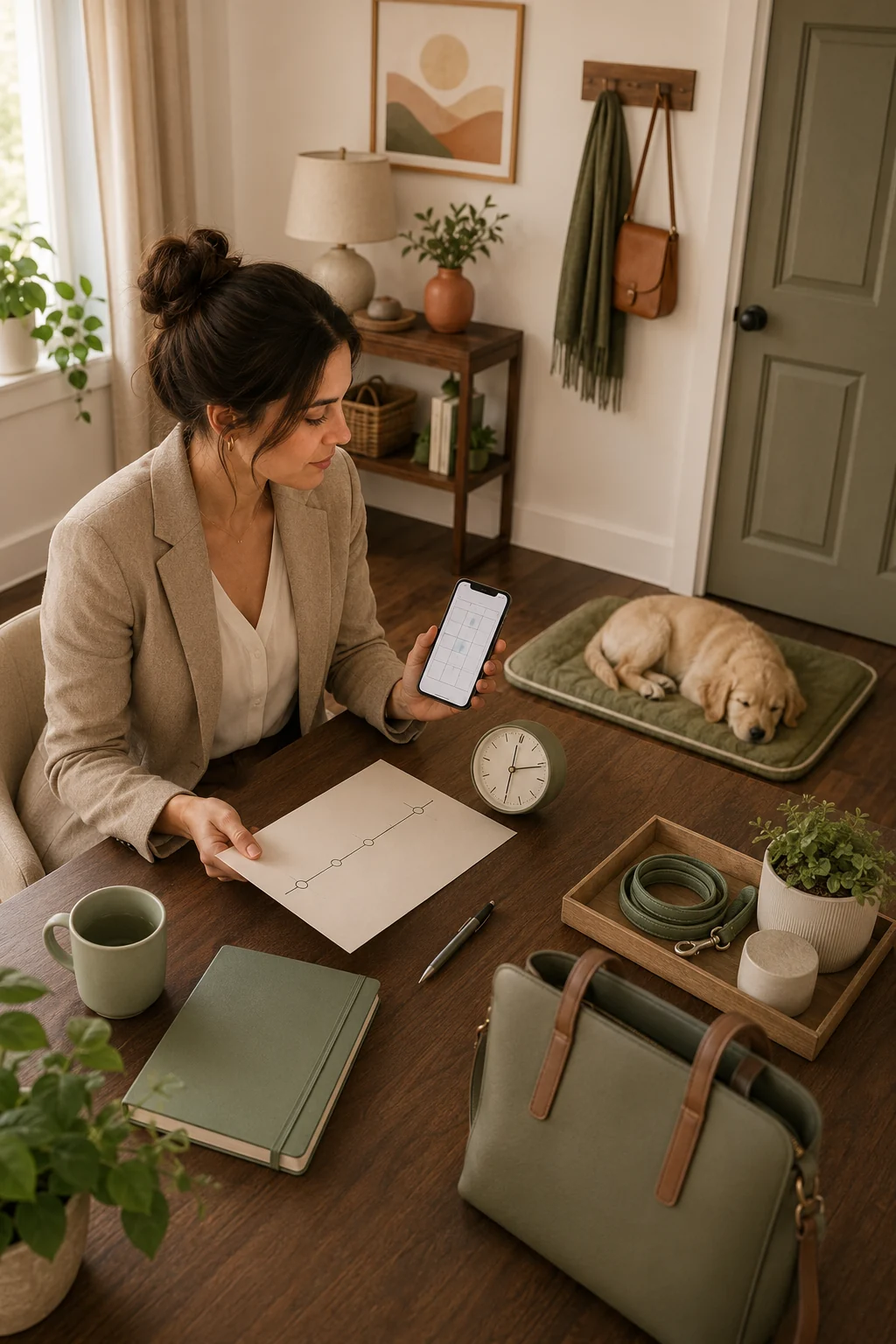
Write down the entire period from the moment the puppy is handed to you until you return from work, including commute time. That total—not just paid working hours—is the care gap you must solve.
Use this order of preference:
- Bring the puppy home when you can remain available. A Friday evening, scheduled day off, vacation day, or shared household day gives you time to observe the puppy before any meaningful absence.
- Stagger adult coverage. One person handles pickup and settling; another covers later potty, feeding, and calm companionship periods.
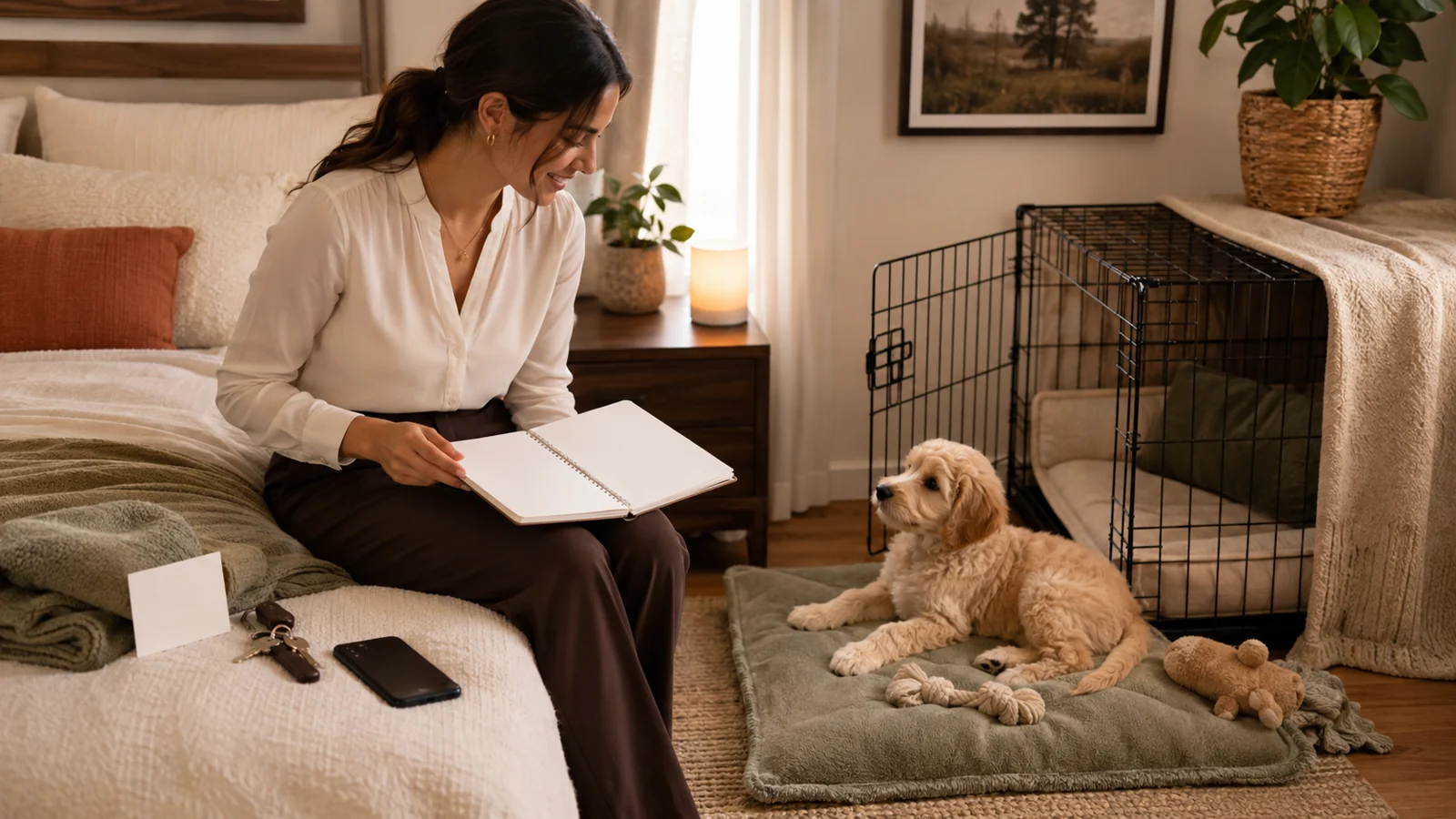
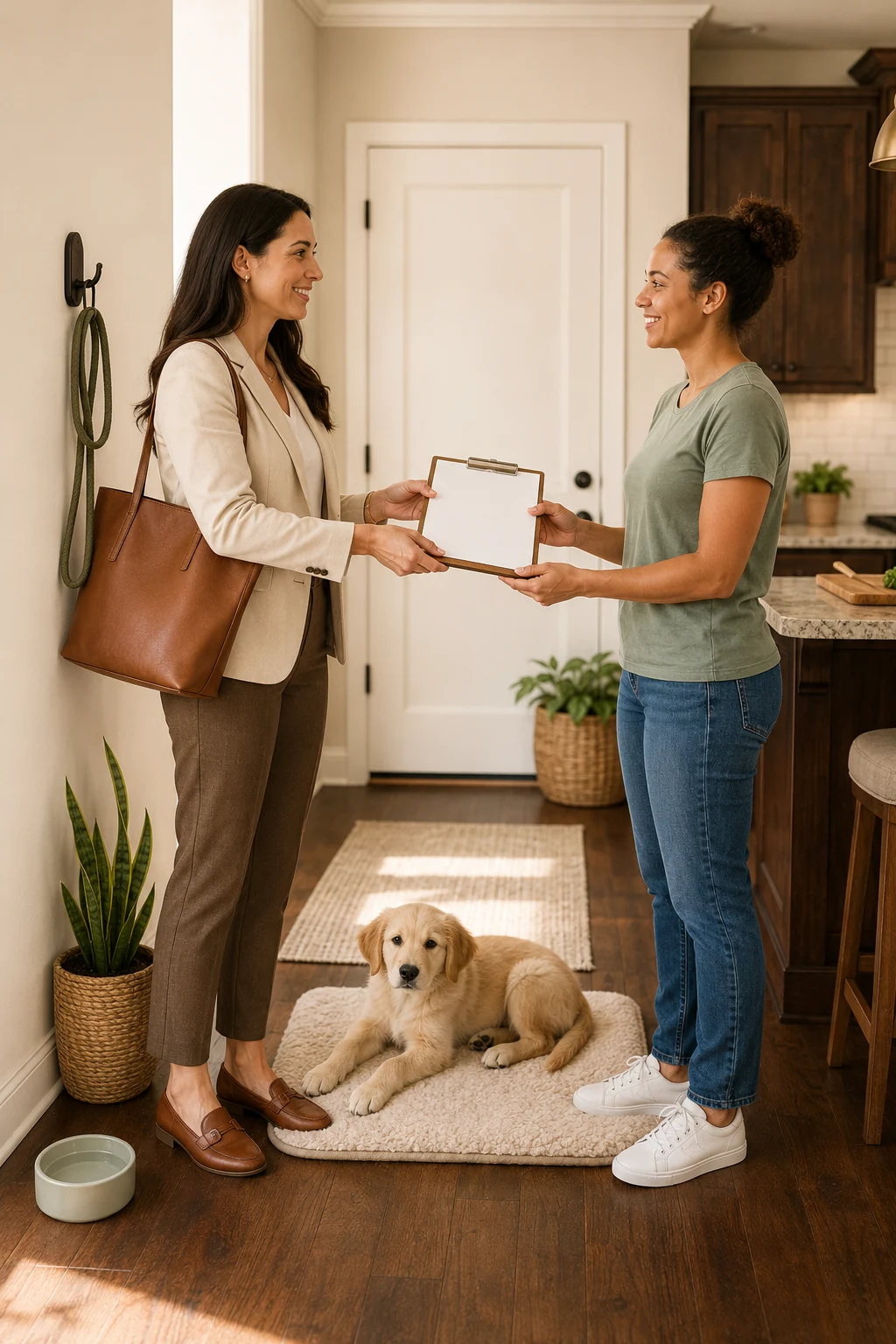
- Book a trusted in-home caregiver. Give the caregiver exact visit windows and a written handoff card rather than a vague instruction to “check on the puppy.”
- Change the pickup date when coverage is incomplete. Delaying pickup is more responsible than improvising after the puppy is already home.
AAHA recommends building a support team before day one and agreeing on predictable feeding, potty, play, and bedtime routines. It also notes that the early adjustment period is demanding and normal routines may need to pause. See AAHA’s preparation guidance.
A daycare or group setting is not automatically the best first-day solution. The puppy has just experienced a major transition, and vaccination status, facility policies, temperament, travel, and exposure risks all need individual review. For this first-day plan, prioritize quiet, known adult coverage in the home unless your veterinarian, breeder, rescue, and the facility have already agreed on another arrangement.
Build the day backward from the office schedule
Plan from your required departure time backward, then add the puppy’s arrival rather than squeezing the puppy into an ordinary morning.
Option A: evening arrival after work
This is often the cleanest choice when the pickup source permits it.
- After work: Pick up the puppy and travel directly home.
- On arrival: Go first to the designated elimination area.
- Next 30–60 minutes: Allow quiet exploration of the limited area you prepared, with direct supervision.
- Later: Follow the breeder’s or rescue’s current feeding instructions and offer another potty opportunity after eating, waking, and active play.
- Before bedtime: Keep the evening calm, note what helped the puppy settle, and prepare for overnight potty needs.
Option B: midweek arrival with a half-day or full-day leave
Use leave for the arrival period, not for errands. The useful work is observing the puppy’s signals, confirming that the caregiver can follow the route and schedule, and practicing very brief separations while the puppy remains calm.
An illustrative timetable might look like this:
| Time | First-day task | Who is responsible |
|---|---|---|
| 8:00 a.m. | Pickup and direct trip home | Owner |
| 9:00 a.m. | Potty opportunity, quiet settling, observation | Owner |
| 10:30 a.m. | Nap and one very brief separation practice | Owner |
| 12:00 p.m. | Potty, meal if due under the existing feeding plan, calm interaction | Owner |
| 2:00 p.m. | Caregiver arrives before owner leaves | Owner + caregiver |
| 2:30–5:30 p.m. | Supervision, rest, scheduled potty opportunities, notes | Caregiver |
| After commute | Owner returns, receives handoff, continues quiet evening | Owner |
This is a planning example, not a universal puppy schedule. Age, recent travel, food timing, sleep, health, and the puppy’s behavior can change the timing. Keep the first day flexible enough to respond to the puppy rather than forcing every event to happen by the minute.
Use conservative alone-time limits
There is no single number that fits every puppy, and bladder capacity is not the same as emotional readiness to be alone. On the first day, use the shorter limit created by these two questions:
- How soon will this puppy likely need another potty opportunity?
- How long can this puppy remain calm during a practiced separation?
VCA’s housetraining guidance says puppies may need potty opportunities every one to two hours while awake, after naps, after meals or large drinks, and during active periods. It also states that puppies left for more than three hours need a potty break, with a friend, sitter, or a larger managed area that separates resting and toileting space as possible solutions. Read the full VCA housetraining guidance.
For very young puppies, VCA’s pediatric guidance uses a more age-specific starting point: puppies six to eight weeks old should be taken out about every two hours, with longer intervals introduced as they mature. See VCA’s potty-training article.
Treat those intervals as planning ceilings, not goals to push toward on arrival day. A puppy who is awake, active, drinking, unsettled, or signaling may need help sooner. A puppy who sleeps for part of the interval still needs a prompt potty opportunity after waking.
Also separate confinement tolerance from absence tolerance. AAHA advises teaching crate comfort through positive association and not closing a puppy inside until the puppy voluntarily rests there. It specifically cautions against forcing a puppy into a crate or leaving them to cry it out. Review AAHA’s first-home guidance.
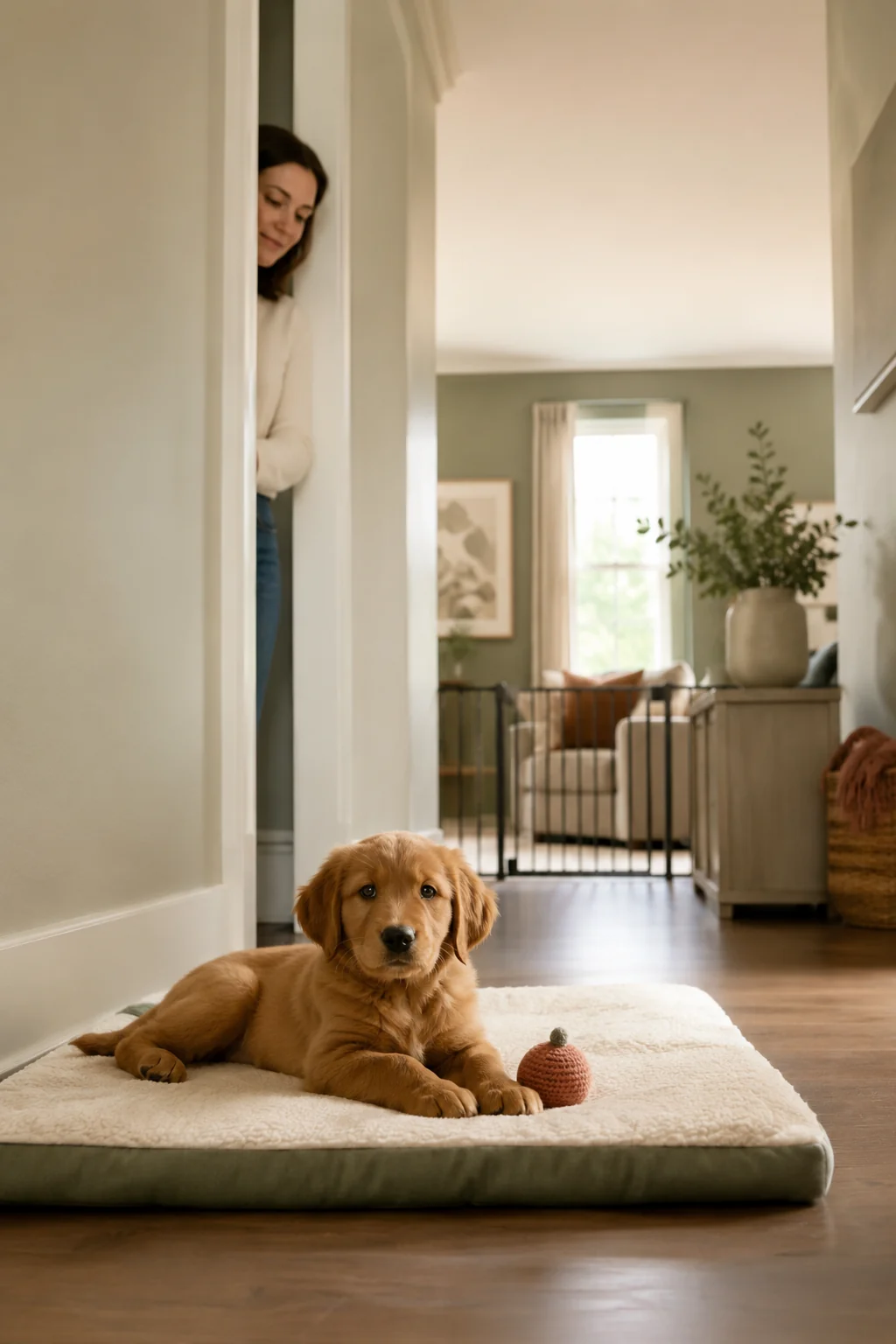
For day one, practice separations measured in seconds or a few minutes while you are still available to observe. Return before the puppy escalates into sustained distress. Do not jump from “the puppy rested while I showered” to “the puppy can handle my commute and office shift.”
Run a calm first-day sequence
The first-day sequence should be simple enough that a substitute caregiver can repeat it.
- Potty before touring the home. Go directly to the chosen elimination area after the trip.
- Limit the first exploration. Use the already prepared, supervised area rather than opening the entire home. Detailed puppy-safe-room design is outside this guide.
- Keep visitors off the calendar. The goal is orientation and rest, not a welcome party. AAHA’s new-dog checklist recommends a calm environment, minimal visitors, and monitoring eating and bathroom habits.
- Preserve food continuity. Use the food and instructions supplied by the breeder, rescue, or veterinarian. Do not introduce a new diet simply because it is the first day.
- Offer potty opportunities at predictable transitions. Think after travel, waking, eating, drinking, and active play—not only at fixed clock times.
- Let sleep happen. Do not keep waking the puppy for entertainment or photos.
- Record observations. Note the time of meals, water, potty results, sleep, caregiver arrivals, brief absences, and any distress behavior.
A first-day accident is information, not disobedience. Clean it calmly and shorten the time to the next supervised potty opportunity. Do not punish the puppy for an accident; redirect future elimination to the chosen location and reward success.
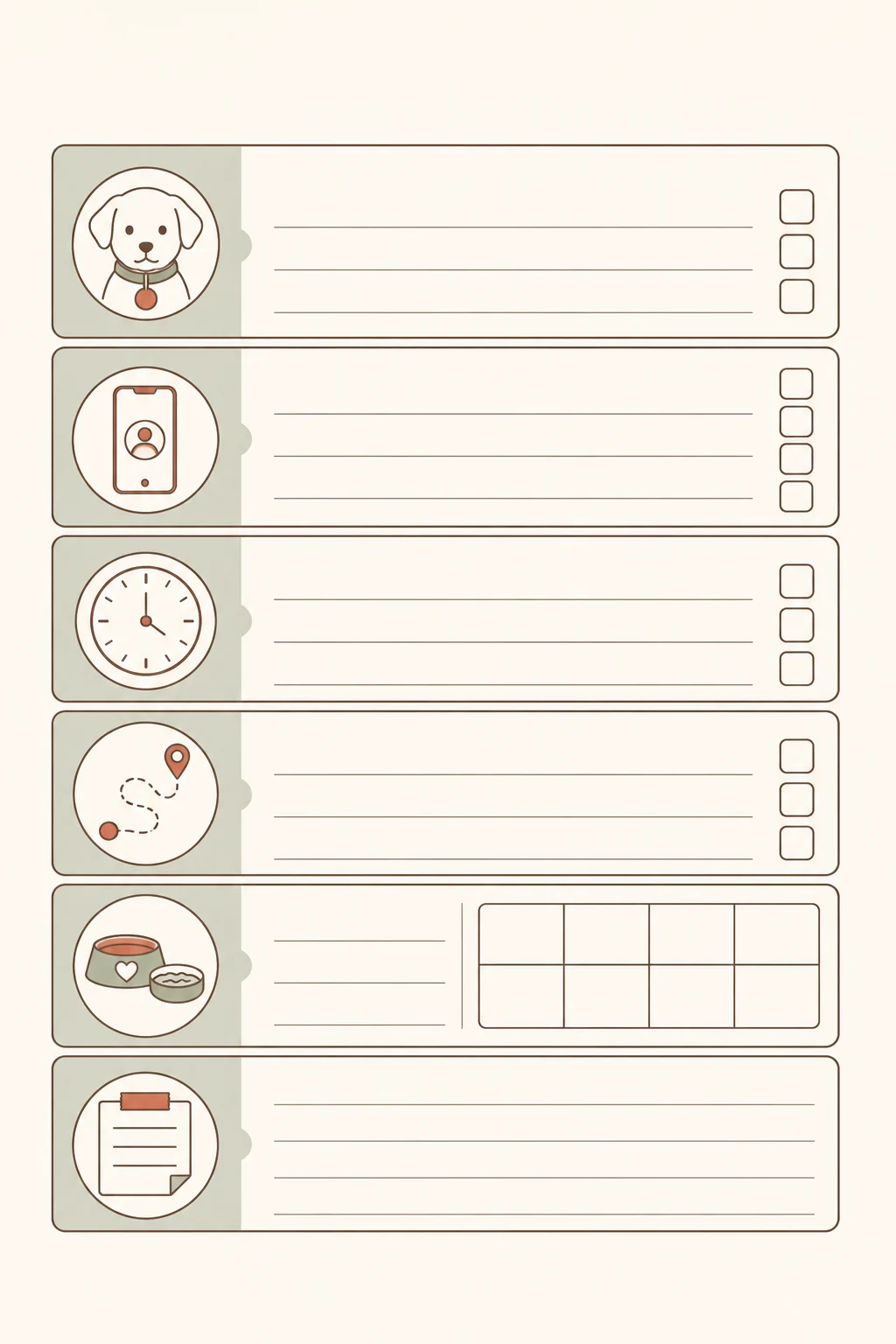
Puppy’s first-day caregiver handoff card
Copy this card into a note, print it, or send it to every adult covering the puppy. Complete every blank before the caregiver is alone with the puppy.
Puppy and contact details
- Puppy name: ____________________
- Age/date of birth: ____________________
- Arrival date: ____________________
- Owner name and mobile: ____________________
- Backup contact and mobile: ____________________
- Regular veterinary clinic: ____________________
- Emergency veterinary contact: ____________________
- Pickup source contact, if needed today: ____________________
Today’s fixed care plan
- Owner departure time: ____________________
- Expected owner return time, including commute: ____________________
- Caregiver arrival and departure window: ____________________
- Next caregiver or backup window: ____________________
- Maximum planned gap with no adult present today: ____________________
- Where the puppy rests between visits: ____________________
- Where the puppy eliminates: ____________________
- Exact door or route to the potty area: ____________________
Food, water, and potty record
- Food currently being used: ____________________
- Meal time and amount supplied by owner or pickup source: ____________________
- Last meal time: ____________________
- Last water check: ____________________
- Last successful potty time and result: ____________________
- Next planned potty opportunity: ____________________
- Approved treats or enrichment already tested: ____________________
- Do not give: new foods, table scraps, unapproved chews, supplements, or medication.
Caregiver visit sequence
- Enter calmly and secure doors or gates before giving the puppy access.
- Check the puppy’s location and general condition.
- Take the puppy to the specified potty area using the specified route.
- Quietly praise successful elimination; do not punish an accident.
- Provide the premeasured meal only if it is due.
- Offer calm interaction and supervised movement in the approved area.
- Return the puppy to the approved resting area only if the puppy can settle there safely.
- Send the owner the check-in report below before leaving.
Check-in report
- Arrival time: ____________________
- Potty: urine / stool / neither
- Meal offered and eaten: ____________________
- Water checked: yes / no
- Activity: sleeping / settled / playful / restless
- Separation behavior observed: ____________________
- Accident or cleanup: ____________________
- Photo or short video sent to owner: yes / no
- Departure time: ____________________
- Next visit due: ____________________
Contact the owner immediately when
- The puppy cannot be safely contained or repeatedly attempts to escape.
- The puppy remains intensely distressed rather than settling during the visit.
- The puppy is injured, appears acutely unwell, or the caregiver is unsure whether the puppy is safe.
- Access, food instructions, potty route, or the next coverage window is unclear.
The card is deliberately operational. It prevents the most common handoff failure: one person thinking another person knows the schedule, route, feeding plan, or backup contact.
Choose coverage by the puppy’s actual gap
Use the following decision check before finalizing pickup:
| Question | If yes | If no |
|---|---|---|
| Can an adult stay through the initial arrival and settling period? | Continue planning. | Move pickup or arrange arrival coverage. |
| Is every absence shorter than the puppy’s planned potty and calm-separation limit? | Write each gap on the handoff card. | Add a caregiver visit or keep an adult home. |
| Has the puppy already shown comfort in the planned resting area? | Use it for short, observed periods. | Do not make the first locked confinement coincide with a long departure. |
| Does the caregiver have access, contacts, food instructions, and the potty route? | Run a verbal handoff. | Do not leave until the card is complete. |
| Is there a backup if a visit is canceled or the commute runs long? | Confirm the backup window. | Treat the plan as incomplete. |
A single lunch visit may still leave two long gaps around it. Calculate each segment separately: departure to visit, visit to next visit, and final visit to your arrival home. Include traffic, parking, elevators, and transit delays.
Common planning mistakes
Picking up the puppy before a normal office day. The puppy has no chance to learn the home or demonstrate what duration is manageable.
Counting work hours but ignoring the commute. A nominal eight-hour day can become ten hours door to door.
Assuming a crate creates bladder capacity or emotional readiness. A crate is a management tool that requires positive introduction; it does not make a first-day puppy ready for a long absence.
Hiring help without a timed handoff. “Stop by around lunch” is not precise enough for a young puppy. Give an arrival window, task sequence, next-visit time, and backup contact.
Changing food, routine, and caregivers all at once. Preserve what can remain familiar, especially the existing food instructions, while the puppy adjusts to the new home.
Interpreting crying as a test of will. First-day vocalizing can reflect uncertainty, toileting need, confinement discomfort, or distress. Check the setup and timing rather than escalating the separation.
A workable first day is a covered first day
For a dog mom with a full-time office schedule, success is not proving that a puppy can be left through the workday. Success is arranging the day so the puppy receives timely potty opportunities, calm supervision, predictable handoffs, and only brief separations that the puppy can handle without escalating distress.
Finalize the caregiver card before pickup, calculate every absence door to door, and keep a backup adult available. When the schedule cannot meet the puppy’s first-day needs, move the pickup date. That decision protects both the puppy’s adjustment and your ability to return to work with a plan you can actually sustain.
Helpful visuals from this guide
Use these five visuals as quick reminders, then return to the full guide for context, limitations, and source details.
Pinterest does not let websites prefill its Title field. Each button below copies the correct title and opens that Pin. Click the Title field in Pinterest, press Ctrl + V, then save it to the board above.
Start with Pin 1 and repeat through Pin 5.
- Plan a Puppy’s First Day Around Work
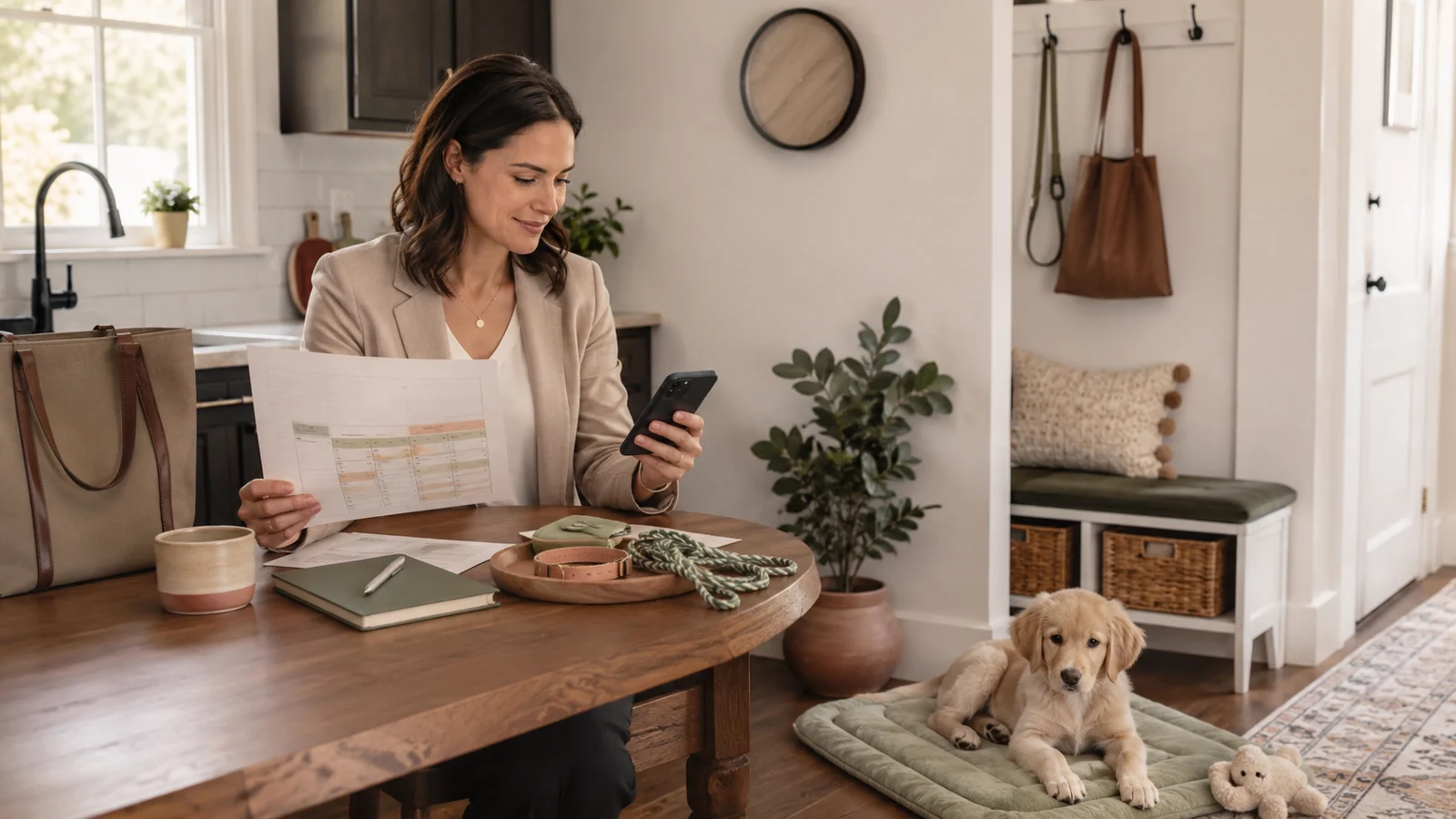
See how to map pickup, commute, potty breaks, caregiver visits, and return time before bringing a puppy home on an office week.
- Puppy Caregiver Handoff Card
Create a clear first-day handoff for puppy contacts, visit windows, potty notes, food instructions, check-ins, and backup coverage.
- Make the Puppy Care Handoff Clear
Use a calm in-home handoff to confirm who arrives when, what the puppy needs, and who handles the next visit.
- Start Puppy Alone Time Gradually
The first day is for calm, brief separation practice—not for testing whether a new puppy can manage an office shift alone.
- Check Every Puppy Care Gap
Break the day into departure-to-visit, visit-to-next-care, and final-care-to-home segments before confirming coverage.
Optional: choose all 5 images at once
Frequently asked questions
Can I pick up my puppy before a normal office shift?
That plan is risky unless a trusted adult will remain with the puppy and cover the full door-to-door absence. An evening pickup, scheduled leave day, or changed pickup date is usually easier to manage.
Is one lunchtime puppy visit enough?
Not necessarily. Calculate the morning gap, the afternoon gap, and both commute periods separately. A single visit can still leave one or both sides longer than the puppy’s potty or calm-separation limit.
How long can an eight-week-old puppy be alone on day one?
Do not set a target based only on age. VCA advises potty opportunities about every two hours for puppies six to eight weeks old, while emotional tolerance may be much shorter on the first day.
Should the caregiver put the puppy in a crate?
Only use a crate as planned confinement when the puppy has already begun choosing to rest there comfortably. The first long owner absence should not also be the puppy’s first locked-crate experience.
What should I leave for the first-day caregiver?
Provide exact visit windows, access instructions, owner and backup contacts, the potty route, current food directions, approved items, the next coverage time, and a simple check-in record.
What if my puppy cries when I step away?
Shorten the separation and check for potty need, confinement discomfort, or escalating distress. First-day practice should end before sustained panic rather than testing whether the puppy will eventually stop.
Sources & further reading
- What to do before you bring home a new puppyAmerican](https://www.aaha.org/resources/what-to-do-before-you-bring-home-a-new-puppy/%22,%22publisher%22:%22American) Animal Hospital Association · Accessed 2026-07-31
- What to do when you first bring home a new puppyAmerican](https://www.aaha.org/resources/what-to-do-when-you-first-bring-home-a-new-puppy/%22,%22publisher%22:%22American) Animal Hospital Association · Accessed 2026-07-31
- New dog checklist: Your step-by-step guide to a successful startAmerican](https://www.aaha.org/resources/new-dog-checklist-your-step-by-step-guide-to-a-successful-start/%22,%22publisher%22:%22American) Animal Hospital Association · Accessed 2026-07-31
- Housetraining for Puppies and Dogs | VCA Animal HospitalsVCA](https://vcahospitals.com/know-your-pet/house-training-your-puppy%22,%22publisher%22:%22VCA) Animal Hospitals · Accessed 2026-07-31
- How To Potty Train Your PuppyVCA](https://vcahospitals.com/pediatric/puppy/behavior-training/how-to-potty-train-your-puppy%22,%22publisher%22:%22VCA) Animal Hospitals · Accessed 2026-07-31