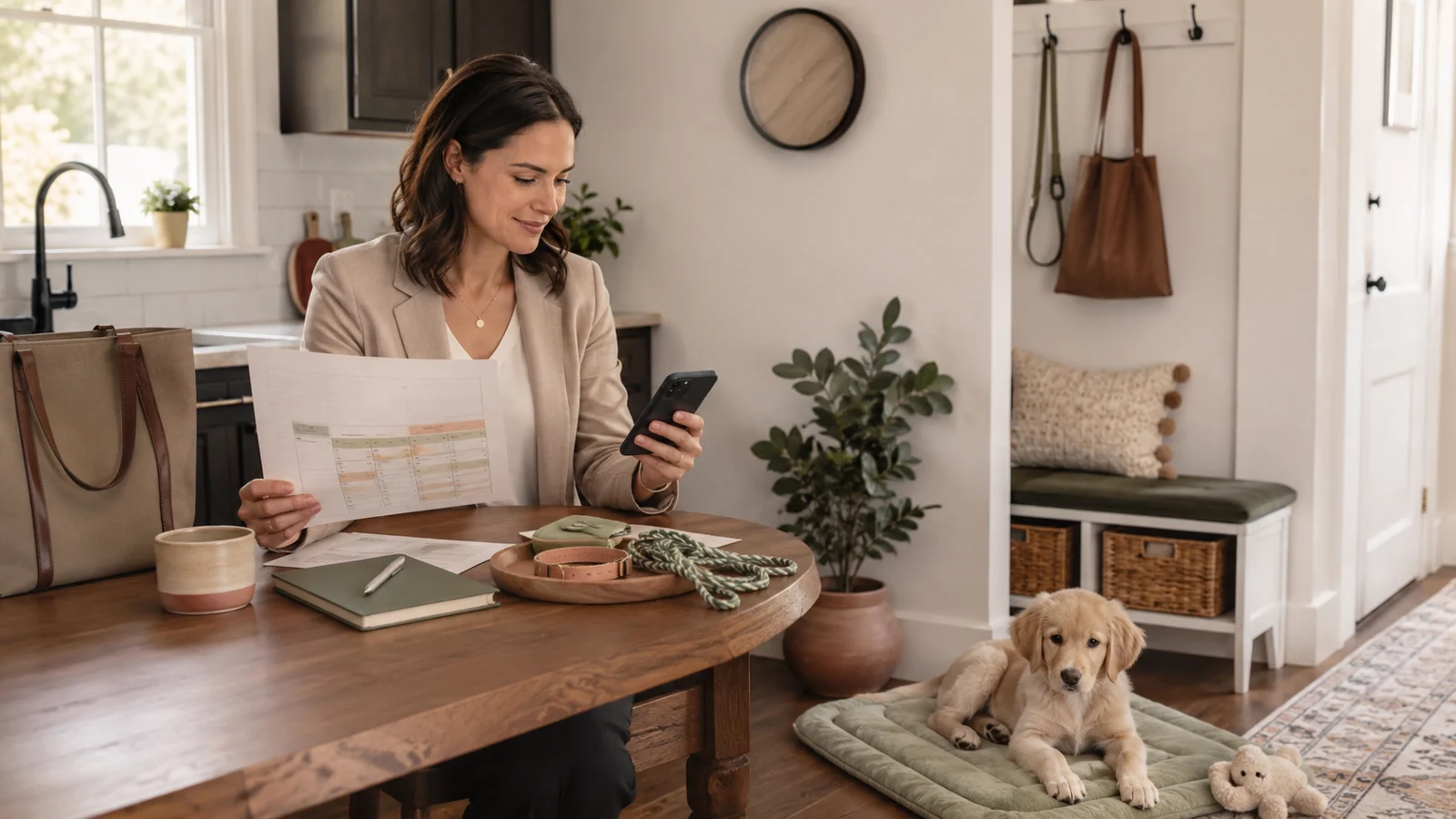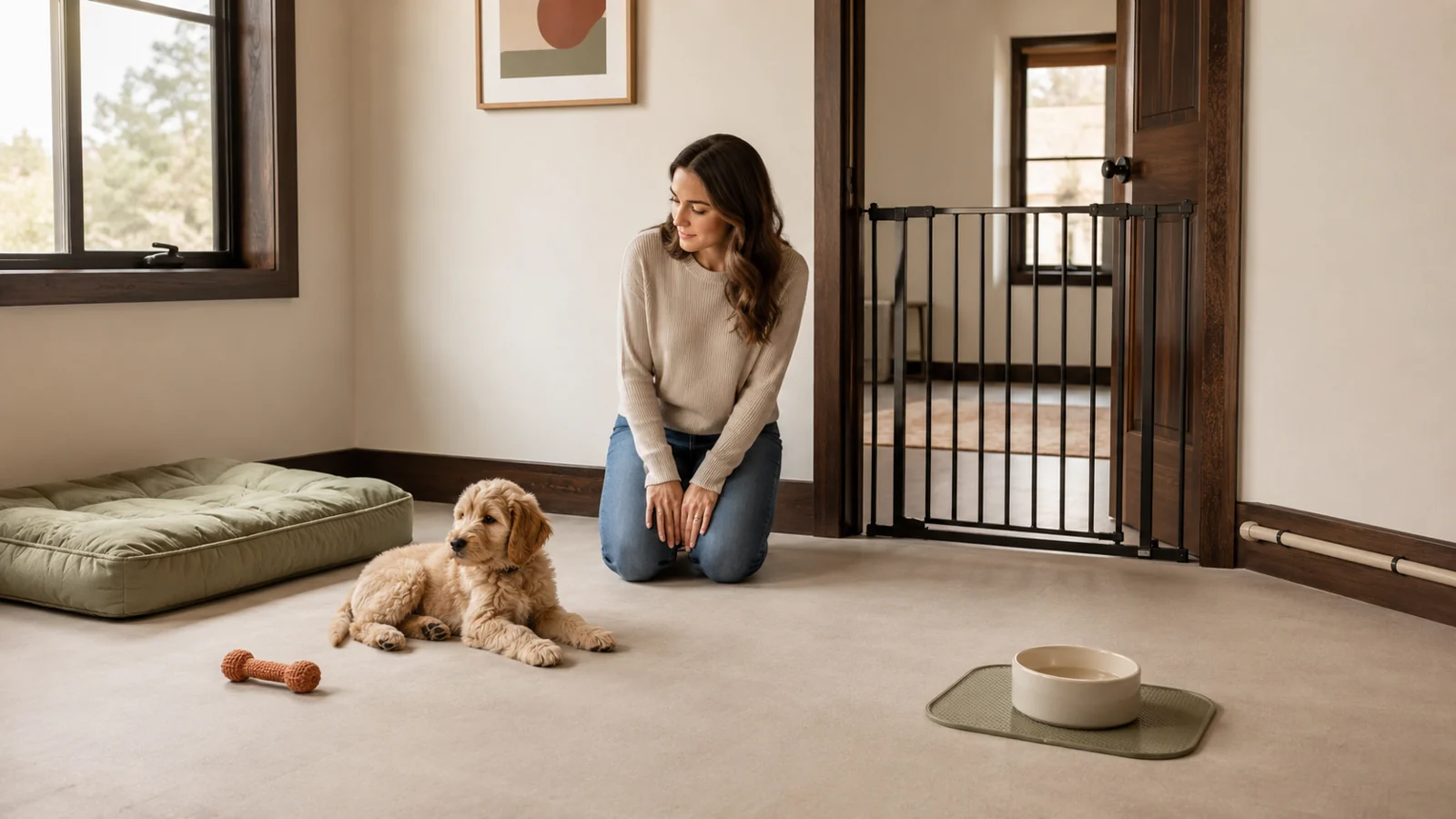
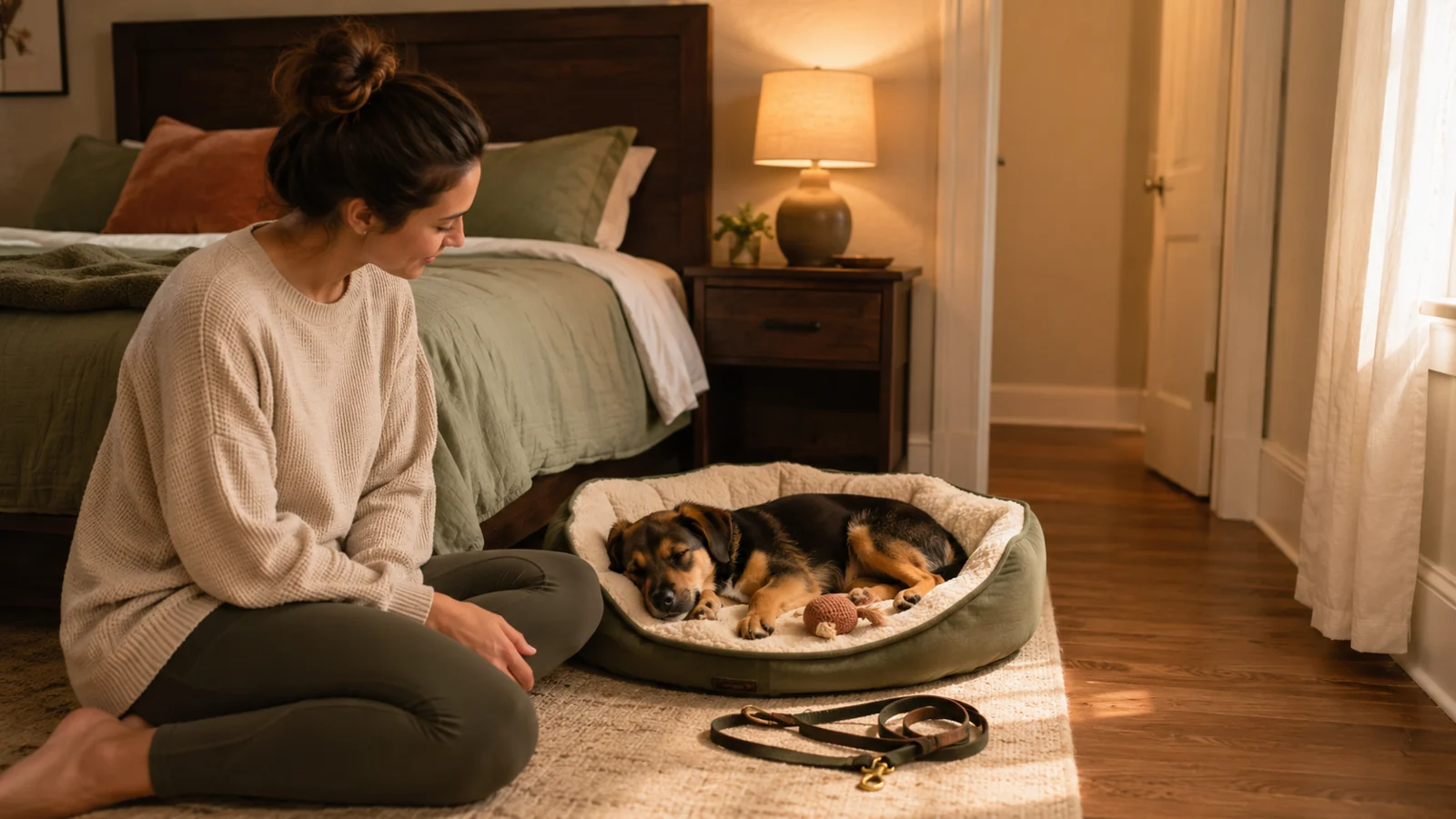
A successful first night is not a perfectly quiet night. It is a night in which you already know where your puppy will sleep, what you will do when they wake, and what information you will record in the morning. For a first-time dog mom, the simplest reliable plan is: one calm sleep station near you, one low-stimulation response routine, and one written observation log.
This guide stays focused on the first-night system. It does not replace a full puppy-safe-room setup or a complete potty schedule.
1. Collect the facts you do not know yet
Limited experience is manageable when you replace guessing with five direct questions. Before pickup—or as soon as possible—ask the breeder, rescue, foster, or previous caregiver:
- Where has the puppy been sleeping: crate, pen, kennel run, room, or with littermates?
- Has the puppy ever slept alone, and what happened?
- What time was the puppy’s last meal and usual bedtime?
- What signals have preceded an overnight bathroom need?
- Is there a familiar washable blanket or towel that can come home?
Write the answers down. Do not rely on remembering them after an emotional, tiring pickup day.
Then complete this one-sentence plan:
Tonight, my puppy will sleep in __________, positioned __________, and when they wake I will first __________.
A dedicated sleep area helps create predictability. The Merck Veterinary Manual notes that puppies can benefit from a designated place to rest or sleep, commonly a crate. The ASPCA’s general dog-care guidance also recommends a warm, quiet resting place away from drafts.
2. Build one first-night sleep station
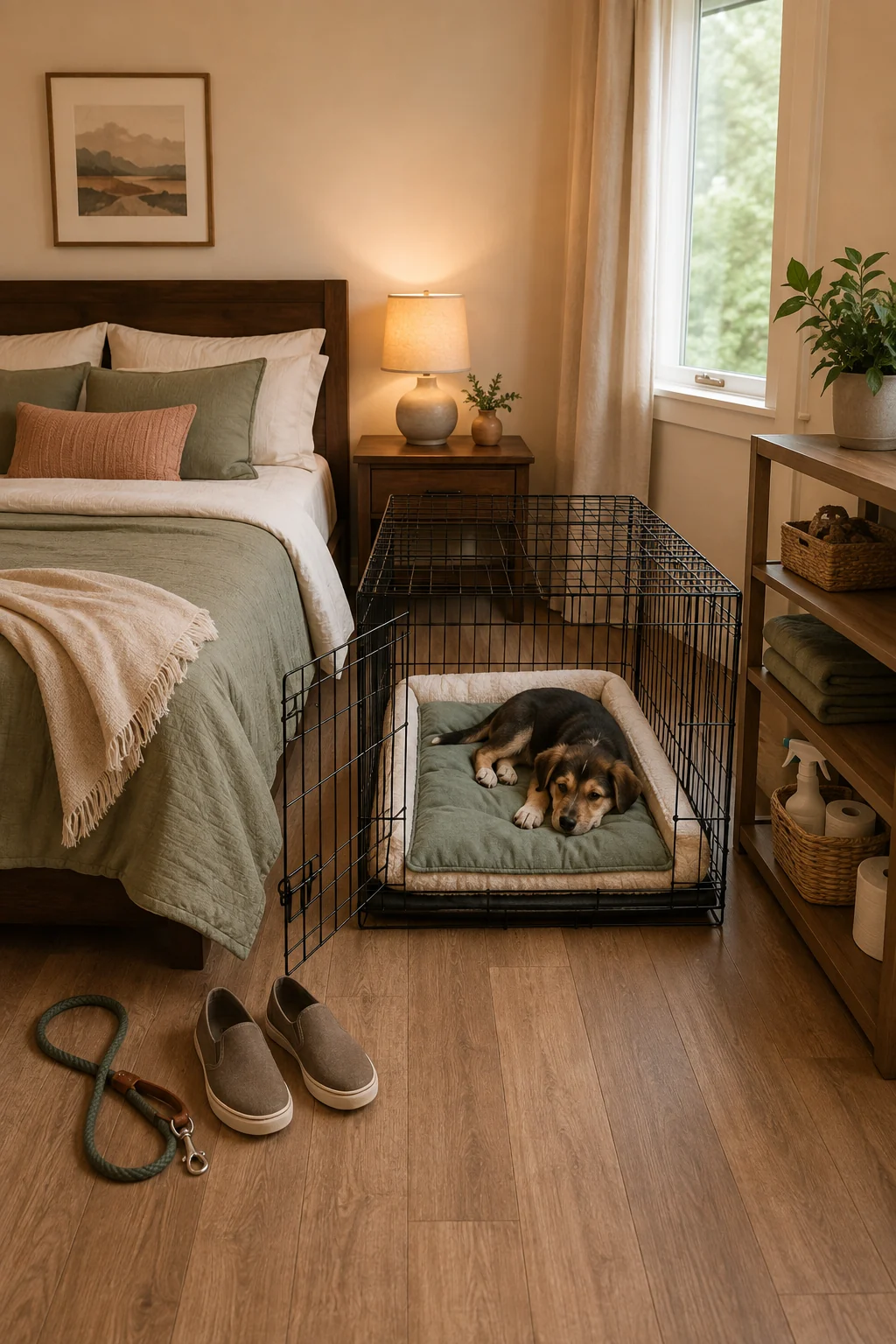
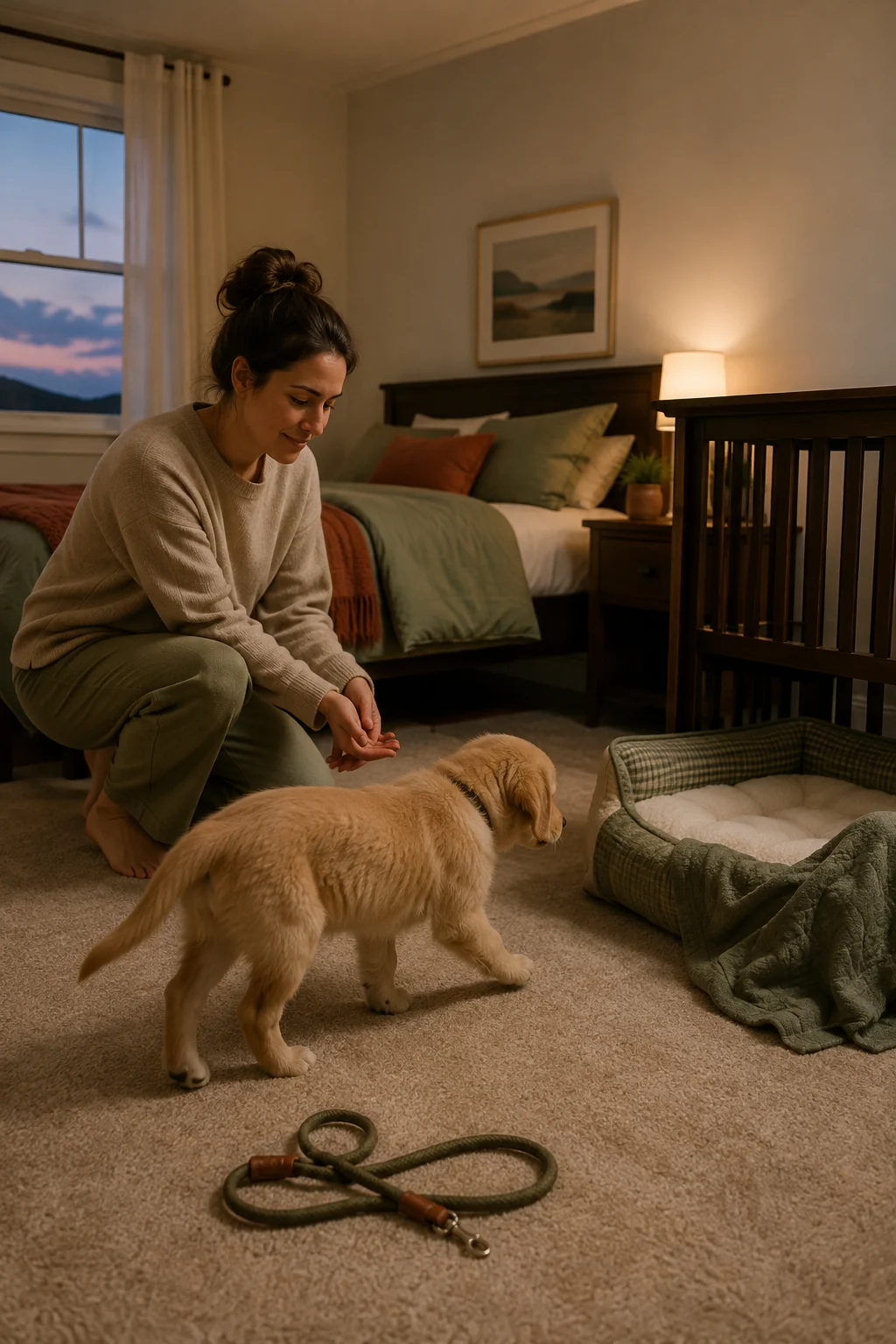
Choose one location before the evening becomes hectic. For many first-time owners, placing the puppy’s crate or secure confinement area in the bedroom—or immediately outside the bedroom—makes observation easier without turning every wake-up into play.
The station should include:
- the crate, pen, or other secure sleep area you have chosen;
- simple, washable bedding appropriate for the puppy;
- a leash and shoes placed where you can reach them quietly;
- cleanup supplies kept nearby but outside the puppy’s reach;
- a dim light you can use without switching on bright overhead lighting;
- your written response steps.
Keep the household calm. VCA recommends a comfortable puppy area, a quiet home, and regular opportunities to use the designated elimination spot when preparing for a new arrival in its new-puppy preparation guidance.
Do not create three competing sleep options “just in case.” Moving the puppy from crate to couch to bed to another room during one difficult night makes it harder for you to tell whether the puppy is objecting to confinement, needs to eliminate, is overstimulated, or simply needs time to settle.
First-night station check
Before bedtime, confirm:
- The puppy can stand, turn, lie down, and settle in the chosen space.
- Nothing can wrap around the puppy, snag a collar, or be shredded and swallowed.
- The station is not in a draft, direct heat, or a noisy traffic path.
- Doors and gates are secure.
- Your route outside is clear.
- Everyone in the home knows who responds overnight.
3. Use a calm pre-bed sequence
Your goal is not to exhaust the puppy. Your goal is to lower stimulation and make the next event predictable.
Use this sequence:
- Quiet connection: Spend a few calm minutes near the puppy without excited greetings or rough play.
- Final planned bathroom opportunity: Take the puppy to the location you have already chosen, using the guidance supplied by the puppy’s previous caregiver.
- Brief settling period: Return indoors with low lights and minimal conversation.
- Into the sleep station: Guide the puppy into the planned area with a calm cue and an appropriate positive association.
- Record the start time: Note when the puppy entered the sleep area and when they first became quiet.
VCA’s puppy crate-training article explains that very young puppies may need several overnight checks and gives age-based examples. Treat those examples as context, not a universal timetable. Your puppy’s age, prior routine, health, travel day, and caregiver instructions matter. When you are unsure, ask your veterinarian rather than inventing a schedule from a formula.
Avoid introducing a brand-new, highly exciting chew, noisy toy, or elaborate bedtime ritual that you cannot repeat. The first-night system should be simple enough to use while tired.
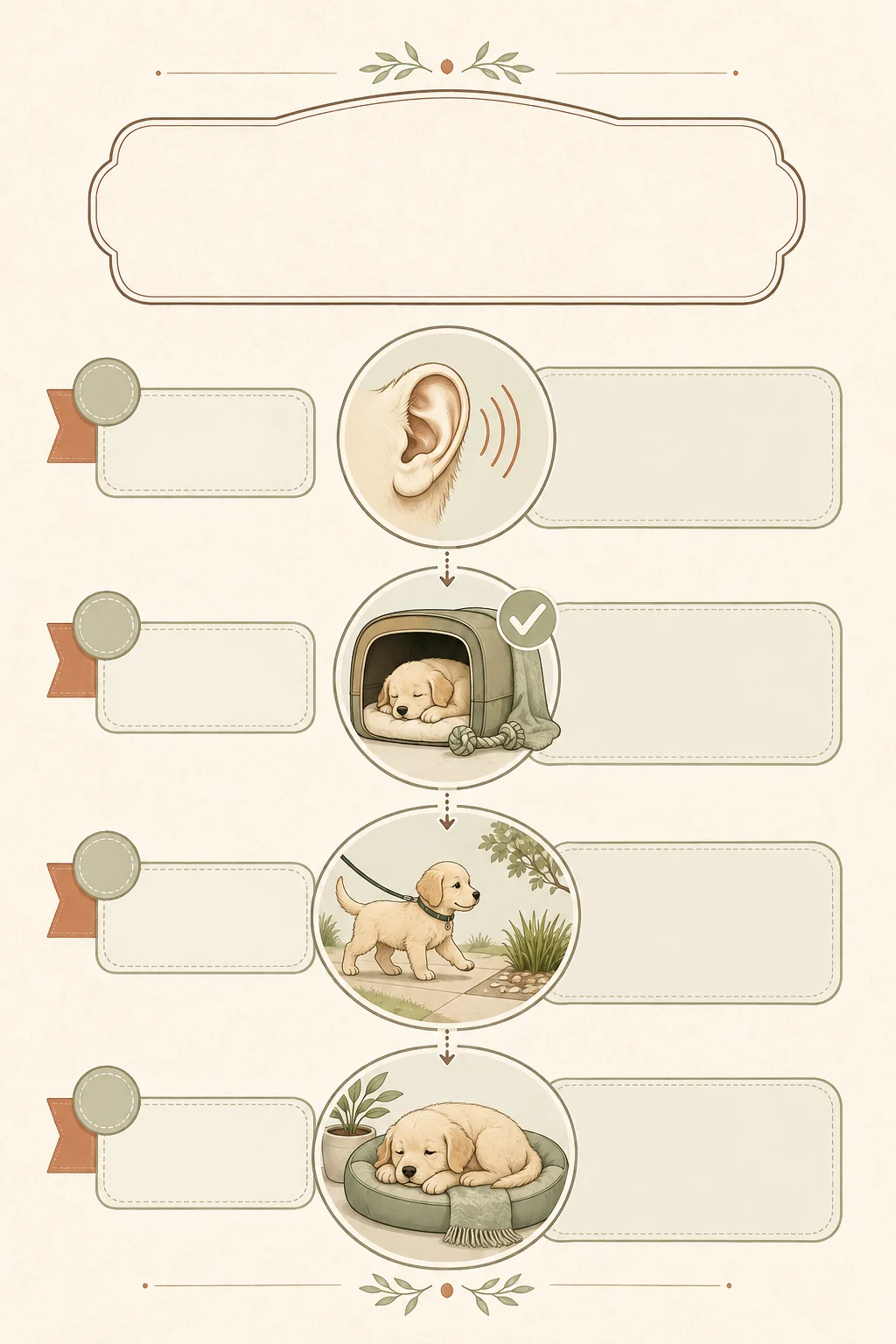
4. Follow the four-step wake-up response
Expecting some vocalizing does not mean ignoring every sound. It means using the same decision order each time.
Step 1: Pause and listen
Give yourself a brief moment to identify the pattern. A few soft whimpers followed by repositioning are different from escalating, frantic behavior. Listen for movement, scratching, repeated crying, or a sudden change from the puppy’s previous state.
Step 2: Check the most likely immediate need
Ask:
- Was the puppy given a recent bathroom opportunity?
- Is the bedding wet or soiled?
- Is the puppy caught, too warm, too cold, or otherwise unsafe?
- Is the behavior mild protest, or is it escalating distress?
Do not label the puppy “stubborn” or “manipulative.” You do not have enough history on the first night to make that conclusion.
Step 3: If a bathroom trip is reasonable, make it boring
Use the leash, go directly to the chosen area, keep lights and conversation low, and avoid play. After the opportunity, return the puppy to the same sleep station. This is an overnight response, not a full potty-training lesson.
Step 4: Help the puppy resettle without changing the whole plan
Stay nearby, speak softly if that helps, and reduce stimulation. Avoid opening the sleep area repeatedly for attention alone. However, do not force a crate when the puppy is showing severe confinement distress.
The ASPCA’s separation-anxiety guidance notes that crates help some dogs but add stress for others; heavy panting, excessive salivation, frantic escape attempts, or persistent intense vocalizing are reasons to reconsider confinement and seek professional guidance. A secure pen or puppy-proofed small area may be a better temporary option for a puppy who cannot safely tolerate a crate.
5. Decide in advance what counts as “call for help”
First-time owners often swing between two extremes: worrying about every sound or dismissing everything as normal adjustment. A written threshold reduces both errors.
Contact a veterinarian or emergency clinic when you believe the puppy may be medically unwell, injured, exposed to something harmful, or in severe distress—not merely disappointed about bedtime. Do not use an online article to diagnose the cause.
Contact the breeder, rescue, or foster the next morning when the puppy’s behavior conflicts sharply with the history you were given. Useful questions include: “Did this happen in foster care?” and “What settling method was already familiar?”
Ask a qualified reward-based trainer or veterinary behavior professional for help when intense confinement distress repeats, the puppy is trying to injure themselves escaping, or your attempts are making the response worse.
Your first night is an observation period, not a test of willpower.
6. Use the seven-day first-night observation tracker
The first night gives you one data point. The next six nights show whether your system is improving, staying the same, or becoming harder. Use this tracker every morning for one week.
Rating key
- Settling time: minutes from entering the sleep station to sustained quiet.
- Wake-up: any event that required you to listen, get up, or intervene.
- Intensity: 0 = quiet, 1 = mild fussing, 2 = repeated crying, 3 = escalating or unsafe distress.
- Response: bathroom opportunity, quiet presence, safety check, cleanup, or alternate safe confinement.
- Next-night change: only one adjustment, so you can tell whether it helped.
| Night | Bedtime and last bathroom opportunity | Settling time | Wake-ups and approximate times | Highest intensity 0–3 | What response worked | Accident or cleanup | Morning condition | One change for next night |
|---|---|---|---|---|---|---|---|---|
| 1 | Record after the night | Record | Record | Record | Record | Record | Calm, tired, playful, unsettled, or other | Choose one |
| 2 | Record after the night | Record | Record | Record | Record | Record | Record | Choose one |
| 3 | Record after the night | Record | Record | Record | Record | Record | Record | Choose one |
| 4 | Record after the night | Record | Record | Record | Record | Record | Record | Choose one |
| 5 | Record after the night | Record | Record | Record | Record | Record | Record | Choose one |
| 6 | Record after the night | Record | Record | Record | Record | Record | Record | Choose one |
| 7 | Record after the night | Record | Record | Record | Record | Record | Record | Choose one |
How to read the tracker
Look for direction, not perfection.
- Settling time decreases: Keep the same basic setup.
- Wake-ups become more predictable: Prepare for the pattern rather than adding new rules.
- Intensity rises for two or more nights: Review crate tolerance, location, noise, temperature, and prior-caregiver information.
- Accidents repeat: Ask your veterinarian or previous caregiver whether your overnight expectations fit this puppy’s age and history.
- Your response changes every night: Simplify. Choose one safe response sequence and repeat it.
The tracker is also useful when asking for help because it replaces “the puppy cried all night” with specific times, intensity, responses, and outcomes.
7. Avoid the first-time-owner mistakes that create confusion
Changing the sleep location during every wake-up
This may stop crying temporarily but leaves you with no consistent pattern to evaluate. Change the plan for safety or serious distress, not simply because the first attempt was inconvenient.
Turning overnight trips into play sessions
Bright lights, excited praise, wandering through the house, and long cuddling sessions can make waking more stimulating. Keep necessary care calm and brief.
Punishing vocalizing or accidents
The first night combines separation from familiar people or littermates, a new environment, and an unfamiliar routine. Punishment does not teach the puppy what to do next and can damage the sleep area’s positive association.
Expecting the crate to solve every problem
A crate is a management tool, not a substitute for observation. Some puppies are not yet comfortable in one, and some show distress that calls for a different secure setup.
Making several changes at once
If you move the crate, add sound, change bedding, alter the response, and delay bedtime all at once, you will not know what helped. The tracker deliberately asks for one next-night adjustment.
8. Complete the morning debrief
Within an hour of waking, write three sentences:
- What happened: “The puppy settled in 18 minutes and woke twice.”
- What worked: “A quiet bathroom opportunity followed by immediate return helped.”
- What changes tonight: “I will move the leash beside the door and keep everything else the same.”
Then check the puppy’s overall condition and compare it with the history you received. Share objective concerns with the veterinarian, breeder, rescue, or foster rather than trying to interpret every behavior alone.
Your first-night plan is complete when you have a fixed sleep station, a repeatable wake-up response, a clear help threshold, and the first row of the seven-day tracker ready to fill in. The win is not sleeping through the night immediately. The win is replacing panic and improvisation with calm observation.
Helpful visuals from this guide
Use these five visuals as quick reminders, then return to the full guide for context, limitations, and source details.


Pinterest does not let websites prefill its Title field. Each button below copies the correct title and opens that Pin. Click the Title field in Pinterest, press Ctrl + V, then save it to the board above.
Start with Pin 1 and repeat through Pin 5.
- Set Up a Puppy First-Night Sleep Station
See how a first-time dog mom can arrange one calm puppy sleep station with practical nighttime essentials and less visual clutter.
- A Calm Puppy Bedtime Sequence
Use a quiet connection, final bathroom opportunity, low lights, and a consistent return to the same sleep station.
- Puppy Night Wake-Up Response Flow
A simple visual framework helps first-time owners respond consistently instead of improvising during every puppy wake-up.
- Seven-Day Puppy Night Tracker
Track settling time, wake-ups, response intensity, accidents, and one next-night adjustment to spot patterns across the first week.
- Do a Puppy First-Night Morning Debrief
A three-sentence morning review helps a first-time dog mom improve the next night without changing everything at once.
Optional: choose all 5 images at once
Frequently asked questions
Should my puppy’s sleep station be in my bedroom?
For many first-time owners, a bedroom or immediately adjacent location makes observation and calm overnight responses easier. The best location is secure, quiet, draft-free, and consistent with the sleep setup you plan to continue.
What should I do when my puppy cries on the first night?
Pause briefly, listen for escalation, check safety and likely bathroom needs, and use a calm, low-stimulation response. Return the puppy to the same sleep area unless the confinement itself is causing severe distress.
How often should I check a puppy overnight?
There is no single interval that fits every puppy. Age, prior routine, health, travel, and caregiver guidance matter. Ask the previous caregiver and veterinarian, and use age-based examples from veterinary sources as context rather than a rigid formula.
Can my puppy sleep in my bed on the first night?
Choose the arrangement you can manage safely and consistently. A secure sleep station is often easier for a first-time owner to observe and repeat, especially when the puppy’s nighttime habits, bathroom signals, and movement are still unfamiliar.
What if my puppy refuses to enter the crate?
Do not force the puppy into escalating distress. Keep the introduction positive and consider a secure pen or small puppy-proofed area while you seek guidance from the previous caregiver, veterinarian, or qualified reward-based trainer.
When is first-night crying more than normal adjustment?
Mild, brief fussing can occur during adjustment, but frantic escape attempts, heavy panting, excessive salivation, injury risk, or persistent intense distress justify changing the setup and contacting a veterinarian or behavior professional.
Sources & further reading
- How to crate train your puppyVCA](https://vcahospitals.com/pediatric/puppy/behavior-training/how-to-crate-train-your-puppy%22,%22publisher%22:%22VCA) Animal Hospitals · Accessed 2026-07-31
- How to prepare for a new puppyVCA](https://vcahospitals.com/pediatric/puppy/prep-supplies/preparing-for-a-new-puppy%22,%22publisher%22:%22VCA) Animal Hospitals · Accessed 2026-07-31
- General Dog CareASPCA · Accessed 2026-07-31
- Separation](https://www.aspca.org/pet-care/dog-care/general-dog-care%22,%22publisher%22:%22ASPCA%22,%22accessedDate%22:%222026-07-31%22},{%22title%22:%22Separation) AnxietyASPCA · Accessed 2026-07-31
- Providing](https://www.aspca.org/pet-care/dog-care/common-dog-behavior-issues/separation-anxiety%22,%22publisher%22:%22ASPCA%22,%22accessedDate%22:%222026-07-31%22},{%22title%22:%22Providing) a Home for a DogMerck](https://www.merckvetmanual.com/dog-owners/selecting-and-providing-a-home-for-a-dog/providing-a-home-for-a-dog%22,%22publisher%22:%22Merck) Veterinary Manual · Accessed 2026-07-31