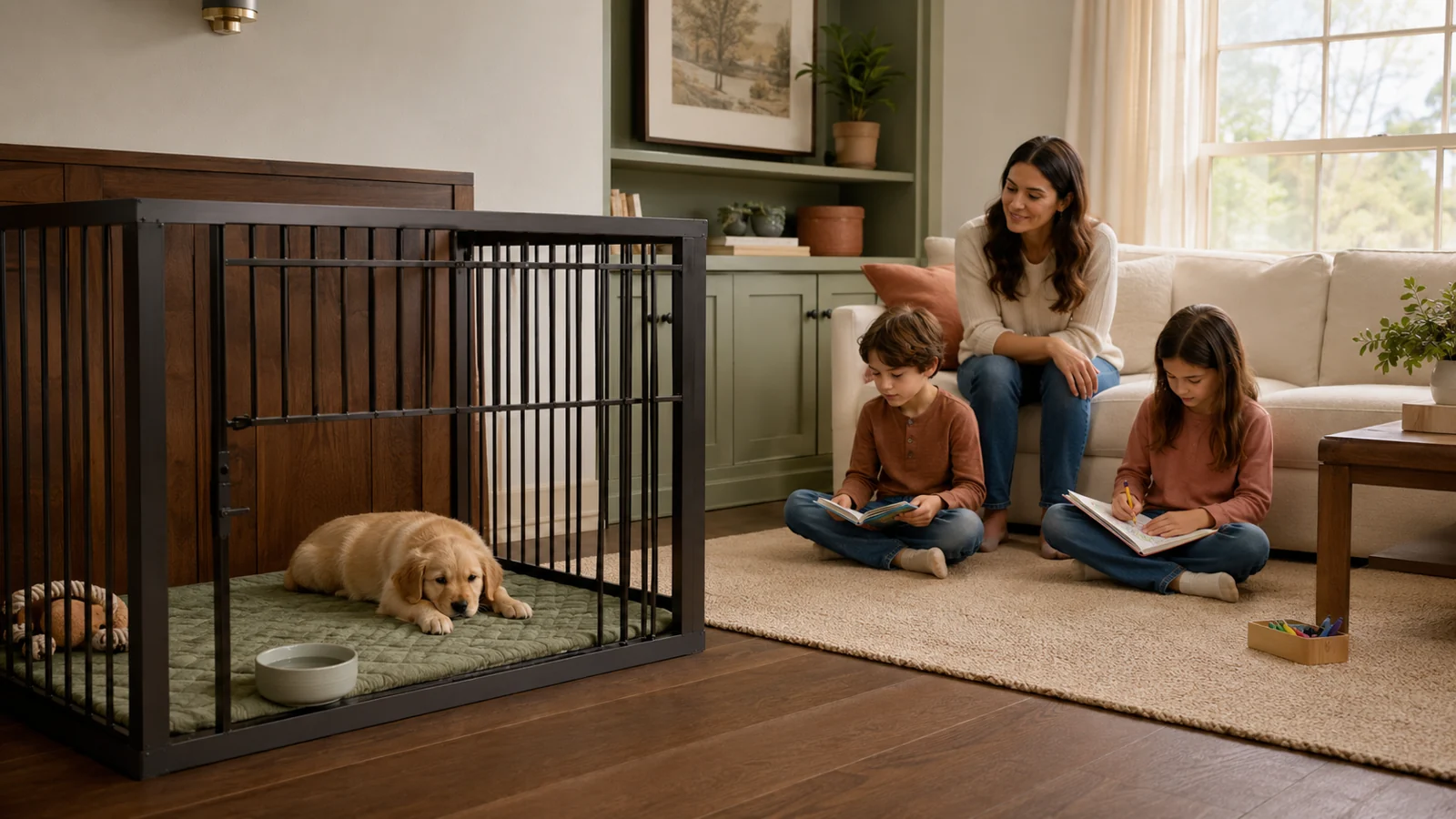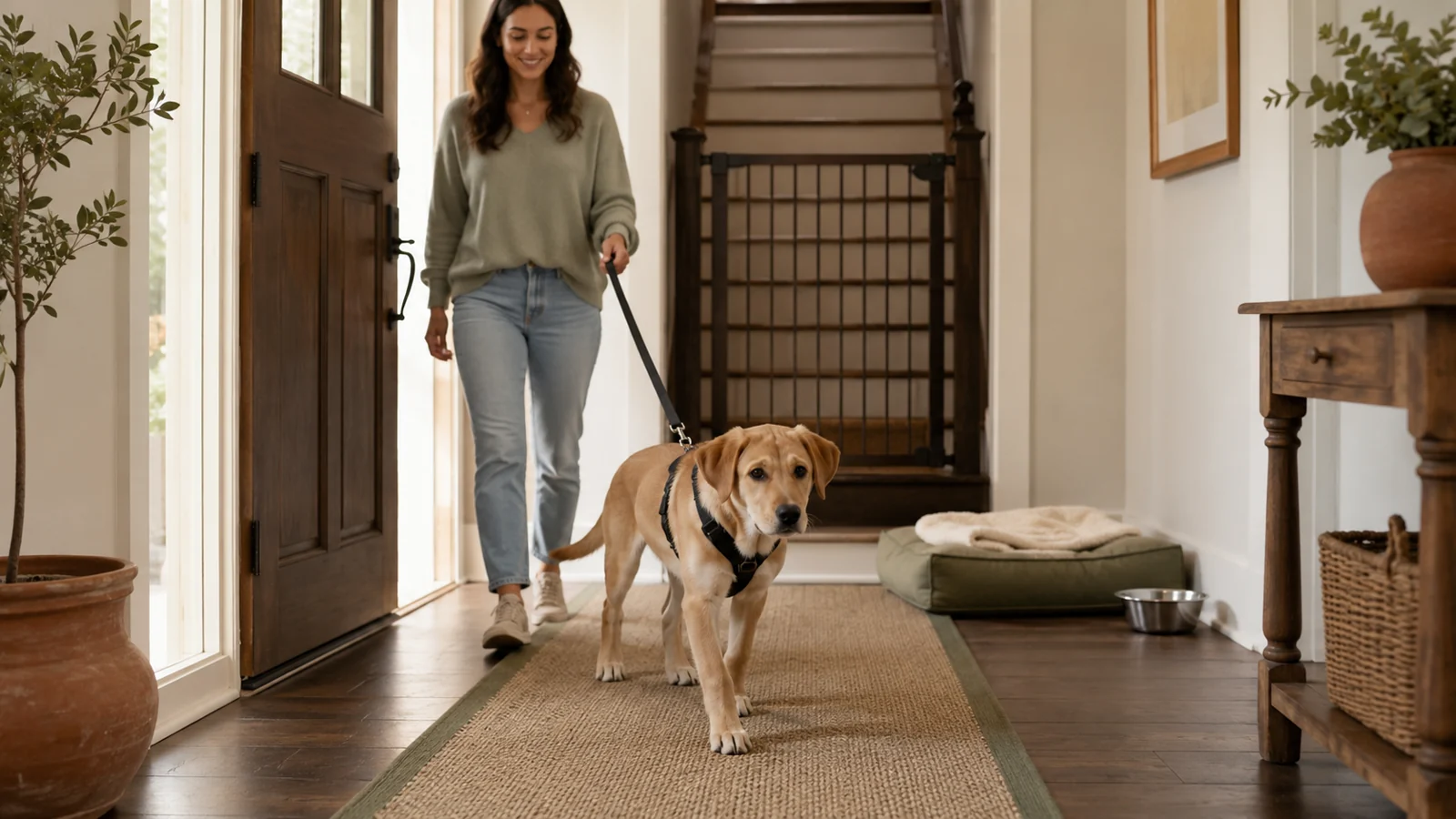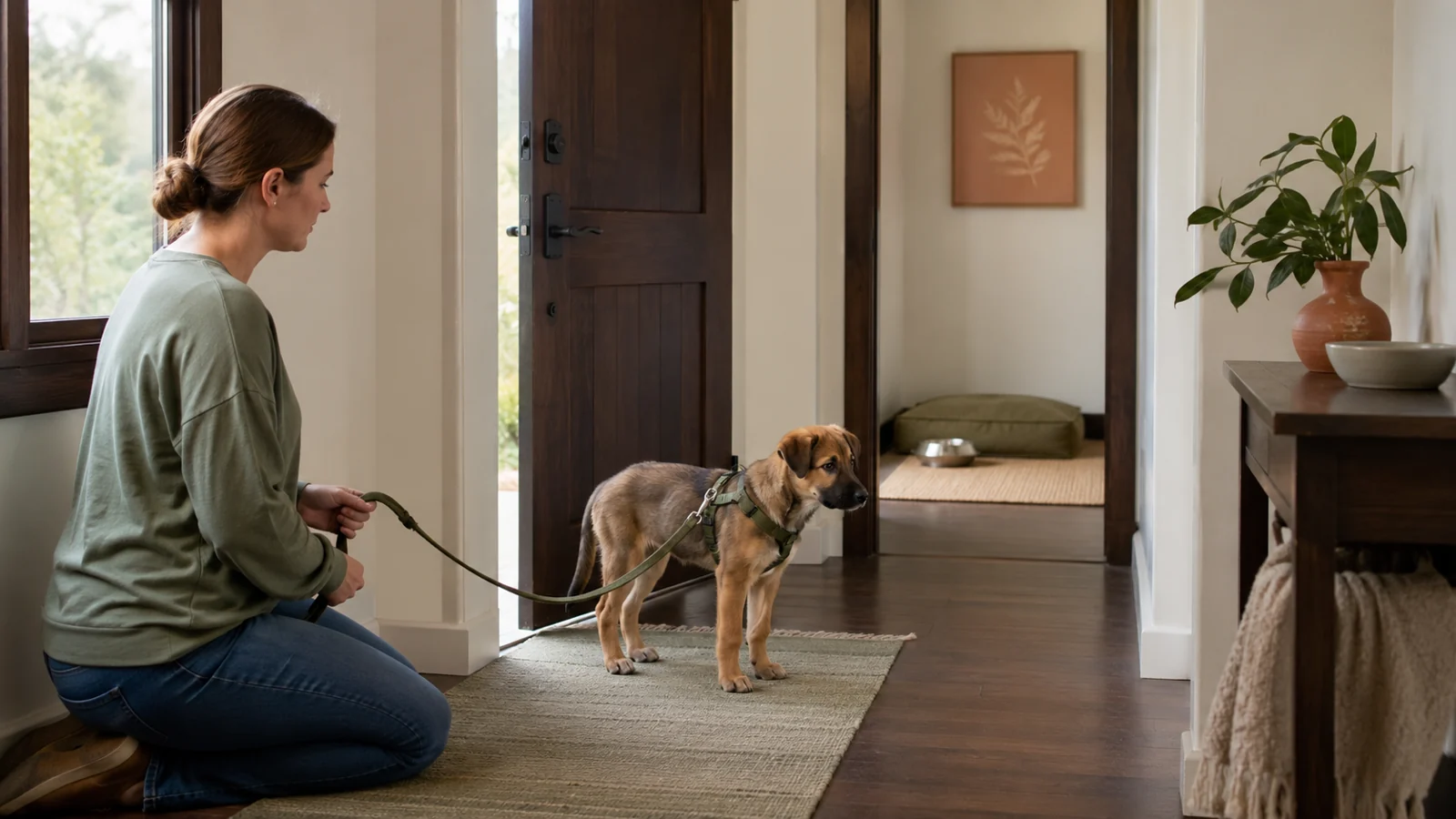
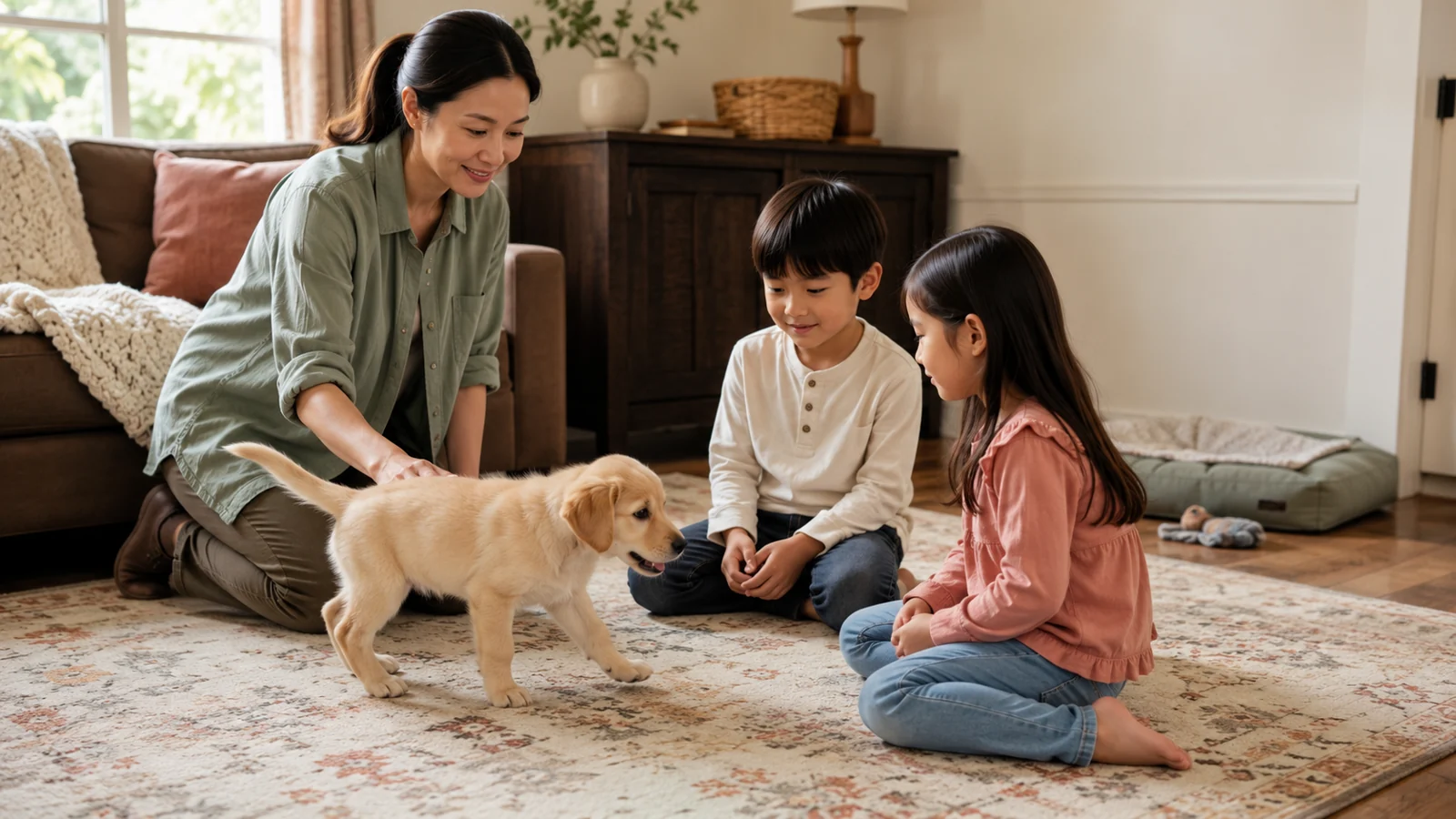
Bringing a puppy home to young children works best when the first day is planned as a series of short, calm, adult-led moments—not one long play session. Choose one adult to supervise every shared interaction, give the puppy frequent breaks away from the children, and teach the children a few concrete actions they can remember: use quiet voices, keep hands low, let the puppy approach, and stop when the puppy moves away.
The goal is not instant friendship. The goal is a first day in which the puppy can explore without being crowded and the children can participate without being responsible for safety. The AVMA advises careful management of introductions and supervision of young children around dogs, while the CDC says young children should not play with dogs without supervision, including familiar family dogs.
Choose the first-day standard: calm contact, not constant contact
Young children often show excitement by running, squealing, hugging, following, or repeatedly touching. A newly arrived puppy may also be excited, tired, uncertain, mouthy, or overwhelmed. Those two energy patterns can amplify each other.
Use this first-day standard:
- The adult manages distance. The adult decides when the puppy and children are together and when they separate.
- The child follows one instruction at a time. “Sit on the rug” works better than a long lecture about being gentle.
- The puppy can leave. Moving away ends the interaction; nobody follows.
- Every shared moment has a planned finish. Stop while everyone is still calm rather than waiting for a problem.
- Separation is normal, not punishment. Breaks protect the puppy’s rest and help children reset.
“Supervised” should mean an attentive adult is close enough to intervene immediately—not cooking in another room, looking at a phone, or assuming an older sibling is watching. The ASPCA recommends never leaving a baby or young child alone with a dog and giving the dog space and opportunities to rest.
Assign jobs before the puppy enters
Do not make a young child the puppy’s handler on day one. Give each person a simple role so transitions are predictable.
| First-day moment | Adult job | Child-safe instruction | End the moment when |
|---|---|---|---|
| Puppy enters the home | Hold the leash loosely or guide the carrier; keep the route clear | “Stand still and use your quiet voice” | The puppy starts scanning, pulling away, jumping repeatedly, or mouthing |
| First greeting | Sit near the child and control access | “Let the puppy come to you” | The puppy turns away, freezes, hides, or becomes more excited |
| Brief touch | Guide one child at a time | “One slow stroke on the shoulder, then hands back” | The puppy moves away or the child cannot stay calm |
| Floor time | Stay within arm’s reach and keep toys simple | “Roll or place the toy; do not grab from the mouth” | Play becomes fast, rough, chase-like, or noisy |
| Puppy rest | Move the child to a different activity | “Rest time means we look, not touch” | The puppy wakes and an adult chooses the next step |
| Food or chew time | Keep children physically separated | “We leave puppies alone when they eat or chew” | The item is finished and the adult has cleared the area |
Before arrival, rehearse the child instructions without the puppy. Keep the wording identical so the child hears familiar cues during an exciting moment. A preschooler may remember three short rules better than ten detailed ones:
- Feet still.
- Hands low.
- Puppy walks away, we stop.
For toddlers, rely more on physical management than verbal compliance. A toddler who understands a rule may still be unable to follow it consistently when excited. Use an adult-held hand, distance, gates or closed doors, and separate activities rather than repeated correction.
Use a predictable arrival sequence
The exact clock time matters less than the order. A practical first-day sequence is:
1. Settle the children first
Before the puppy comes through the door, have the children seated with a quiet activity. Explain that the puppy may not want to say hello immediately. Remove running toys, loud electronic sounds, and food the children might drop or wave.
2. Let the puppy enter with one adult
Keep the doorway clear. Other family members should remain still and avoid leaning over the puppy. Allow a brief look around under adult control. Do not form a circle around the puppy or pass the puppy from person to person.
3. Offer one child one brief greeting
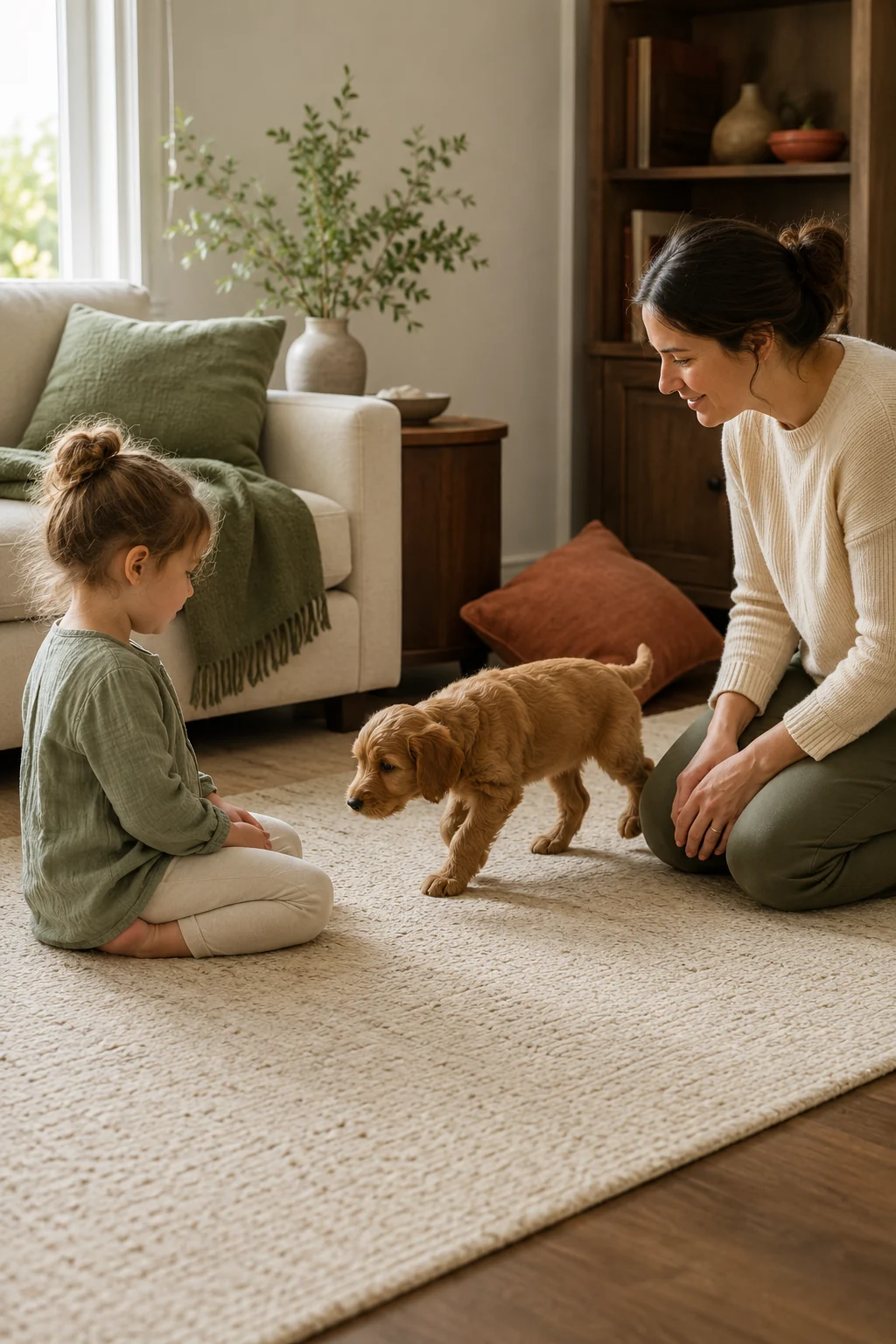
Begin with the calmest child. The child can sit sideways rather than facing the puppy head-on, keep hands in their lap, and allow the puppy to approach. If the puppy chooses contact, the adult may guide one short shoulder or chest stroke. Avoid hugs, face-to-face contact, kisses, tail touching, paw holding, or lifting.
4. End the greeting early
After a few calm seconds, call the child back to the planned activity and let the puppy disengage. The first greeting does not need to become play. A successful greeting may be nothing more than a sniff and a quiet retreat.
5. Alternate contact with breaks
Use short shared windows followed by puppy rest and child-only time. A break is appropriate after travel, exploration, toileting, a greeting, a burst of play, or any rise in noise. Do not wake a sleeping puppy so every child gets a turn.
6. Repeat only if both sides are ready
Repeat a greeting when the puppy is loose-bodied and choosing to approach, the child can follow instructions, and an adult is available to supervise. If any one of those conditions is missing, choose separation instead.
This sequence compares two choices at every transition: continue because both puppy and child are calm, or pause because either one needs help. That is safer and more useful than trying to complete a fixed number of greetings.
Teach child-safe actions for common moments
Young children need instructions that describe what to do, not only what not to do.
When the puppy approaches
Say: “Be a quiet statue. Let the puppy sniff.”
The child keeps feet still, hands low, and face away from the puppy’s face. The adult controls the duration. If the puppy jumps or mouths, the adult calmly creates distance; the child should not push, squeal, flap hands, or run.
When the puppy has a toy
Say: “Ask an adult. We trade; we do not grab.”
On the first day, the adult should manage toys and retrieve dropped objects. Children should not pull items from the puppy’s mouth, start tug games, or chase the puppy for an object.
When the puppy is eating, chewing, hiding, or sleeping
Say: “That is puppy private time.”
The CDC advises not disturbing dogs while they are eating or sleeping and not continuing contact when a dog is hiding or seeking time alone. Keep children physically away rather than expecting them to remember the rule while standing beside the puppy.
When the child wants affection
Say: “Invite, don’t hold.”
The child may sit and pat their leg once if the adult approves. The puppy decides whether to approach. Avoid hugging, pinning, climbing on, carrying, dressing up, or putting faces close together.
When excitement rises
Say: “Hands to your body; walk to the grown-up.”
Running away can trigger chasing. Teach children to stop movement and move calmly with the adult. The adult then separates the puppy and child without scolding either one.
Read the puppy’s answer before continuing
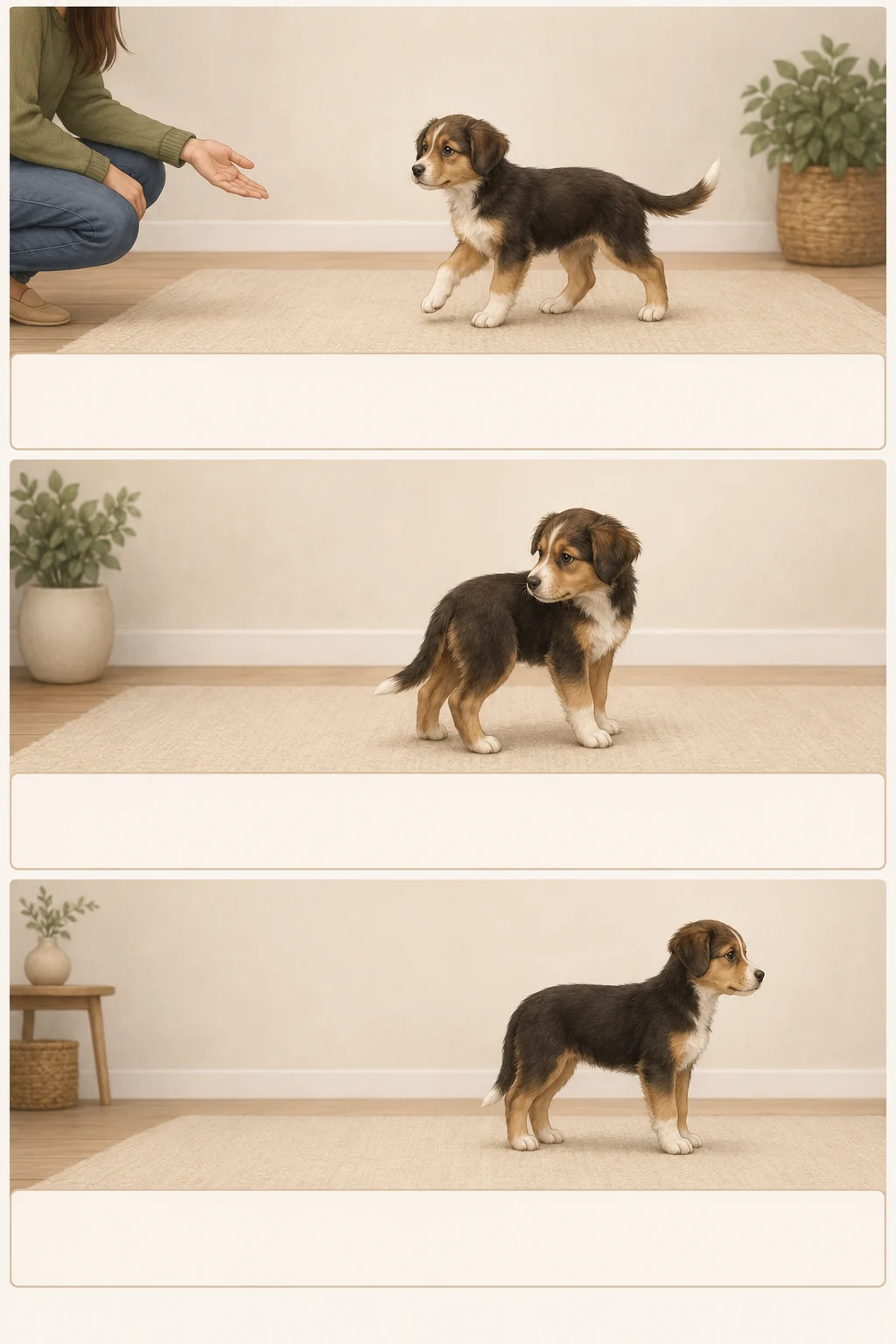
A wagging tail alone is not a reliable permission signal. Look at the puppy’s whole body and the context. The ASPCA notes that anxious dogs may crouch, lower the head, lick the lips, tuck the tail, flatten the ears, yawn, look away, freeze, or move away. VCA also describes pacing, repeated yawning, lip licking, pinned ears, rigid posture, avoidance, hiding, and escape attempts as possible stress indicators and advises removing the dog from the stressor rather than forcing interaction: Signs Your Dog is Stressed and How to Relieve It.
Use a three-level comparison:
| What you observe | First-day meaning | Adult response |
|---|---|---|
| Loose body, soft face, voluntary approach, easy disengagement | The puppy may be comfortable enough for a brief interaction | Continue for a few seconds, then offer a break |
| Turning away, repeated lip licking, yawning outside sleep, low posture, pinned ears, avoiding touch, hiding, refusing engagement | The puppy needs more distance or less stimulation | End contact, quiet the environment, and allow uninterrupted space |
| Freezing, stiffening, hard staring, growling, snarling, snapping, repeated lunging, or inability to settle | Interaction should stop immediately | Separate securely; do not punish the warning; contact a veterinarian or qualified behavior professional for individualized guidance before further child contact |
A growl is information that the situation has exceeded the puppy’s comfort. Do not tell a child to “show the puppy who is boss,” and do not punish the puppy for communicating discomfort. Increase distance and prevent a repeat of the same setup.
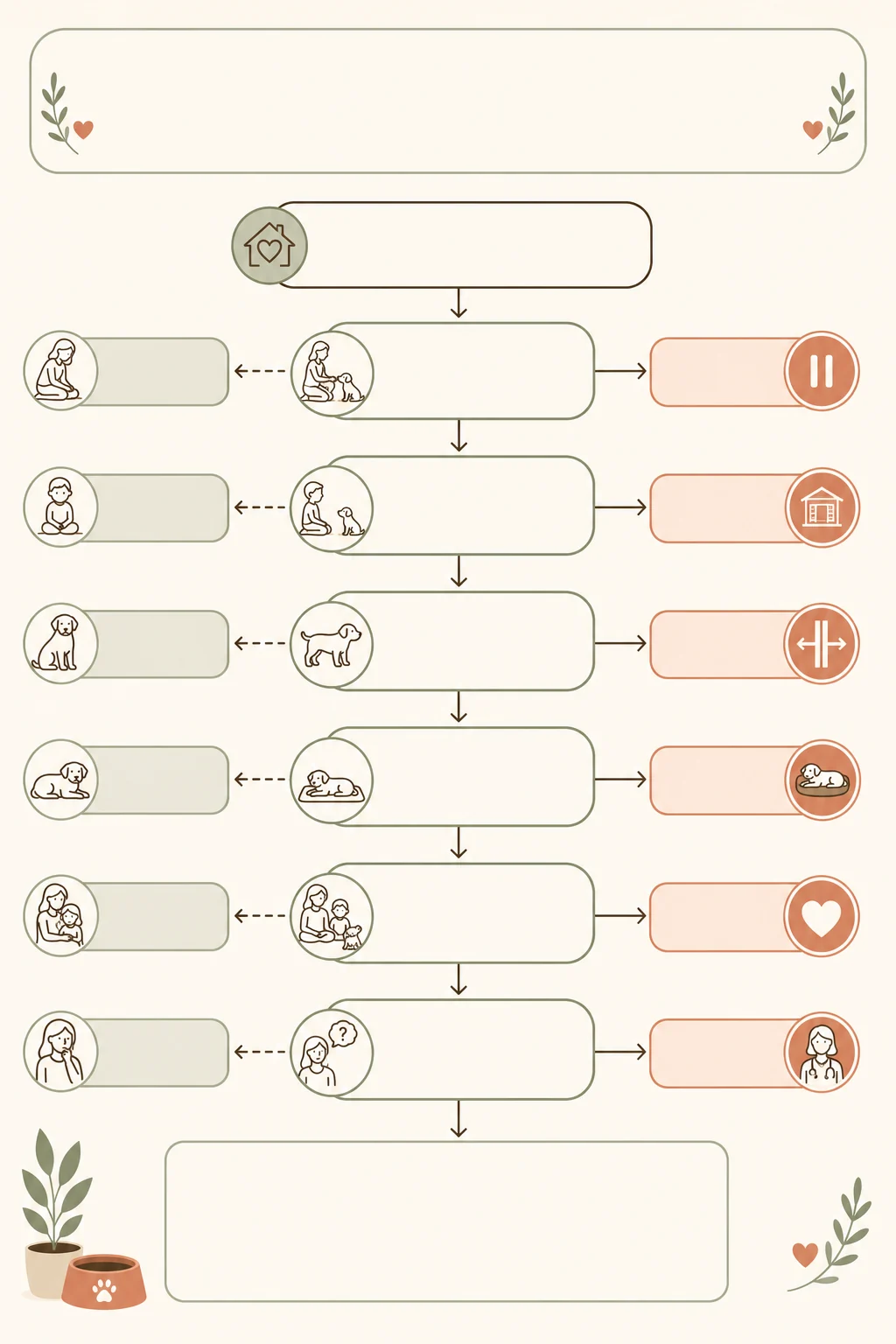
Puppy’s first-day troubleshooting decision tree
Use this decision tree each time a child asks to interact. It is designed for the first day only.
START: A child wants to approach the puppy.
- Is an attentive adult available to stay within immediate reach for the entire interaction?
- No → Keep puppy and child separated. Offer the child a different job, such as choosing a quiet toy for the adult to place nearby later.
- Yes → Go to Question 2.
- Is the puppy awake, voluntarily visible, and not eating, chewing, sleeping, hiding, or eliminating?
- No → Declare “puppy private time.” Do not wake, lure out, touch, or crowd the puppy. Recheck later.
- Yes → Go to Question 3.
- Can the child keep feet still, voice quiet, hands low, and face away from the puppy’s face?
- No → Practice the rules away from the puppy or use a visual-only observation from a safe distance. Recheck after the child is calm.
- Yes → Go to Question 4.
- Is the puppy showing a loose body and choosing to approach?
- No, the puppy turns away or stays distant → Respect the choice. End the attempt without coaxing.
- No, the puppy shows stress signs → Increase distance and give a quiet break.
- Yes → Allow a brief sniff or one slow shoulder/chest stroke, then go to Question 5.
- After a few seconds, are both puppy and child still calm?
- No, the child becomes loud, grabby, fast, or frustrated → Adult ends the interaction and guides the child away.
- No, the puppy mouths, jumps repeatedly, avoids, freezes, stiffens, growls, or tries to escape → Adult separates immediately. Do not punish either one.
- Yes → End on success anyway. Offer a break before deciding whether another short interaction is appropriate.
- Did any freeze, growl, snap, bite attempt, or repeated intense reaction occur?
- No → Record the trigger and use more distance next time.
- Yes → Prevent further child-puppy contact until the family has obtained individualized guidance from a veterinarian or appropriately qualified behavior professional. If anyone is bitten or scratched, follow current medical and public-health guidance.
This tree prevents the common mistake of treating “the child wants to play” as the deciding factor. Interaction happens only when the adult is available, the child is capable of following the immediate instruction, and the puppy is choosing contact.
Prevent predictable first-day mistakes
Mistake: Everyone greets the puppy at once. Better choice: one calm adult, one child, one short greeting.
Mistake: Asking children to tire the puppy out. Better choice: adults manage activity; children participate only in brief, structured moments. An overtired puppy may become more mouthy or less able to settle.
Mistake: Treating stillness as consent. Better choice: notice whether the puppy is loose and approaching or frozen and enduring. A motionless puppy may be uncomfortable.
Mistake: Letting the child follow the puppy. Better choice: the puppy’s movement away ends the interaction.
Mistake: Allowing face licking because it looks affectionate. Better choice: keep faces apart. The CDC advises against letting dogs lick around the mouth and face and recommends adult-supervised handwashing for young children.
Mistake: Correcting the child repeatedly while leaving access unchanged. Better choice: change the environment. Create distance, move one party, or close a barrier. Management is more dependable than expecting perfect impulse control from a young child.
Mistake: Forcing another try after a stressful moment. Better choice: stop, note what happened just before the reaction, and simplify or defer the next interaction.
Make the evening handoff clear
Before bedtime, the adults should make a brief first-day record:
- Which child instructions worked without repeated prompting?
- Which moments increased the puppy’s energy or stress?
- What did the puppy do before moving away, mouthing, hiding, freezing, or vocalizing?
- Which separation point was easiest to use?
- Who is the supervising adult for the next shared transition?
- Is any further contact inappropriate until professional advice is obtained?
Also supervise handwashing after children touch the puppy, puppy supplies, food bowls, saliva, or waste. Clean accidents promptly and keep children away from the cleanup area. These are first-day hygiene steps, not a substitute for veterinary care.
A good first day may look quieter than the family imagined. The children may spend more time watching than touching, and the puppy may spend more time resting than playing. That is not a missed bonding opportunity. It is a controlled introduction that teaches the children predictable rules and shows the puppy that moving away will be respected.
Helpful visuals from this guide
Use these five visuals as quick reminders, then return to the full guide for context, limitations, and source details.
Pinterest does not let websites prefill its Title field. Each button below copies the correct title and opens that Pin. Click the Title field in Pinterest, press Ctrl + V, then save it to the board above.
Start with Pin 1 and repeat through Pin 5.
- A Calm First Puppy Greeting With Kids
See how adult positioning, quiet child body language, and a puppy-led approach can shape a calmer first greeting at home.
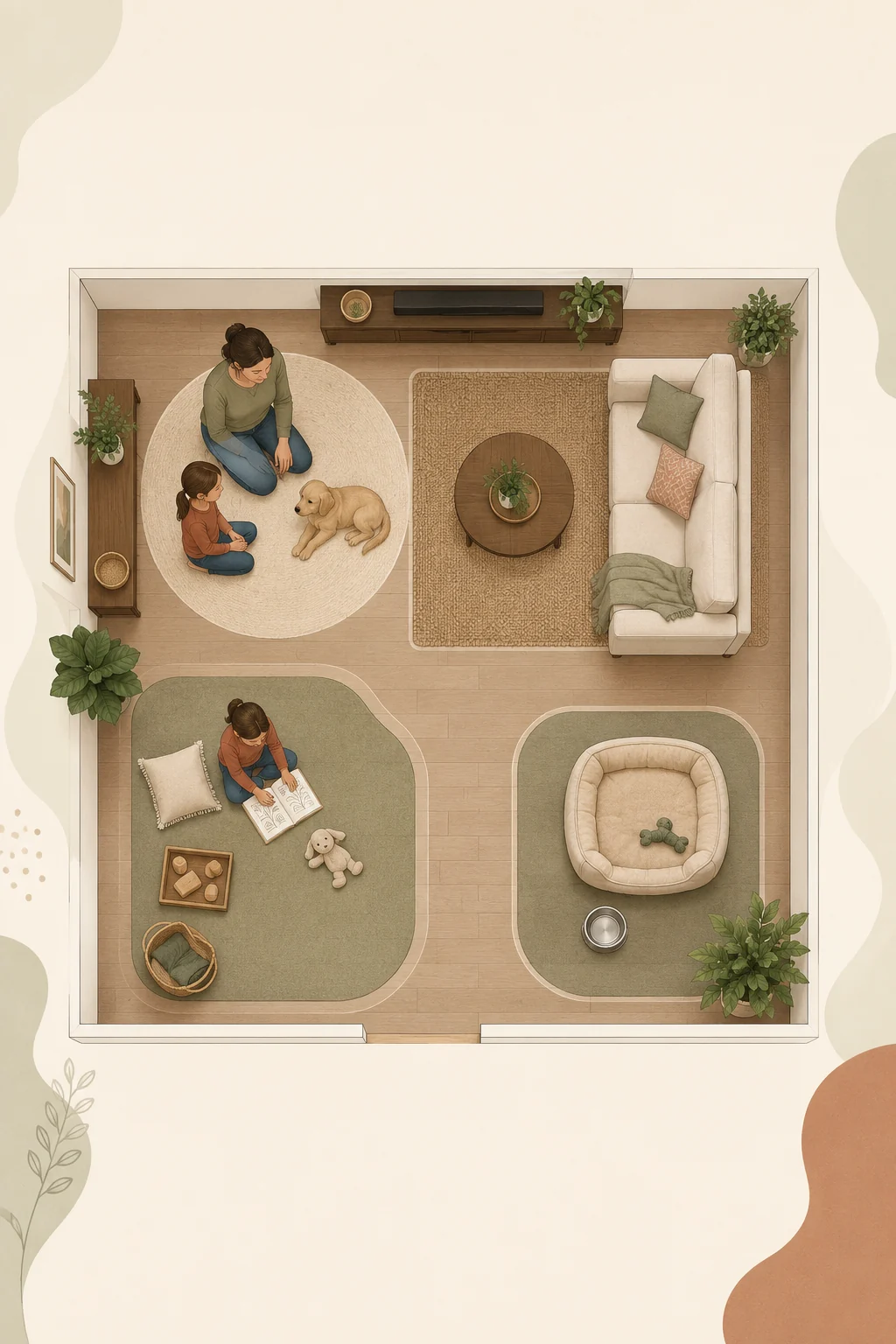
- Plan Puppy and Kid Zones for Day One
Use a simple visual plan to separate greetings, children's activities, and puppy breaks without turning the day into nonstop play.
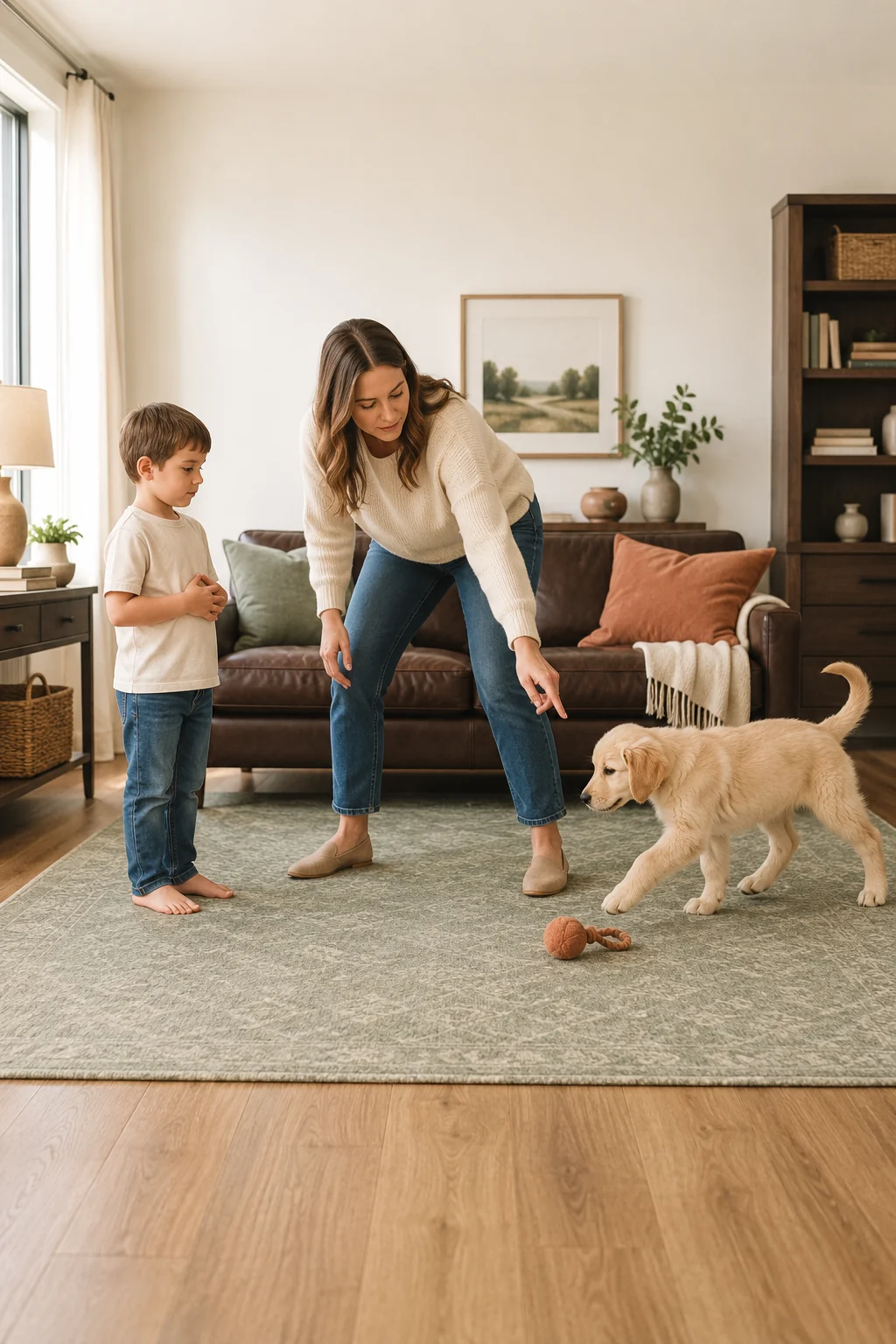
- Teach Kids What to Do When a Puppy Jumps
A simple first-day response helps children avoid running or flapping while an adult calmly separates and redirects the puppy.
- Read Puppy Body Language Around Children
Compare relaxed, uncertain, and stop-now body positions so first-day interactions can end before stress escalates.
- Puppy and Kids First-Day Decision Tree
Turn each greeting request into a clear continue, pause, or separate decision using the guide's first-day troubleshooting flow.
Optional: choose all 5 images at once
Frequently asked questions
Should every child greet the puppy as soon as it arrives?
No. Begin with the calmest child and one attentive adult, keep the greeting brief, and let other children wait until both the puppy and the next child are ready.
Can a young child hold the puppy on the first day?
It is safer for an adult to manage handling. Young children can sit nearby and allow the puppy to approach without lifting, restraining, hugging, or bringing faces together.
What should I do if the puppy keeps jumping on the children?
Have the children stop moving and bring their hands close to their bodies while an adult calmly creates distance and redirects the puppy. End the interaction if excitement continues.
Is a wagging tail enough to show the puppy wants petting?
No. Consider the whole body and context. A loose voluntary approach is more reassuring than a wag combined with freezing, crouching, pinned ears, avoidance, or stiffness.
What if the puppy growls at a child on the first day?
Separate the puppy and child immediately without punishing the growl. Prevent a repeat of the setup and seek individualized guidance before allowing further close contact.
How can a toddler participate without touching the puppy?
A toddler can watch from a safe distance, choose a quiet toy for an adult to place, help say the rest-time phrase, or join supervised handwashing after contact.
Sources & further reading
- Preventing dog bitesAmerican Veterinary Medical Association · Accessed 2026-07-31
- Dog Bite PreventionASPCA · Accessed 2026-07-31
- Dogs | Healthy Pets, Healthy PeopleCenters for Disease Control and Prevention · Accessed 2026-07-31
- Signs Your Dog is Stressed and How to Relieve ItVCA Animal Hospitals · Accessed 2026-07-31
- Preventing Campylobacter Infection from PuppiesCenters for Disease Control and Prevention · Accessed 2026-07-31