A large-breed puppy’s first day should be calm, physically easy, and built around current fit rather than future adult size. Prepare a short non-slip route between the entry, toilet area, water, and resting place; use secure equipment that fits the puppy today; prevent unsupervised access to stairs and furniture; keep movement self-paced; and record the puppy’s actual measurements so you can resize gear before rapid growth creates a safety problem.
This guide is intentionally narrow. It covers the first day for a puppy expected to become a large adult dog, with special attention to growth, equipment fit, physical safety, and professional follow-up. It does not replace a veterinarian, provide a complete puppy-safe-room plan, or build a full emergency kit.
Why a future large dog needs a different first-day plan
The puppy arriving today may look manageable, but the equipment and habits introduced now must work through a period of fast change. Large- and giant-breed dogs can remain skeletally immature longer than smaller dogs; AAHA notes that some may not reach skeletal maturity until about 15–16 months. That is a reason to plan for repeated reassessment, not to treat the puppy as fragile or prohibit normal movement. See AAHA’s age- and breed-specific guidance.
The first-day goal is therefore not “tire the puppy out.” It is to create a predictable route, let the puppy move at an easy pace, and learn what fits, startles, or fatigues this individual puppy. VCA advises avoiding puppy games that involve jumping down from height, leaping high, sudden hard stops, or rapid repeated changes of direction because growing puppies are still developing coordination. See VCA’s play and exercise guidance.
There is also a practical human-safety reason to start thoughtfully. A puppy who is allowed to launch through doors, pull toward every distraction, or jump from furniture will become harder to manage as body mass and strength increase. On day one, reward calm pauses, four paws on the floor, and voluntary check-ins without demanding a long training session.
Set up a low-risk arrival route, not an entire room project
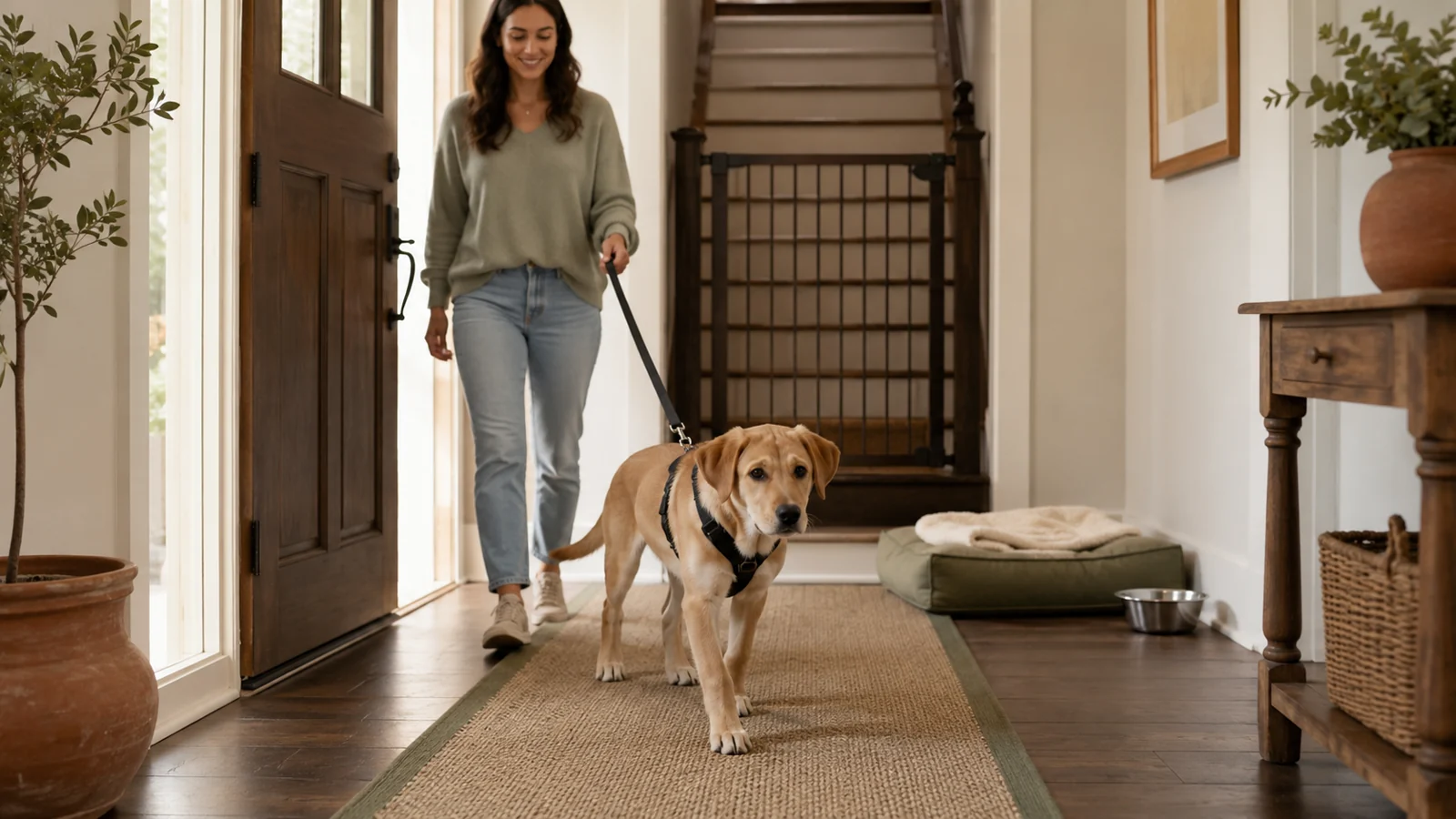
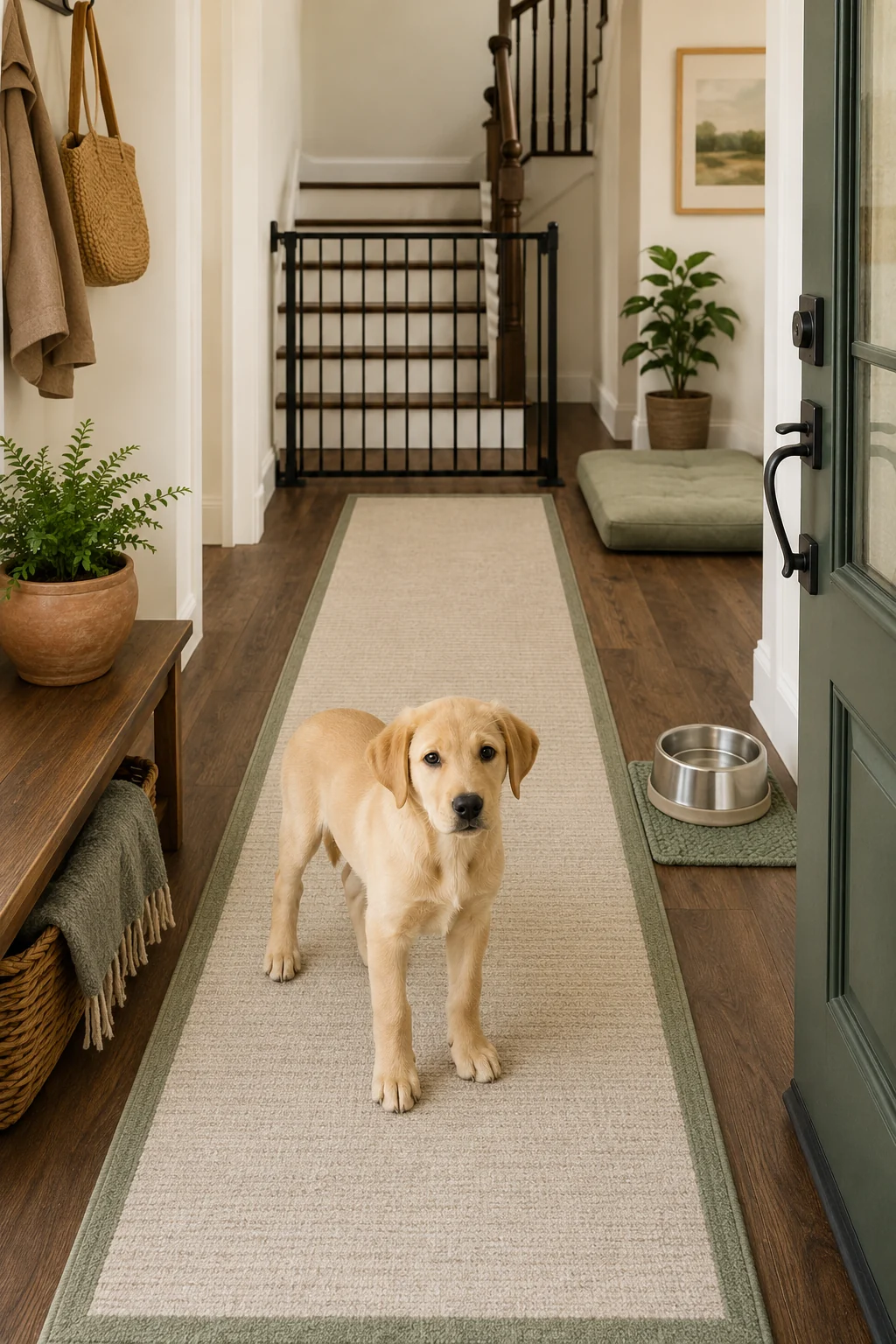
You do not need to redesign the whole house before pickup. For the first day, create one supervised path that the puppy can use repeatedly:
- Entry to toilet area: Clear shoes, cords, bags, and unstable objects from the path.
- Toilet area to water: Use a route without slick turns or clutter that encourages scrambling.
- Water to resting place: Put a washable mat or bed on a stable, non-slip surface.
- Resting place to nighttime exit: Make the route easy to follow in low light without loose rugs or obstacles.
Use gates or closed doors to block stairs, balconies, garages, workshops, and rooms you are not actively supervising. This is not a complete puppy-safe-room specification; it is a first-day traffic plan. The point is to reduce repeated slipping, jumping, and chaotic rushing while the puppy is learning the layout.
Place traction where the puppy must turn, stop, or rise: near the door, beside the water bowl, and in front of the resting area. Secure runners so they cannot bunch up. Do not assume a soft rug is safe if it slides under the puppy.
Before arrival, choose a veterinarian and know how to contact the practice. AAHA recommends building the puppy’s professional support team before day one and discussing background, feeding continuity, and household expectations with the breeder or rescue. See AAHA’s pre-arrival guidance.
Size every item for the puppy you have today
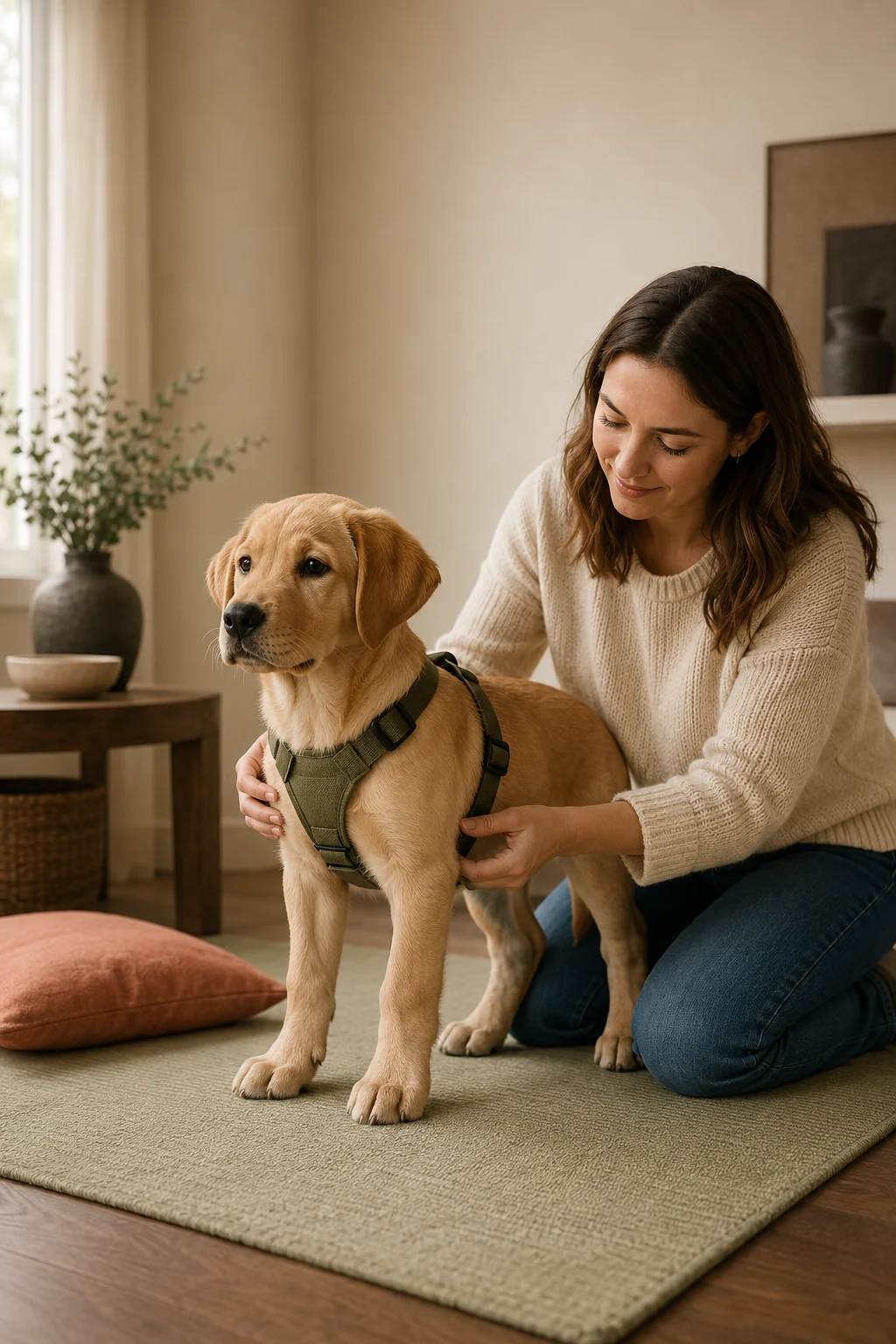
Buying “room to grow” is useful only when the item remains secure and comfortable now. Oversized walking gear can permit escape, rub the body, or shift into an unsafe position. VCA advises that collars and harnesses fit comfortably, be introduced gradually in a quiet setting, and be supervised because entanglement can cause injury. See VCA’s collar and harness guide.
Use this first-day fit table:
| Item | First-day fit test | Growth-smart choice | Recheck trigger |
|---|---|---|---|
| Collar | Secure without constricting; cannot slide off over the head during gentle handling | Adjustable current-size collar, not an adult collar cinched far beyond its intended range | Tag position changes, pressure marks, coughing, slipping, or a noticeable neck-size change |
| Harness | Lies flat, does not rub behind elbows, does not restrict front-leg movement, and cannot be backed out of | Multiple adjustment points and a shape suited to the puppy’s body | Strap reaches adjustment limit, rubbing, twisting, or changed gait |
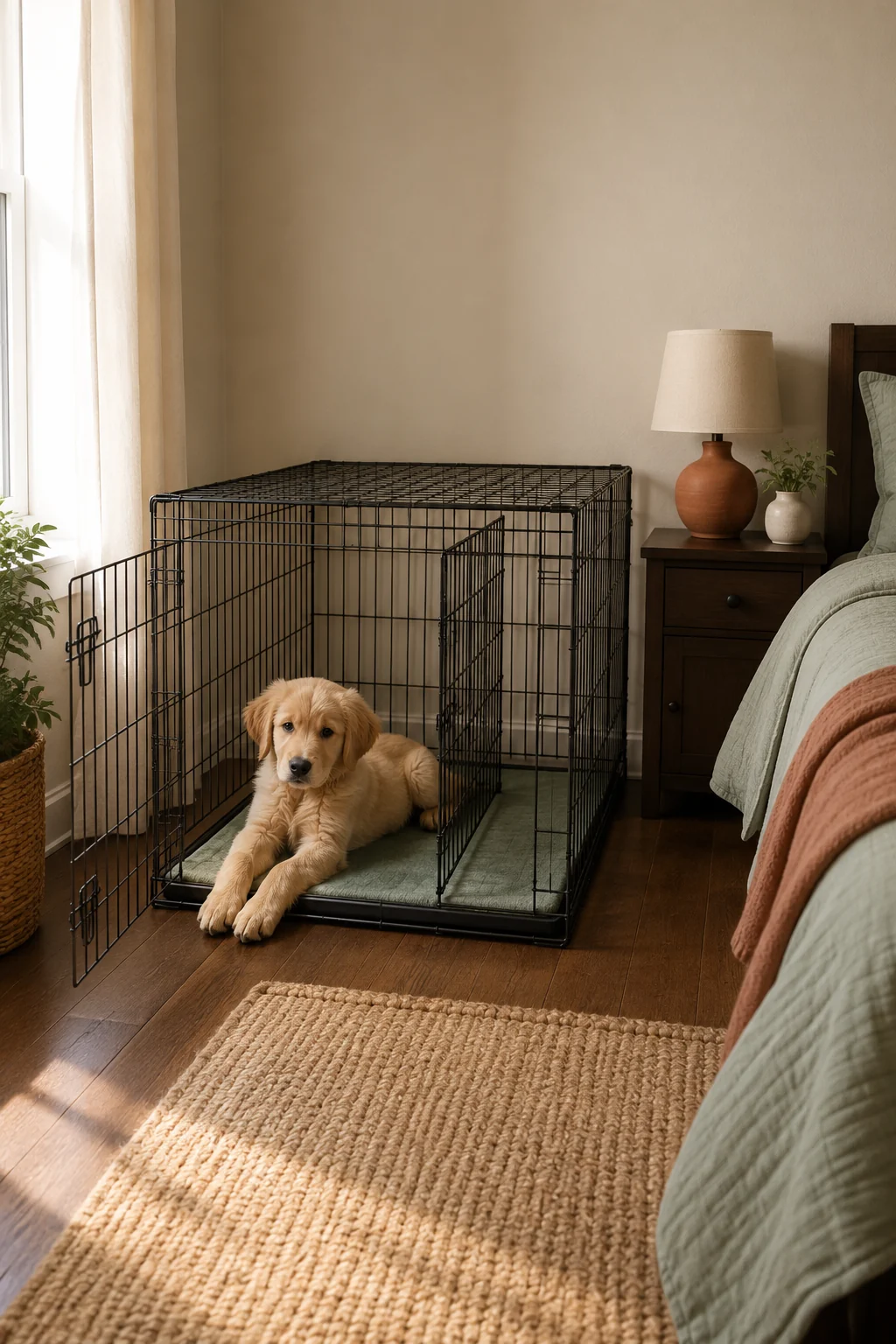
| Crate | Puppy can stand, turn, and stretch out comfortably | Adult-size crate may be used with a secure divider if the current usable section fits properly | Ears or back approach the top, turning becomes cramped, or stretching is restricted |
| Bed or mat | Entire body can rest without hanging over a hard edge | Washable, flat support with room for near-term growth | Puppy repeatedly chooses the floor because the bed is cramped or unstable |
| Gate or pen | Cannot be pushed over, squeezed through, climbed, or caught in gaps | Sturdy system that can be repositioned as reach and strength increase | Puppy can brace against it, reach the latch, or place paws near the top |
| Bowl station | Bowls stay put during normal drinking and eating | Stable, non-slip base that remains easy to clean | Puppy moves the stand, tips bowls, or must adopt an awkward position |
| Leash | Comfortable grip for the handler and manageable length in the arrival area | Fixed-length leash for predictable control; avoid equipment that encourages sudden extension | Hardware becomes too light for the growing puppy or the handler loses reliable control |
For the crate, use the puppy’s body rather than the manufacturer’s adult-breed chart as the immediate test. VCA states that a crate should be large enough for the dog to stand, turn, and stretch out. See VCA’s crate-training guide. A divider can make a larger crate usable now, but it must be secure and leave enough room for comfortable posture.
Remove collars or harnesses when they could snag and you are not supervising, especially in a crate or during rough play. Follow the equipment maker’s instructions and ask a qualified professional to check the fit if you are uncertain.
The large-breed puppy first-day action map
Use this sequence as the original Happy Tail Mom action map. It is designed to keep the day calm while collecting the information needed for safer growth-related decisions.
Step 1: Before pickup — verify the handoff facts
Collect the puppy’s birth date, current weight if known, feeding schedule, food name, recent veterinary records, microchip details if applicable, and the breeder’s or rescue’s estimate of adult size. Ask what collar, harness, crate, surfaces, and stairs the puppy has already experienced. Do not make a major food change on arrival day unless a veterinarian has told you to do so.
Write down two professional questions for the first veterinary visit: “What adult size range should I plan around?” and “What movement or exercise limits are appropriate for this puppy’s breed, structure, and health history?” AAHA emphasizes that puppy care should be individualized by age, size, lifestyle, health status, and breed.
Step 2: At the door — go directly to the planned toilet area
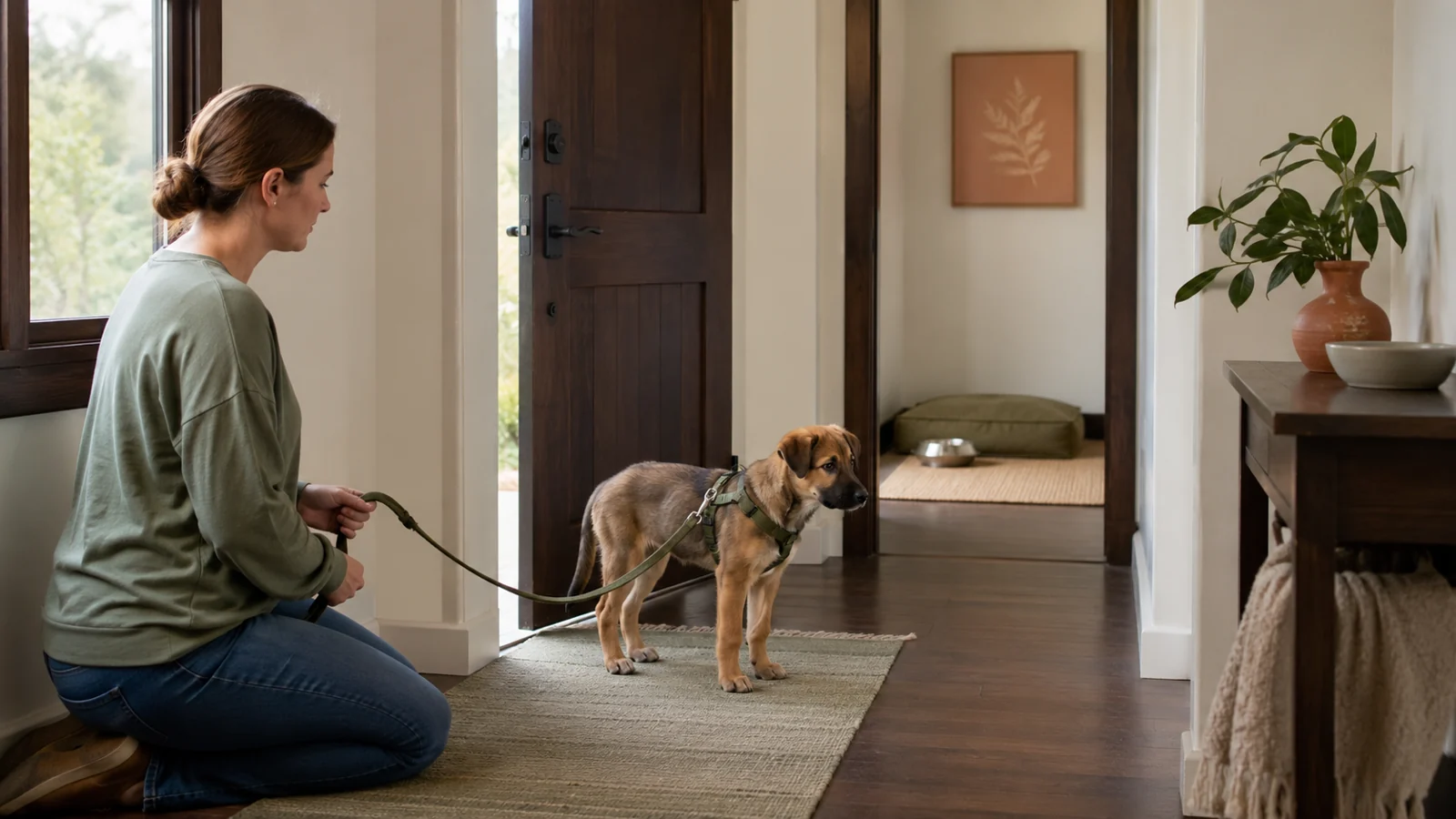
Keep the greeting quiet. Clip the leash to properly fitted equipment before opening an exterior door. Walk the puppy along the prepared route without inviting running, stair climbing, or a house tour. Reward calm following and allow time to sniff.
If the puppy freezes, do not drag. Pause, reduce pressure, and make the route easier. If carrying is necessary and safe for both puppy and person, support the body securely; do not rely on carrying as the long-term plan for a rapidly growing dog.
Step 3: After toileting — offer water and a small, controlled exploration
Guide the puppy to water, then allow supervised exploration of only the prepared area. Keep doors and gates closed so curiosity does not turn into sprinting through the whole home. Let the puppy choose whether to investigate, rest, or remain close to you.
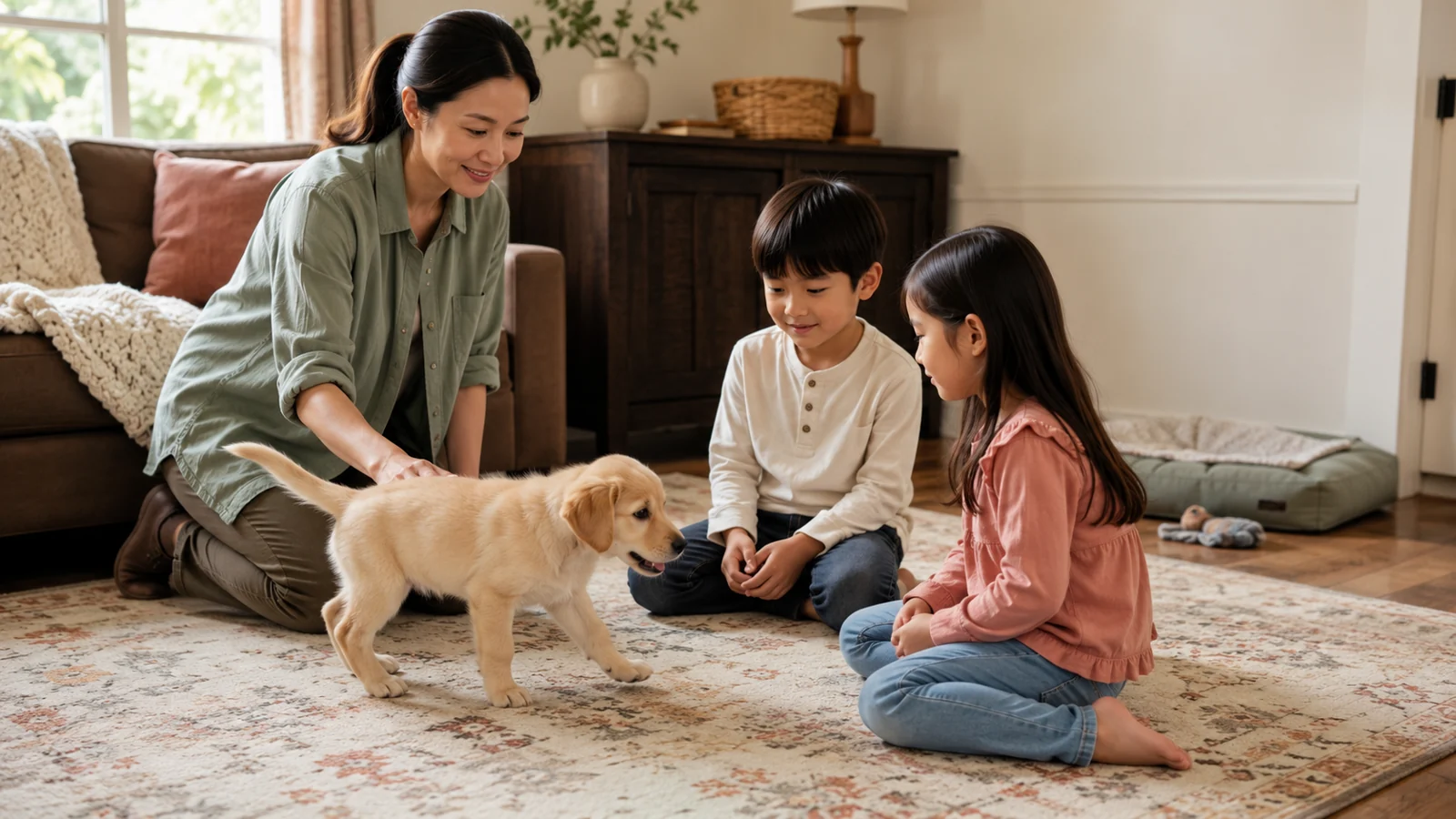
Avoid a parade of visitors. AAHA’s first-day guidance recommends managed, calm exposure rather than forced interaction and notes that the veterinarian should guide health-related exposure decisions. See AAHA’s first-day puppy guidance.
Step 4: Run the equipment fit check
Indoors, let the puppy briefly wear the collar or harness while you observe. Check for slipping, twisting, rubbing, restricted shoulder movement, or attempts to escape. Attach the leash and take a few calm steps in the safe area. Do not jerk the leash or use discomfort to gain control.
Measure and record neck circumference, chest girth at the equipment maker’s stated point, approximate body length for bedding, standing height for crate clearance, and current weight if you can obtain it without stress. Use the same measurement method at future checks so changes are meaningful.
Step 5: Alternate easy activity with real rest
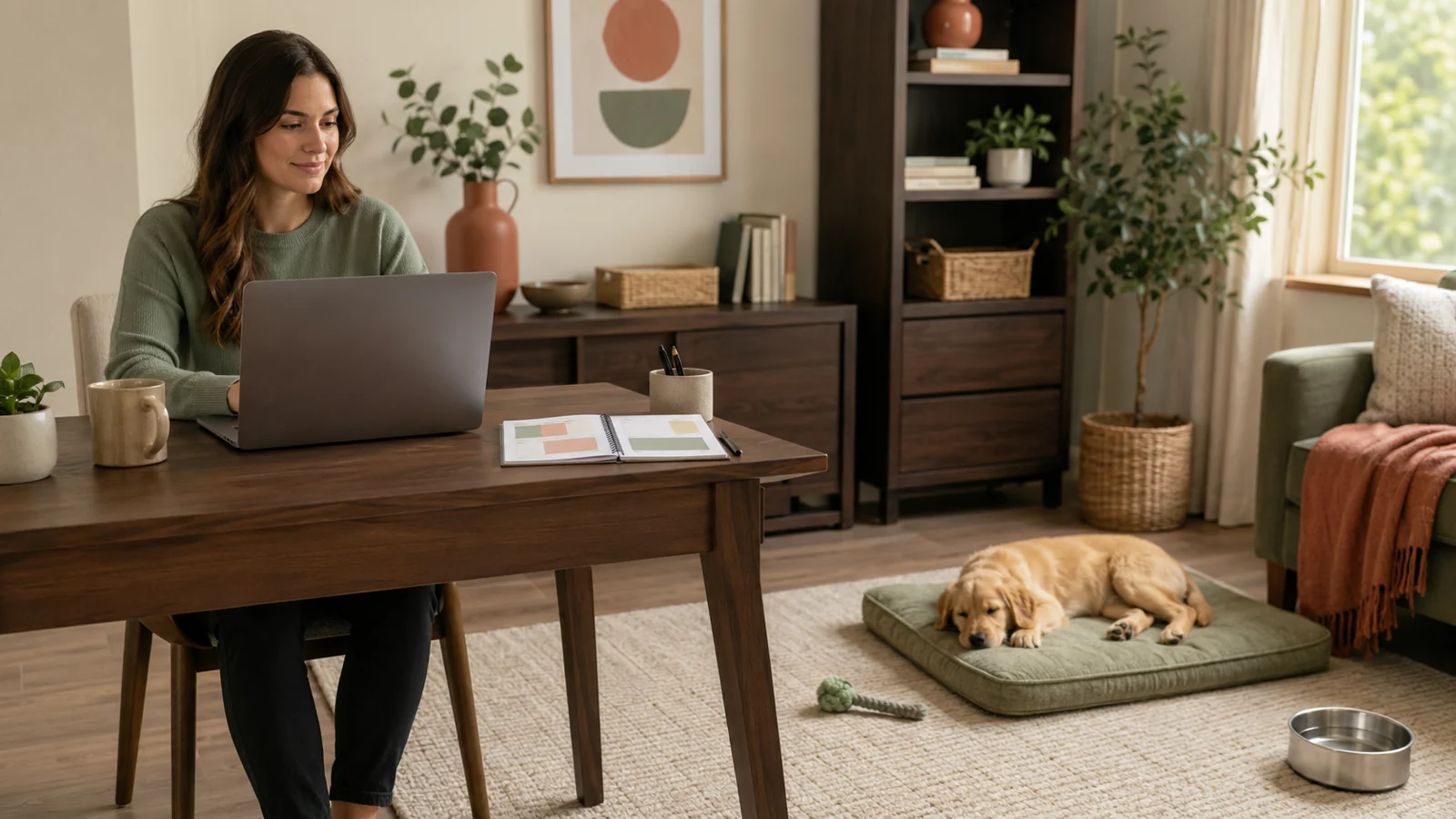
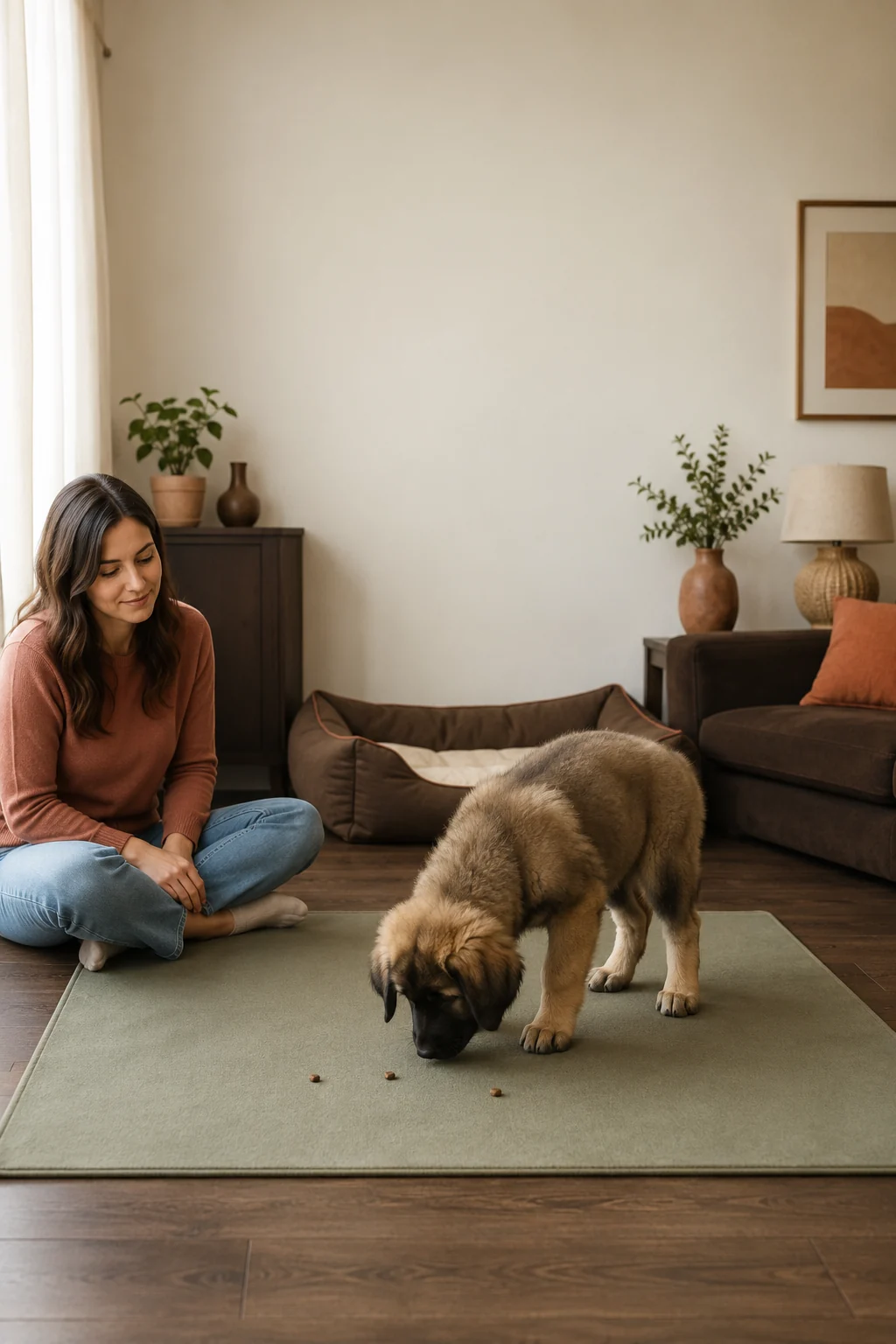
Choose low-impact options: sniffing, following you at a walking pace, finding a few pieces of the puppy’s normal food on a mat, or gently exploring one new household object. Skip repetitive stair trips, jumping from sofas, high-arousal chase, sharp-turn fetch, forced distance walking, and jogging.
End activity while the puppy still looks coordinated and responsive. VCA advises watching for fatigue and stopping when a puppy repeatedly sits or lies down, becomes less responsive, changes posture, or appears unable to settle comfortably after activity.
Step 6: Keep meals familiar and save nutrition changes for professional guidance
Feed the food and schedule supplied by the breeder, rescue, or veterinarian unless there is a specific professional instruction to change it. The first day is not the time to add calcium, supplements, rich toppers, or multiple new treats. Large-breed growth nutrition deserves individualized veterinary guidance, but a full nutrition plan is outside this article’s boundary.
Record what was offered, what was eaten, and any questions for the veterinary team. This creates a factual handoff instead of guessing from appetite during a stressful transition.
Step 7: Prepare the nighttime route before the puppy is sleepy
Check that the path to the toilet area is lit enough for the handler, clear of loose objects, and blocked from stairs or furniture. Place the crate or resting area where the puppy is not isolated from all household sound. Introduce the crate positively; do not use it as punishment. The puppy should be able to stand, turn, and stretch in the usable section.
Before bed, repeat the same calm sequence: toilet opportunity, water access as advised for the individual puppy, quiet settling, and no rough “last burst of exercise.”
Step 8: End the day with a five-minute handoff note
Record:
- Actual neck, chest, body-length, crate-height, and weight measurements available today
- Gear that fit securely and gear that needs exchange or adjustment
- Surfaces where the puppy slipped, hesitated, or rushed
- Any attempts to jump, climb, squeeze through, or push gates
- Activity that helped the puppy settle
- Questions for the veterinarian or qualified trainer
- The date you will recheck fit—soon enough to catch rapid growth, not only when equipment looks obviously tight
This note is the bridge between day one and responsible growth management.
Common large-breed first-day mistakes
Buying only adult-size equipment. A giant crate with no divider, an oversized harness, or a heavy adult collar may not function safely for a young puppy. Plan for the adult, but fit the puppy.
Trying to exhaust the puppy. A long walk, repeated fetch, or constant visitor interaction can produce fatigue and overarousal rather than calm adjustment.
Allowing furniture jumping because the puppy is still small. Habits practiced now become harder to interrupt when the dog is larger. Manage access and provide an easy floor-level resting option.
Using stairs as entertainment or exercise. The issue is not that every stair is automatically harmful; the problem is uncontrolled repetition, rushing, slipping, and falls. Use barriers and supervised access, then ask the veterinarian what is suitable for this puppy.
Waiting for visible tightness before checking gear. Rapid growth can change fit between casual observations. Scheduled measurement is more reliable than memory.
Following a generic breed chart instead of the individual puppy. Expected adult size is useful for purchasing strategy, but current body shape determines today’s fit.
When professional guidance belongs in the first-day plan
Arrange a veterinary visit according to the puppy’s records and the clinic’s advice. Bring the handoff information, food details, current measurements, and questions about expected adult size, body condition, exercise, growth monitoring, and equipment fit. Do not wait for a problem before asking how often the puppy should be weighed or remeasured.
A qualified, humane trainer can also help you build calm doorway behavior, loose-leash foundations, cooperative handling, and safe household routines before the puppy becomes physically powerful. AAHA notes that dog training is unregulated and recommends looking for evidence-based, humane professionals with recognized credentials.
Contact a veterinarian promptly if the puppy shows a concerning change in movement, cannot bear weight normally, repeatedly collapses, appears in significant pain, has trouble breathing, or has any other urgent change. This guide does not diagnose those signs.
Conclusion
A successful first day for a future large-breed dog is not a miniature version of an adult-dog routine. It is a controlled introduction built around secure current fit, easy movement, traction, blocked hazards, frequent rest, and written observations. Complete the action map, measure the puppy you actually brought home, and use the resulting notes to guide timely veterinary and training conversations as growth accelerates.
Helpful visuals from this guide
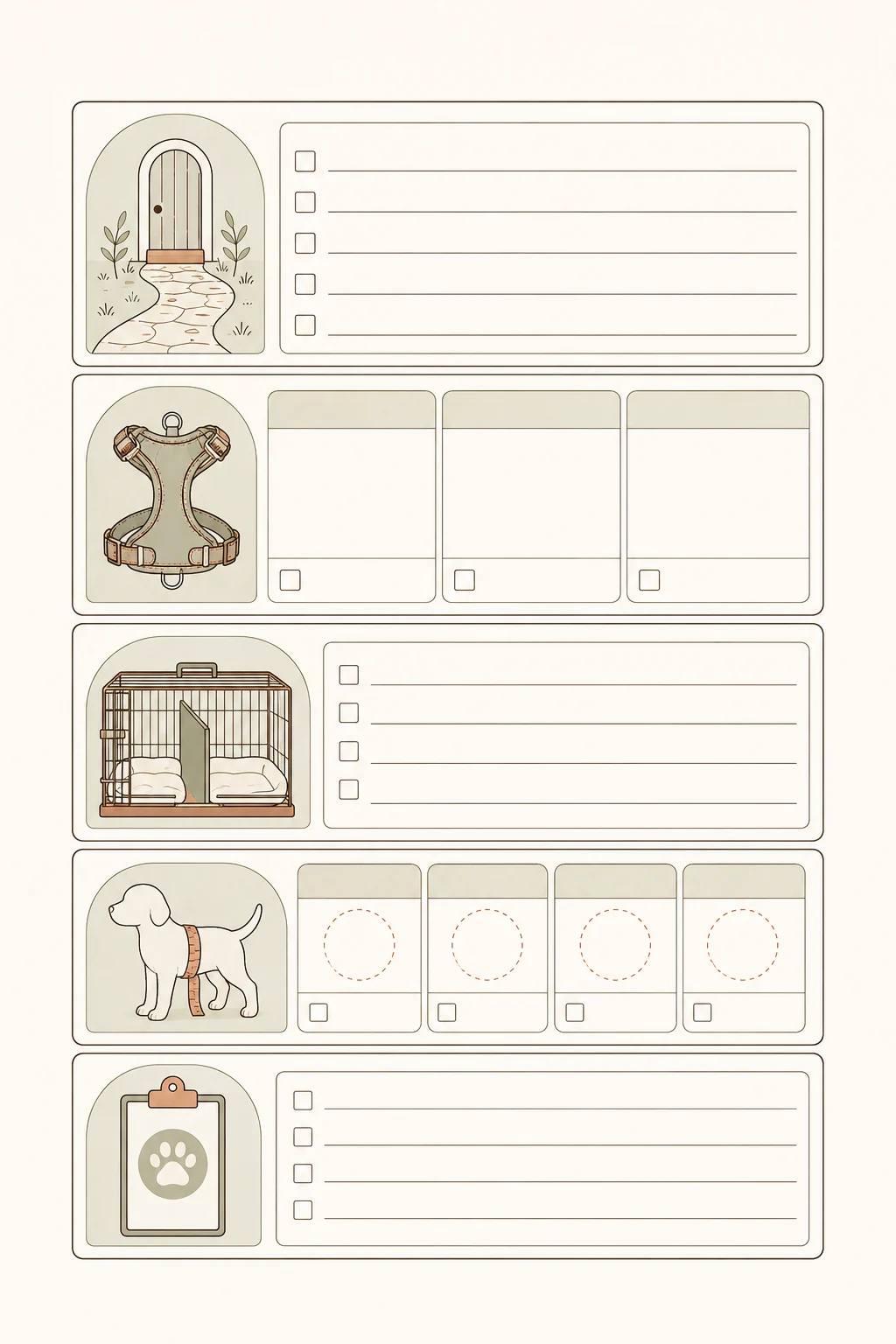
Use these five visuals as quick reminders, then return to the full guide for context, limitations, and source details.
Pinterest does not let websites prefill its Title field. Each button below copies the correct title and opens that Pin. Click the Title field in Pinterest, press Ctrl + V, then save it to the board above.
Start with Pin 1 and repeat through Pin 5.
- Set Up a Safer Large-Breed Puppy Arrival Route
See how a simple first-day route can reduce rushing, slipping, and uncontrolled access to stairs while a future large dog learns the home.
- Check a Large-Breed Puppy Harness on Day One
Use current body fit—not expected adult size—to check for slipping, twisting, rubbing, and restricted shoulder movement.
- Plan Crate Growth Without Oversizing Day One
A secure divider can preserve appropriate current space while leaving a practical path for future crate growth.
- Choose Calm First-Day Activity for a Growing Puppy
A quiet sniffing activity, walking pace, and easy rest can help a future large dog settle without jumping or hard repetitive play.
- Large-Breed Puppy First-Day Action Map
A practical framework for arrival steps, current gear fit, growth measurements, surface observations, and questions for the veterinary team.
Optional: choose all 5 images at once
Frequently asked questions
Should I buy an adult-size harness for a large-breed puppy?
No. Buy or adjust equipment so it fits securely and comfortably now, with useful adjustment range for growth. An oversized harness can twist, rub, restrict movement, or allow the puppy to back out.
Can I use an adult-size crate on the first day?
Yes, when a secure divider creates a current usable section in which the puppy can stand, turn, and stretch comfortably. Reposition the divider as the puppy grows.
Should a large-breed puppy avoid all stairs?
This guide does not make a blanket medical rule. On the first day, block unsupervised access and prevent rushing, slipping, repeated trips, or falls; ask the veterinarian what is appropriate for the individual puppy.
How much exercise should the puppy get on arrival day?
There is no universal first-day duration. Favor brief, self-paced sniffing and calm walking, stop before coordination or responsiveness declines, and ask the veterinary team for an individual movement plan.
How often should I recheck collar and harness fit?
Set an early recurring check based on the puppy’s growth pace and recheck immediately after any visible size change, rubbing, twisting, slipping, gait change, or reaching an adjustment limit.
What should I ask the veterinarian about large-breed growth?
Bring the puppy’s records, food details, current measurements, and activity observations. Ask about expected adult size, body condition, weighing frequency, growth monitoring, exercise, nutrition, and equipment fit.
Sources & further reading
- What to do before you bring home a new puppyAmerican Animal Hospital Association · Accessed 2026-07-31
- What to do when you first bring home a new puppyAmerican Animal Hospital Association · Accessed 2026-07-31
- Age-specific and Breed-specific DietsAmerican Animal Hospital Association · Accessed 2026-07-31
- Collar and Harness Options for DogsVCA Animal Hospitals · Accessed 2026-07-31
- How to Crate Train Your DogVCA Animal Hospitals · Accessed 2026-07-31
- Dog Behavior and Training - Play and ExerciseVCA Animal Hospitals · Accessed 2026-07-31